Architectural Record
search
cart
facebook twitter linkedin youtube
  • Sign In
  • Subscribe
  • Sign Out
  • My Account
Architectural Record
  • NEWS
    • Latest News
    • Awards
    • Interviews
    • Obituaries
    • Podcasts
      • Design:Ed Podcast
      • Sponsored Podcasts
  • OPINION
    • Book Reviews / Excerpts
    • Exhibition Reviews
    • Forum
  • EXCLUSIVES
    • Videos
    • Design Vanguard
    • Top 300 Firms
    • Sponsored Content
    • Sponsored eBooks
    • From the Archives
  • CONTINUING ED
    • Editorial Continuing Ed
    • CE Center
    • CE Academies
  • PROJECTS
    • Buildings By Type
    • Reuse & Renovation
    • Museums & Arts Centers
    • Colleges & Universities
    • Multifamily Housing
    • Interiors
    • Lighting
    • Kitchen & Bath
  • HOUSES
    • Record Houses
    • House of the Month
    • Featured Houses
  • PRODUCTS
    • Products by Category
    • Record Products of the Year
    • Latest Products
  • EVENTS
    • Dates & Events
    • Record on the Road
    • Innovation Conference
    • Sustainability in Practice
    • Women In Architecture
    • Webinars
    • Ad Excellence Awards
    • Submit an Event
  • CONNECT
    • Ask RECORD AI
    • Newsletters
    • Contact
    • Advertise
    • Editorial Calendar
    • Store
    • Customer Service
  • SUBMIT
    • Submission Guidelines
    • RECORD Competitions
  • MAGAZINE
    • Subscribe
    • My Account
    • Digital Edition
    • Current Issue
    • Firm Pass
    • Historic Archive
Architecture News

Form Follows Feathers: Bird-Friendly Architecture

By Ted Smalley Bowen
January 10, 2008

Santiago Calatrava’s 2,000-foot-tall Chicago Spire is a lofty experiment in bird-safe design. The residential skyscraper is rising in the midst of a large year-round bird population and in the path of a major migratory flyway on the shores of Lake Michigan, but its glass is designed to be visible to birds, which should help prevent fatal collisions.
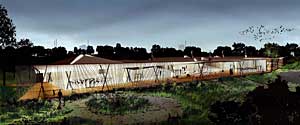
Ford Calumet Environmental Center in Chicago
Images courtesy Studio Gang Architects

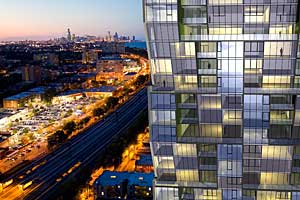
Studio Gang Architects included several bird-friendly elements in its design of the Ford Calumet Environmental Center in Chicago, a 28,000-square-foot environmental education center due to open in 2009 (top) To reduce the possibility of bird strikes on the building’s south elevation, a porch is enclosed with a basket-like mesh with four-inch openings (second image). Studio Gang also incorporated bird-friendly strategies into the design of Solstice on the Park, a 26-story condominium tower in Chicago’s Jackson Park district, due to open in 2010 (third image). Low-e glass on the tower’s south elevation is angled to create self-shading and reduces its reflective qualities (above).

An estimated 1 billion birds die annually in the United States as a result of striking buildings, bridges, and other manmade structures. Many factors play a role, including lights, vegetation, and water. But glass is the main culprit, according to bird-safe design guidelines released in 2007 by the New York City Audubon Society, the Chicago Birds & Buildings Forum, and the City of Toronto. Since birds don’t perceive conventionally formulated glass as a solid barrier, they fly into it. They may mistake reflections as continuous space and be attracted to trees or other objects in or visible through a glassed-in space.

The design guidelines are largely an appeal to enlightened self-interest, saving birds while reaping the financial benefits of green building. A number of cities are pushing bird-safe design, although mostly as a recommendation. Toronto may adopt green building requirements that include bird safety criteria, and in Manhattan the environmental impact statement for the reconstruction of the World Trade Center addresses bird safety. A handful of top designers have made it a priority, and the USGBC is beginning highlight it, but advocates note that it’s far from a mainstream design consideration.

The guidelines emphasize creating “visual noise,” i.e., patterns that birds can register. With glass, this means enhancing ultraviolet-reflectivity, color, texture, or opacity. Keeping openings small also helps ward off birds. Shading, brises soleil, colored and reflective solar blinds, or curtains also alert birds to buildings.

As LEED gains traction, establishing bird-safe design on the scorecard can give it more of a boost. “We want to enshrine bird-safe design in LEED as a proven innovation point, and we need legislation and mandates,” says Bruce Fowle, senior principal at FXFowle Architects in New York. “The immediate goal is to have bird-kill reduction identified as an option in the LEED reference manual.”

But green building is no guarantee of bird-safety. If not patterned, tinted, or used in small panes, low-e glass has a dangerously mirror-like quality and green roofs reflected on surrounding buildings can lure birds into walls. With its highly reflective windows and

nearby stand of trees, Emory University’s LEED-certified Mathematics and Science Center, designed by Cooper Carry and opened in 2002, decimated neo-tropical fall migrants. Officials were forced to drape netting over the building, according to chief environmental officer John Wegner, and bird safety has since been added to campus design criteria.

Bird safety is easier to sell when it overlaps with other green strategies, says Jeanne Gang, principal and founder of Studio Gang Architects, in Chicago. Her firm’s 26-story Solstice on the Park, in Chicago, uses angled glass, fritted glass, and visual cues to decrease bird strikes. “Slanted glass reduces solar heat gain but also works to effectively reduce bird injuries,” Gang explains. “Fritted glass reduces heat gain, and if it’s 50 percent, you can still see through it.”

Most birds can see ultraviolet light, which is invisible to humans, and in nature it often attracts birds, according to Daniel Klem, an ornithologist and biology professor at Muhlenberg College in Allentown, Pennsylvania. More tests are needed to see if birds avoid UV-reflective glass, he says, “but it would be the most elegant solution if it works.” The German manufacturer Isolar Glass already markets patterned, UV-reflective glass, and Guardian Global, of Auburn Hills, Michigan, expects to release a bird-safe line by 2009.

Installing glass that birds can see would be simpler than current options. “There’s no easy way to convince clients that they need dots every four inches or stripes or louvers or angled glass,” Fowle says. The New York Times Building, designed by FXFowle and Renzo Piano, uses thin horizontal ceramic tubing to form an external latticework that reduces heat gain and makes the building visible to birds.

While major cities located along migratory flyways get a lot of attention, they account for a comparatively small percentage of kills. The crucial next step, says New York City Audubon Society executive director Glenn Phillips, is “getting to the big designers of suburban and exurban buildings.”

Share This Story

Looking for a reprint of this article?
From high-res PDFs to custom plaques, order your copy today!
Post a comment to this article

Report Abusive Comment

Subscription Center
  • Create an Account
  • Start a Subscription
  • Manage My Account
  • Sign Up for Newsletters
  • Visit Customer Service
  • Update Preferences

More Videos

Sponsored Content

Sponsored Content is a special paid section where industry companies provide high quality, objective, non-commercial content around topics of interest to the Architectural Record audience. All Sponsored Content is supplied by the advertising company and any opinions expressed in this article are those of the author and not necessarily reflect the views of Architectural Record or its parent company, BNP Media. Interested in participating in our Sponsored Content section? Contact your local rep!

close
  • TAMLYN XtremeTrim Exterior Trim
    Sponsored byTamlyn

    Designing Cleaner Panel Facades: Why Exterior Trim Details Matter

  • Building with Vapor Barriers
    Sponsored byReef Industries, Inc.

    Vapor Barriers Help Control Moisture in Tighter Building Designs

  • Duct Interior with Prodeq System
    Sponsored byHenry, a Carlisle Company

    Designing Resilient Water Containment Systems

DESIGN:ED Podcast
Listen to Architectural Record’s DESIGN:ED Podcast

Events

June 11, 2026

Very Early Warning Fire Detection for Mission-Critical Facilities

Credits: 1 AIA LU/HSW; 1 AIBD P-CE; 0.1 ICC CEU

Examine advanced fire detection strategies that support uptime and enhance safety in data centers and other mission-critical facilities.

June 16, 2026

Focus on the Façade: Exploring Steel, Timber & Fire-Rated Curtain Walls and Channel Glass Systems

Credits: 1 AIA LU/HSW; 1 AIBD P-CE; 0.1 ICC CEU

Explore modern façade and glazing systems that enhance daylighting, fire safety, and thermal performance while expanding architectural design possibilities.

View All Submit An Event

Products

2026 Architect's Square Foot Costbook

2026 Architect's Square Foot Costbook

See More Products

Popular Stories

Practice Matters illustration

What’s in a (Firm’s) Name? Thinking About Succession and Legacy

Coronado Bridge

The Architect’s Guide to San Diego

Practice Matters illustration

By the Numbers: Counting America's Architects

Crane Cove, ONO

Design Vanguard 2026 Winners

House on a Hill

Design Vanguard 2026: Forma

Broader Sustainability of CMU - Free Webinar - May 21, 2026

Related Articles

  • Wood Blocks and Steel Feathers: Architecture at SXSW

    See More
  • Professor Uses Bacteria To Make Eco-Friendly Bricks

    See More
  • Design Miami Dispatch

    Design Miami 2017: Art Meets Architecture at the Jade Signature, the Bass Museum, and ‘Form and Space’

    See More

Related Products

See More Products
  • 1118715683.gif

    Kitchen and Bath Design Principles: Elements, Form, Styles, 2nd Edition

  • ribbonarch.jpg

    Ribbon Architecture: Light, Shadow, and Reflection in Architecture

See More Products
×

The latest news and information

#1 Source for Architectural Design, News and Products

SUBSCRIBE
  • RESOURCES
    • Advertise
    • Contact Us
    • Submit
    • Store
  • ACCOUNT CENTER
    • Create an Account
    • Start a Subscription
    • Manage My Account
    • Sign Up for Newsletters
    • Visit Customer Service
    • Update Preferences
  • PRIVACY
    • PRIVACY POLICY
    • TERMS & CONDITIONS
    • DO NOT SELL MY PERSONAL INFORMATION
    • PRIVACY REQUEST
    • ACCESSIBILITY
  • SERVICES
    • Marketing Services
    • Reprints
    • Market Research
    • List Rental
    • Survey/Respondent Access
  • STAY CONNECTED
    • Linkedin
    • Facebook
    • Instagram
    • YouTube
    • X (Twitter)

Copyright ©2026. All Rights Reserved BNP Media, Inc. and BNP Media II, LLC.

Design, CMS, Hosting & Web Development :: ePublishing