Architectural Record
search
cart
facebook twitter linkedin youtube
  • Sign In
  • Subscribe
  • Sign Out
  • My Account
Architectural Record
  • NEWS
    • Latest News
    • Awards
    • Interviews
    • Obituaries
    • Podcasts
      • Design:Ed Podcast
      • Sponsored Podcasts
  • OPINION
    • Book Reviews / Excerpts
    • Exhibition Reviews
    • Forum
  • EXCLUSIVES
    • Videos
    • Design Vanguard
    • Top 300 Firms
    • Sponsored Content
    • Sponsored eBooks
    • From the Archives
  • CONTINUING ED
    • Editorial Continuing Ed
    • CE Center
    • CE Academies
  • PROJECTS
    • Buildings By Type
    • Reuse & Renovation
    • Museums & Arts Centers
    • Colleges & Universities
    • Multifamily Housing
    • Interiors
    • Lighting
    • Kitchen & Bath
  • HOUSES
    • Record Houses
    • House of the Month
    • Featured Houses
  • PRODUCTS
    • Products by Category
    • Record Products of the Year
    • Latest Products
  • EVENTS
    • Dates & Events
    • Record on the Road
    • Innovation Conference
    • Sustainability in Practice
    • Women In Architecture
    • Webinars
    • Ad Excellence Awards
    • Submit an Event
  • CONNECT
    • Ask RECORD AI
    • Newsletters
    • Contact
    • Advertise
    • Editorial Calendar
    • Store
    • Customer Service
  • SUBMIT
    • Submission Guidelines
    • RECORD Competitions
  • MAGAZINE
    • Subscribe
    • My Account
    • Digital Edition
    • Current Issue
    • Firm Pass
    • Historic Archive
Residential Architecture

Strickland-Ferris Residence

Frank Harmon raised the Strickland-Ferris Residence off the ground, then let its roof take flight.

By Clifford A. Pearson
January 19, 2008

Architects & Firms

Frank Harmon Architect

Raleigh, North Carolina

A steep escarpment and a wooded site shaped Frank Harmon’s design for the Strickland-Ferris Residence in Raleigh, North Carolina. Built for Lynda Strickland, a North Carolina native who returned home after a couple of decades of living in Washington, D.C., and other places, the 1,800-square-foot house perches above the ground, supported by nine wood trusses sitting on concrete columns. “We knew we had to raise the house off the ground and let the water flow under it,” says Harmon. The strategy not only preserved the site’s hydrological patterns but allowed the architect to build without cutting down any major trees in the 150-year-old beech-and-oak forest.
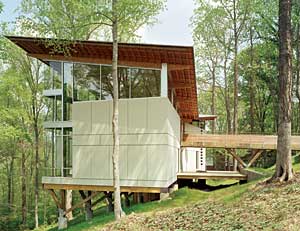
Strickland-Ferris Residence
Photo ' Timothy Hursley

Additional Content:
Jump to credits & specifications

To collect rainwater (for use in irrigating the forest floor), Harmon designed a butterfly roof with a gutter running along its crease. “It looks like a Wright flyer,” says the architect, referring to the first plane launched by the Wright brothers at Kitty Hawk, about 200 miles away. The flight imagery is particularly strong as you drive up to the house and see just the roof floating above a band of windows wrapping around the top of the building. Below this transparent “cornice,” though, the house presents a mostly opaque face to the street, with cement board protecting the interior from the southern sun and views from neighboring houses. Deep eaves also shade the upper glass band from direct rays of the sun.

From the street, you enter the house at its upper level via an ipé-wood bridge. As you step inside, you’re greeted with an expansive view of the woods and, in the distance, Crabtree Creek. “I wanted to feel as if I were living in the trees,” explains Strickland. A glass-and-steel wall running the length of the building on its north facade and reaching as high as 27 feet creates an ethereal boundary between inside and out, between modern living and the great outdoors. Polished cherry-wood floors, as well as laminated-wood beams and columns, bring a natural warmth to the large, open living-dining space. Harmon used salvaged steel for an elegant stair that glides along the glass wall, and Strickland found sheets of scrap metal to clad the kitchen’s backsplash and the low partitions enclosing the master bathroom upstairs. The juxtaposition of luxurious materials like polished cherry and rough ones like plywood and scrap steel reminds Harmon of Japanese temples where gold leaf sometimes coats rough-wood columns.

Strickland had taken a class on architectural appreciation taught by Harmon years before and was thoroughly engaged in the design of her house. “This was a real collaboration between client and architect,” states Harmon. Strickland told Harmon from the start that she wanted a house with no ornamentation. Instead, exposed beams, sloping plywood ceiling, and the client’s collection of Modern furniture provide the necessary visual appeal whenever people aren’t staring out the windows and soaking up the view. She also insisted on keeping the manufacturer’s markings on the wood beams, injecting a quirky reminder of provenance to structural members.


Credits

Architect
Frank Harmon Architect
706 Mountford Avenue
Raleigh, North Carolina 27603
p 919 829 9464
f 919 829 2202

Frank Harmon, FAIA Partner in Charge

Sarah Glee Queen Project Manager


Interior designer:
Lynda Strickland


Engineer(s):
Richard Kaydos-Daniels


General contractor:
Greg Paul Builder


Photographer(s)
Timothy Hursley 
(501)372-0640

Jeffrey Jacobs 
(901)274-7632


CAD system, project management, or other software used:

PowerCADD

Specifications

Structural system:
Exterior cladding
Metal/glass curtainwall:

Kawneer

Wood:
Atlantic White Cedar

EIFS, ACM, or other:
Hardi Panel – James Hanley

Roofing
Metal:
Galvalume Standing Seam

Windows
Wood:
Pella

Aluminum:
Kawneer

Doors
Wood doors:
Custom

Sliding doors:
Kawneer

Interior finishes
Paints and stains:
Cabots

Metals stairs and rain chain by Liquid Forge
– Lucas House and Eddie Burgess.

 
KEYWORDS: North Carolina

Share This Story

Looking for a reprint of this article?
From high-res PDFs to custom plaques, order your copy today!

Cliff portrait 2 0t5a1761 0031

Contributing editor Clifford Pearson is the co-author, with A. Eugene Kohn, of The World By Design, and writes about architecture and urbanism.

Post a comment to this article

Report Abusive Comment

Subscription Center
  • Create an Account
  • Start a Subscription
  • Manage My Account
  • Sign Up for Newsletters
  • Visit Customer Service
  • Update Preferences

More Videos

Sponsored Content

Sponsored Content is a special paid section where industry companies provide high quality, objective, non-commercial content around topics of interest to the Architectural Record audience. All Sponsored Content is supplied by the advertising company and any opinions expressed in this article are those of the author and not necessarily reflect the views of Architectural Record or its parent company, BNP Media. Interested in participating in our Sponsored Content section? Contact your local rep!

close
  • TAMLYN XtremeTrim Exterior Trim
    Sponsored byTamlyn

    Designing Cleaner Panel Facades: Why Exterior Trim Details Matter

  • Building with Vapor Barriers
    Sponsored byReef Industries, Inc.

    Vapor Barriers Help Control Moisture in Tighter Building Designs

  • Duct Interior with Prodeq System
    Sponsored byHenry, a Carlisle Company

    Designing Resilient Water Containment Systems

DESIGN:ED Podcast
Listen to Architectural Record’s DESIGN:ED Podcast

Events

June 10, 2026

Rethinking Stormwater – The Power of Porous Paving

Credits: 1 AIA LU/HSW; 1 AIBD P-CE; 0.1 ICC CEU

Learn how porous paving systems support stormwater management, reduce heat island effects, and enhance sustainable site design performance.

June 11, 2026

Very Early Warning Fire Detection for Mission-Critical Facilities

Credits: 1 AIA LU/HSW; 1 AIBD P-CE; 0.1 ICC CEU

Examine advanced fire detection strategies that support uptime and enhance safety in data centers and other mission-critical facilities.

View All Submit An Event

Products

2026 Architect's Square Foot Costbook

2026 Architect's Square Foot Costbook

See More Products

Popular Stories

Practice Matters illustration

What’s in a (Firm’s) Name? Thinking About Succession and Legacy

Practice Matters illustration

By the Numbers: Counting America's Architects

House on a Hill

Design Vanguard 2026: Forma

Crane Cove, ONO

Design Vanguard 2026 Winners

House A on a Hill

Design Vanguard 2026: Santiago Valdivieso

Broader Sustainability of CMU - Free Webinar - May 21, 2026

Related Articles

  • Vienna-Way-Residence

    Vienna Way Residence

    See More
×

The latest news and information

#1 Source for Architectural Design, News and Products

SUBSCRIBE
  • RESOURCES
    • Advertise
    • Contact Us
    • Submit
    • Store
  • ACCOUNT CENTER
    • Create an Account
    • Start a Subscription
    • Manage My Account
    • Sign Up for Newsletters
    • Visit Customer Service
    • Update Preferences
  • PRIVACY
    • PRIVACY POLICY
    • TERMS & CONDITIONS
    • DO NOT SELL MY PERSONAL INFORMATION
    • PRIVACY REQUEST
    • ACCESSIBILITY
  • SERVICES
    • Marketing Services
    • Reprints
    • Market Research
    • List Rental
    • Survey/Respondent Access
  • STAY CONNECTED
    • Linkedin
    • Facebook
    • Instagram
    • YouTube
    • X (Twitter)

Copyright ©2026. All Rights Reserved BNP Media, Inc. and BNP Media II, LLC.

Design, CMS, Hosting & Web Development :: ePublishing