Architectural Record
search
cart
facebook twitter linkedin youtube
  • Sign In
  • Subscribe
  • Sign Out
  • My Account
Architectural Record
  • NEWS
    • Latest News
    • Awards
    • Interviews
    • Obituaries
    • Podcasts
      • Design:Ed Podcast
      • Sponsored Podcasts
  • OPINION
    • Book Reviews / Excerpts
    • Exhibition Reviews
    • Forum
  • EXCLUSIVES
    • Videos
    • Design Vanguard
    • Top 300 Firms
    • Sponsored Content
    • Sponsored eBooks
    • From the Archives
  • CONTINUING ED
    • Editorial Continuing Ed
    • CE Center
    • CE Academies
  • PROJECTS
    • Buildings By Type
    • Reuse & Renovation
    • Museums & Arts Centers
    • Colleges & Universities
    • Multifamily Housing
    • Interiors
    • Lighting
    • Kitchen & Bath
  • HOUSES
    • Record Houses
    • House of the Month
    • Featured Houses
  • PRODUCTS
    • Products by Category
    • Record Products of the Year
    • Latest Products
  • EVENTS
    • Dates & Events
    • Record on the Road
    • Innovation Conference
    • Sustainability in Practice
    • Women In Architecture
    • Webinars
    • Ad Excellence Awards
    • Submit an Event
  • CONNECT
    • Ask RECORD AI
    • Newsletters
    • Contact
    • Advertise
    • Editorial Calendar
    • Store
    • Customer Service
  • SUBMIT
    • Submission Guidelines
    • RECORD Competitions
  • MAGAZINE
    • Subscribe
    • My Account
    • Digital Edition
    • Current Issue
    • Firm Pass
    • Historic Archive
Architectural Technology

Following carbon footprints leads architects and consultants to their own doorsteps

By Joann Gonchar, FAIA
March 19, 2007

Last month’s declaration by a United Nations panel that global warming is “unequivocal,” and that fossil fuel use is “very likely” to blame, should intensify discussion of the already hot topic. Of course, many “green” architects and their consultants were already focused on the issue, not only in relationship to the buildings they design, but also in regard to their own business practices.
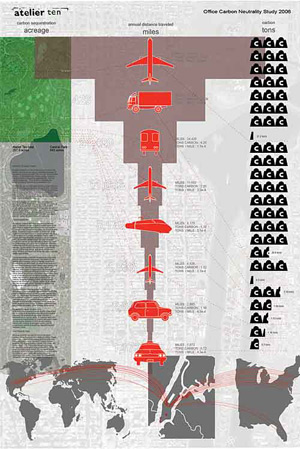
Image © Atelier Ten
For its New York City operations, Atelier Ten, an environmental design firm, recently completed an inventory of office activities associated with carbon emissions that spanned a 12-month period.

Last month’s declaration by a United Nations panel that global warming is “unequivocal,” and that fossil fuel use is “very likely” to blame, should intensify discussion of the already hot topic. Of course, many “green” architects and their consultants were already focused on the issue, not only in relationship to the buildings they design, but also in regard to their own business practices.

Several firms have developed, or are developing, sustainable operations plans for their offices that include minimization of greenhouse gases, primarily carbon dioxide (CO2), as part of their larger missions. “It fits with our mindset and philosophy,” says Rebecca Tannebring, New York City office manager for environmental consultant Atelier Ten.

To shrink the CO2 footprint of their own work spaces, architects and their consultants rely on many of the same strategies they employ in the buildings they design, including daylighting, energy efficient office equipment, and lighting controls such as occupancy sensors. Many firms reduce transportation-related sources of greenhouse gases by eliminating unnecessary business travel and by a variety of programs aimed at making commuting by mass transit a more attractive option.

After reigning in the operational activities associated with greenhouse gas emissions, to come closer to the brass ring of carbon neutrality firms typically participate in “offsets.” This process entails investing, through a third-party provider, in projects that reduce greenhouse gas emissions, such as tree planting, or construction of wind and solar energy facilities.

In order to determine how many offsets to buy, businesses typically conduct an inventory of emissions. And, as part of this accounting task, they must decide which greenhouse gas generating activities to include and which to exclude. A CO2 inventory could conceivably take into account the carbon embedded in office supplies, such as paper and toner, and that generated by outsourced activities, such as printing and shipping. But few, if any firms, are conducting inventories so fine-grained.

Although the boundaries of greenhouse gas inventories vary from firm to firm, among those interviewed for this article, it was common to include electricity use, fuel associated with heating and cooling, and business-related travel. Some go even further. Cook+Fox includes employees’ home electricity consumption estimated through a sampling of staff utility bills, according to Alice Hartley, a member of the firm’s “green team.” The firm purchases renewable energy credits for this electricity use and for that used by its New York City office.

However, including employees’ home power use within the boundaries of a greenhouse gas inventory is highly unusual. Most firms track only that electricity consumed by the operations of their office spaces. This bookkeeping task, especially for large, multilocation practices with a variety of tenancy situations, can be demanding. Perkins+Will, for example, has been following electricity consumption at its 20 North American locations for 18 months. The firm owns some of these spaces and rents others. Some have dedicated meters and others do not. The diversity of arrangements “adds a layer of complexity,” says Chicago-based Gavin Smith, AIA, a project architect with the firm.

For keeping track of air travel, which can account for a huge share of a firm’s emissions, sources have different approaches. Some depend on employees to report air mileage and tie the process directly to the expense-reporting system. Others, like Seattle-based Mithun, depend on one agency for both travel arrangements and for managing the related record keeping, according to Bert Gregory, FAIA, president and C.E.O.

The protocols for determining the amount of CO2 associated with power use, air travel, and other activities, are still not mature. “It’s an emerging area,” says Smith. Perkins+Will, along with many other firms, depends on a greenhouse gas accounting standard developed by the World Business Council for Sustainable Development and the World Resources Institute (www.ghgprotocol.org).

Sources point out that inventories are not static and that regular updates and adjustments are important, especially for quickly growing firms. “It’s a continuous process,” says Atlelier Ten’s Tannebring. The firm recently completed a calculation of its CO2 emissions for the 12-month period ending in April 2006, and is now investigating offset options.

None of the firms interviewed would discuss how much the reduction, record keeping, and offset process adds to overhead. However, some of the expenses can be treated as reimbursable, as any project-related expense would. Cook+Fox, for example, uses a car service with a gas- electric hybrid fleet when travel by mass transit doesn’t make sense. The service, which comes at a slight premium over taxis, is identified as a reimbursable in contracts, helping develop awareness among clients about greenhouse gases and global warming, says Hartley.

Share This Story

Looking for a reprint of this article?
From high-res PDFs to custom plaques, order your copy today!


Joann gonchar

Joann Gonchar, FAIA, LEED AP, is deputy editor at Architectural Record. She joined RECORD in 2006, after working for eight years at its sister publication, Engineering News-Record. Before starting her career as a journalist, Joann worked for several architecture firms and spent three years in Kobe, Japan, with the firm Team Zoo, Atelier Iruka. She earned a Master of Architecture degree from the University of Pennsylvania and a Bachelor of Arts from Brown University. She is licensed to practice architecture in New York State.

Post a comment to this article

Report Abusive Comment

Subscription Center
  • Create an Account
  • Start a Subscription
  • Manage My Account
  • Sign Up for Newsletters
  • Visit Customer Service
  • Update Preferences

More Videos

Sponsored Content

Sponsored Content is a special paid section where industry companies provide high quality, objective, non-commercial content around topics of interest to the Architectural Record audience. All Sponsored Content is supplied by the advertising company and any opinions expressed in this article are those of the author and not necessarily reflect the views of Architectural Record or its parent company, BNP Media. Interested in participating in our Sponsored Content section? Contact your local rep!

close
  • TAMLYN XtremeTrim Exterior Trim
    Sponsored byTamlyn

    Designing Cleaner Panel Facades: Why Exterior Trim Details Matter

  • Building with Vapor Barriers
    Sponsored byReef Industries, Inc.

    Vapor Barriers Help Control Moisture in Tighter Building Designs

  • Duct Interior with Prodeq System
    Sponsored byHenry, a Carlisle Company

    Designing Resilient Water Containment Systems

DESIGN:ED Podcast
Listen to Architectural Record’s DESIGN:ED Podcast

Events

June 10, 2026

Rethinking Stormwater – The Power of Porous Paving

Credits: 1 AIA LU/HSW; 1 AIBD P-CE; 0.1 ICC CEU

Learn how porous paving systems support stormwater management, reduce heat island effects, and enhance sustainable site design performance.

June 11, 2026

Very Early Warning Fire Detection for Mission-Critical Facilities

Credits: 1 AIA LU/HSW; 1 AIBD P-CE; 0.1 ICC CEU

Examine advanced fire detection strategies that support uptime and enhance safety in data centers and other mission-critical facilities.

View All Submit An Event

Products

2026 Architect's Square Foot Costbook

2026 Architect's Square Foot Costbook

See More Products

Popular Stories

Practice Matters illustration

What’s in a (Firm’s) Name? Thinking About Succession and Legacy

Coronado Bridge

The Architect’s Guide to San Diego

Practice Matters illustration

By the Numbers: Counting America's Architects

House on a Hill

Design Vanguard 2026: Forma

Crane Cove, ONO

Design Vanguard 2026 Winners

Broader Sustainability of CMU - Free Webinar - May 21, 2026

Related Articles

  • Makers Quarter Office Building

    Profession Must Zero in on Carbon to Meet 2030 Climate Goals

    See More
  • SelgasCano Live-Work Addition

    José Selgas and Lucía Cano Add a Dash of 21st-Century Whimsy to their Family Compound in Northern Madrid

    See More
  • Catalyst-Building-01.jpg

    Continuing Education: Carbon Crackdown

    See More
×

The latest news and information

#1 Source for Architectural Design, News and Products

SUBSCRIBE
  • RESOURCES
    • Advertise
    • Contact Us
    • Submit
    • Store
  • ACCOUNT CENTER
    • Create an Account
    • Start a Subscription
    • Manage My Account
    • Sign Up for Newsletters
    • Visit Customer Service
    • Update Preferences
  • PRIVACY
    • PRIVACY POLICY
    • TERMS & CONDITIONS
    • DO NOT SELL MY PERSONAL INFORMATION
    • PRIVACY REQUEST
    • ACCESSIBILITY
  • SERVICES
    • Marketing Services
    • Reprints
    • Market Research
    • List Rental
    • Survey/Respondent Access
  • STAY CONNECTED
    • Linkedin
    • Facebook
    • Instagram
    • YouTube
    • X (Twitter)

Copyright ©2026. All Rights Reserved BNP Media, Inc. and BNP Media II, LLC.

Design, CMS, Hosting & Web Development :: ePublishing