Architectural Record
search
cart
facebook twitter linkedin youtube
  • Sign In
  • Subscribe
  • Sign Out
  • My Account
Architectural Record
  • NEWS
    • Latest News
    • Awards
    • Interviews
    • Obituaries
    • Podcasts
      • Design:Ed Podcast
      • Sponsored Podcasts
  • OPINION
    • Book Reviews / Excerpts
    • Exhibition Reviews
    • Forum
  • EXCLUSIVES
    • Videos
    • Design Vanguard
    • Top 300 Firms
    • Sponsored Content
    • Sponsored eBooks
    • From the Archives
  • CONTINUING ED
    • Editorial Continuing Ed
    • CE Center
    • CE Academies
  • PROJECTS
    • Buildings By Type
    • Reuse & Renovation
    • Museums & Arts Centers
    • Colleges & Universities
    • Multifamily Housing
    • Interiors
    • Lighting
    • Kitchen & Bath
  • HOUSES
    • Record Houses
    • House of the Month
    • Featured Houses
  • PRODUCTS
    • Products by Category
    • Record Products of the Year
    • Latest Products
  • EVENTS
    • Dates & Events
    • Record on the Road
    • Innovation Conference
    • Sustainability in Practice
    • Women In Architecture
    • Webinars
    • Ad Excellence Awards
    • Submit an Event
  • CONNECT
    • Ask RECORD AI
    • Newsletters
    • Contact
    • Advertise
    • Editorial Calendar
    • Store
    • Customer Service
  • SUBMIT
    • Submission Guidelines
    • RECORD Competitions
  • MAGAZINE
    • Subscribe
    • My Account
    • Digital Edition
    • Current Issue
    • Firm Pass
    • Historic Archive
Architectural Technology

Seattle's Olympic Sculpture Park

Former brownfield site reinvented as a connection between the city and the water’s edge.
By Joann Gonchar, FAIA
Seattle's Olympic Sculpture Park

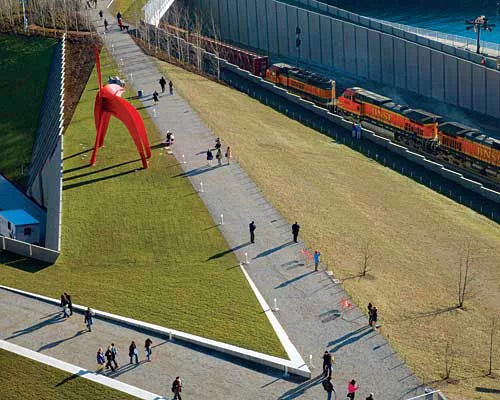
To bridge a busy street and an active rail line, designers created a Z-shaped path and sculpted the earth.

Photo © Lara Swimmer
Seattle's Olympic Sculpture Park

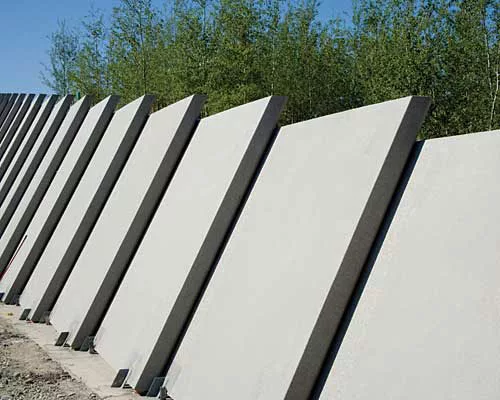
To bridge a busy street and an active rail line, designers created a Z-shaped path and sculpted the earth. To hold back 200,000 cubic yards of fill, engineers devised a mechanically stabilized earth retaining-wall system hidden behind overlapping and sloping precast panels.

Photo © Lara Swimmer

Seattle's Olympic Sculpture Park

To bridge a busy street and an active rail line, designers created a Z-shaped path and sculpted the earth. To hold back 200,000 cubic yards of fill, engineers devised a mechanically stabilized earth retaining-wall system hidden behind overlapping and sloping precast panels.

Photo © Michael Dickter
Seattle's Olympic Sculpture Park

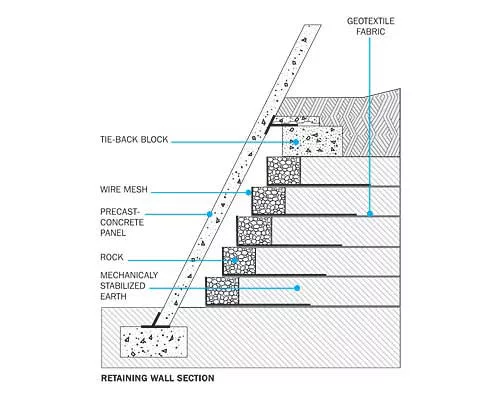
To bridge a busy street and an active rail line, designers created a Z-shaped path and sculpted the earth. To hold back 200,000 cubic yards of fill, engineers devised a mechanically stabilized earth retaining-wall system hidden behind overlapping and sloping precast panels.
Seattle's Olympic Sculpture Park

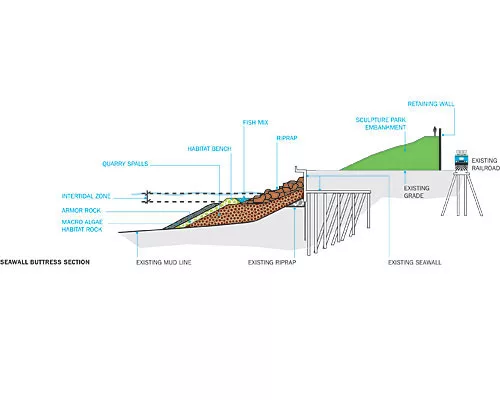
A buttress system stabilizes the aging timber-and-steel seawall along the shoreline. It was designed to also provide refuge for migrating salmon. Just beyond the end of the seawall, the designers have created a beach. The MSE retaining-wall system used to form the park’s contours is composed of layers of soil separated by geotextile fabric. Near the face of the MSE, the soil transitions to rock held in place by wire mesh.
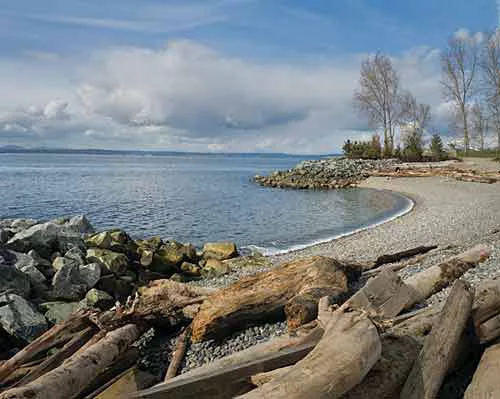
Seattle's Olympic Sculpture Park

A buttress system stabilizes the aging timber-and-steel seawall along the shoreline. It was designed to also provide refuge for migrating salmon. Just beyond the end of the seawall, the designers have created a beach. The MSE retaining-wall system used to form the park’s contours is composed of layers of soil separated by geotextile fabric. Near the face of the MSE, the soil transitions to rock held in place by wire mesh.

Photo © Benjamin Benschneider
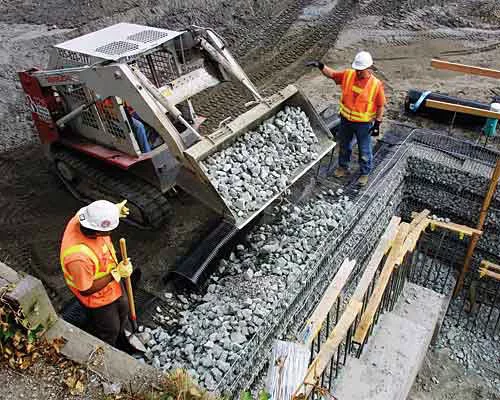
Seattle's Olympic Sculpture Park

A buttress system stabilizes the aging timber-and-steel seawall along the shoreline. It was designed to also provide refuge for migrating salmon. Just beyond the end of the seawall, the designers have created a beach. The MSE retaining-wall system used to form the park’s contours is composed of layers of soil separated by geotextile fabric. Near the face of the MSE, the soil transitions to rock held in place by wire mesh.

Photo © Bruce Moore 

Seattle's Olympic Sculpture Park
July 19, 2007
To create Seattle’s new Olympic Sculpture Park, lead designers Weiss/Manfredi have fittingly sculpted the earth. At the northwest corner of downtown, overlooking Elliott Bay, on land previously used as a fuel storage and transfer facility, the New York City–based firm developed a Z-shaped path that crosses a busy street and active railroad tracks and negotiates a 40-foot grade change. The serpentine route takes visitors past carefully placed works from the Seattle Art Museum collection, including pieces by Alexander Calder, Richard Serra, and Louise Nevelson, and provides stunning views of the city and the surrounding landscape (see the July issue of RECORD, page 110).
 
Not surprisingly, an extensive system of retaining walls was needed to make this new topography and hold back the 8.5-acre site’s 200,000 cubic yards of fill. The only visible part of the system is its overlapping and sloping concrete panels, each 12 feet wide and as tall as 30 feet. The repetitive nature of these precast elements creates “a module and a measure, allowing the site to feel bigger,” and provides an appropriate backdrop to the sculpture, says Marion Weiss, AIA.
 
The real “work” of retaining the earth is actually occurring behind the precast panels. There, mechanically stabilized earth (MSE) holds back tons of fill. “Decoupling” the earth-retaining function from the architecture was a more cost-effective solution than a traditional poured-in-place concrete retaining wall backfilled from behind, says Drew Gangnes, director of civil engineering for Magnusson Klemencic Associates (MKA). The firm was both civil and structural consultant for the project.
 
The MSE stretches horizontally under the park surface for a distance equal to about 80 percent of the height of the wall, and is made up of 18-inch-deep layers of soil separated by geotextile fabric. Near the face of the MSE, the fabric transitions to wire mesh, L-shaped in section, and containing rock rather than soil.
 
The panels are attached to the MSE system with slotted connections to a continuous tie-back block just below grade level and to the footing. To prevent transfer of loads from one panel to another due to settlement or seismic activity, adjacent panels are not connected, explains Jay Taylor, MKA principal. A gap of a few inches between the panels and the MSE face was sized so that the two components do not slam into each other during a temblor, and to prevent the panels from toppling.
 
The project also included reinforcement of the sculpture park’s deteriorating 800-foot-long timber-and-steel seawall. City and state agencies had been studying the wall’s reconstruction as part of a larger proposal to rebuild about 8,000 feet of seawall protecting the downtown waterfront. Preliminary design documents showed the agencies planned a costly behind-the-wall intervention that would avoid disrupting the piers that line much of the Elliott Bay shore.
 
Since there were no piers along the park’s section of waterfront, and because its seawall was not adjacent to a seismically and politically sensitive elevated highway, designers had some freedom to explore alternatives. Their solution was to reinforce the existing seawall with an in-the-water buttress. But in order to obtain permitting, the team had to develop a system that would create a hospitable environment for migrating salmon in addition to providing the necessary reinforcement.
 
The team satisfied both the habitat and structural requirements using layers of riprap and smaller diameter rock carefully sized to create an uninviting environment for salmon’s predators. Incorporated into the buttress, at the level of the intertidal zone, is a so-called “habitat bench.” A hollow in this bench is filled with aggregate and other material that supports the growth of organisms that salmon like to eat. Gangnes estimates that this $5 million buttress, which he jokingly refers to as a “pile of rocks,” cost about a tenth of what the proposed city/state solution would have.
 
Just beyond the end of the seawall, at the northern end of the park, the team designed a crescent-shaped beach protected by two peninsulas. Environmental consultants used computer simulation to model the motion of the waves and wind to make certain that the sand would not be carried away. This beach is the culmination of a journey from the city to the water’s edge, from the most urbane part of the park to that most connected to nature. “It brings in both extremes,” says Weiss.

Share This Story

Looking for a reprint of this article?
From high-res PDFs to custom plaques, order your copy today!

Joann gonchar

Joann Gonchar, FAIA, LEED AP, is deputy editor at Architectural Record. She joined RECORD in 2006, after working for eight years at its sister publication, Engineering News-Record. Before starting her career as a journalist, Joann worked for several architecture firms and spent three years in Kobe, Japan, with the firm Team Zoo, Atelier Iruka. She earned a Master of Architecture degree from the University of Pennsylvania and a Bachelor of Arts from Brown University. She is licensed to practice architecture in New York State.

Post a comment to this article

Report Abusive Comment

Subscription Center
  • Create an Account
  • Start a Subscription
  • Manage My Account
  • Sign Up for Newsletters
  • Visit Customer Service
  • Update Preferences

More Videos

Sponsored Content

Sponsored Content is a special paid section where industry companies provide high quality, objective, non-commercial content around topics of interest to the Architectural Record audience. All Sponsored Content is supplied by the advertising company and any opinions expressed in this article are those of the author and not necessarily reflect the views of Architectural Record or its parent company, BNP Media. Interested in participating in our Sponsored Content section? Contact your local rep!

close
  • TAMLYN XtremeTrim Exterior Trim
    Sponsored byTamlyn

    Designing Cleaner Panel Facades: Why Exterior Trim Details Matter

  • Building with Vapor Barriers
    Sponsored byReef Industries, Inc.

    Vapor Barriers Help Control Moisture in Tighter Building Designs

  • Duct Interior with Prodeq System
    Sponsored byHenry, a Carlisle Company

    Designing Resilient Water Containment Systems

DESIGN:ED Podcast
Listen to Architectural Record’s DESIGN:ED Podcast

Events

June 10, 2026

Rethinking Stormwater – The Power of Porous Paving

Credits: 1 AIA LU/HSW; 1 AIBD P-CE; 0.1 ICC CEU

Learn how porous paving systems support stormwater management, reduce heat island effects, and enhance sustainable site design performance.

June 11, 2026

Very Early Warning Fire Detection for Mission-Critical Facilities

Credits: 1 AIA LU/HSW; 1 AIBD P-CE; 0.1 ICC CEU

Examine advanced fire detection strategies that support uptime and enhance safety in data centers and other mission-critical facilities.

View All Submit An Event

Products

2026 Architect's Square Foot Costbook

2026 Architect's Square Foot Costbook

See More Products

Popular Stories

Practice Matters illustration

What’s in a (Firm’s) Name? Thinking About Succession and Legacy

Coronado Bridge

The Architect’s Guide to San Diego

Practice Matters illustration

By the Numbers: Counting America's Architects

House on a Hill

Design Vanguard 2026: Forma

Crane Cove, ONO

Design Vanguard 2026 Winners

Broader Sustainability of CMU - Free Webinar - May 21, 2026

Related Articles

  • Olympic Sculpture Park

    See More

Related Products

See More Products
  • Architectural Record - July 2025

    Architectural Record July 2025 Issue

See More Products
×

The latest news and information

#1 Source for Architectural Design, News and Products

SUBSCRIBE
  • RESOURCES
    • Advertise
    • Contact Us
    • Submit
    • Store
  • ACCOUNT CENTER
    • Create an Account
    • Start a Subscription
    • Manage My Account
    • Sign Up for Newsletters
    • Visit Customer Service
    • Update Preferences
  • PRIVACY
    • PRIVACY POLICY
    • TERMS & CONDITIONS
    • DO NOT SELL MY PERSONAL INFORMATION
    • PRIVACY REQUEST
    • ACCESSIBILITY
  • SERVICES
    • Marketing Services
    • Reprints
    • Market Research
    • List Rental
    • Survey/Respondent Access
  • STAY CONNECTED
    • Linkedin
    • Facebook
    • Instagram
    • YouTube
    • X (Twitter)

Copyright ©2026. All Rights Reserved BNP Media, Inc. and BNP Media II, LLC.

Design, CMS, Hosting & Web Development :: ePublishing