The Formative Years
Architectural Record turns 125 this year. In celebration, we present memorable moments from the magazine’s early days.
![125th Anniversary [spread]](https://www.architecturalrecord.com/ext/resources/Issues/2016/Jan/1601-125-years-Formative-Years-2.webp?t=1450711861&width=1080)
RECORD railed against brash eclecticism through the unsigned “Architectural Aberrations” feature.
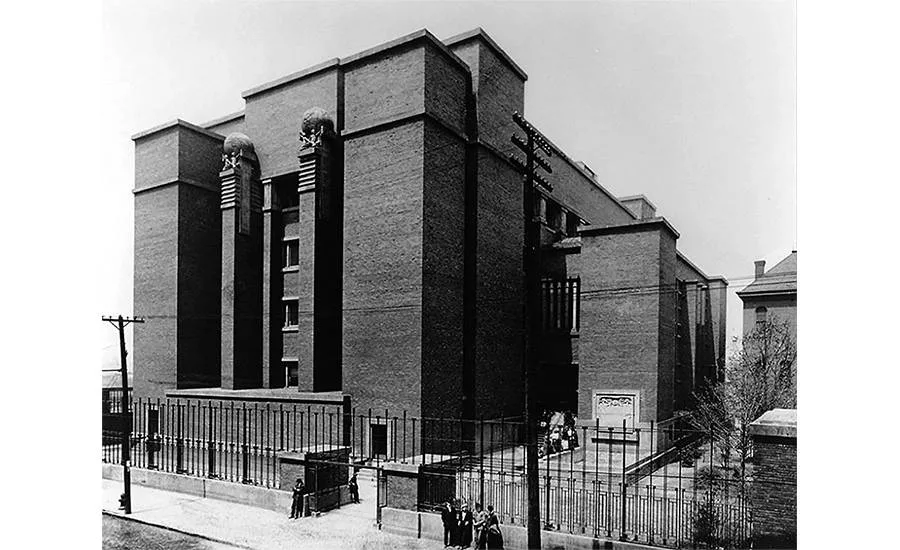
RECORD railed against brash eclecticism through the unsigned “Architectural Aberrations” feature (above, left). Russell Sturgis criticized Frank Lloyd Wright’s Larkin Building in the Aprll 1908 issue.
![125th Anniversary [spread]](https://www.architecturalrecord.com/ext/resources/Issues/2016/Jan/1601-125-years-Formative-Years-4.webp?t=1450711932&width=1080)
In 1910, the mag a zine introduced Picasso and other French artists to the U.S. in Gelett Burgess’s “The Wild Men of Paris.”
![125th Anniversary [spread]](https://www.architecturalrecord.com/ext/resources/Issues/2016/Jan/1601-125-years-Formative-Years-11.webp?t=1450711950&width=1080)
Architectural Record's first cover.
Frank Lloyd wright did not take criticism lightly. He was furious at the stinging denunciation of his revolutionary Larkin Building in Buffalo that was published in Architectural Record in April 1908. Its author, Russell Sturgis, an eminent architect and historian who had written for RECORD since its inception in 1891, called Wright’s office building for a mail-order soap company “ungainly” and “awkward.” This “extremely ugly” structure of unadorned brick lacked “a play of light and shade” through moldings, and was without “a variety of color pattern.” Wright retaliated in an unpublished reply that it was “pathetic” to see a well-respected critic “picking over bit by bit his architectural ragbag for architectural finery wherewith to clothe the nakedness of the young giant.”
Apart from Wright’s arrogance, it’s easy to understand why he was upset: the month before, RECORD had published the largest presentation of his work to date (34 projects, with 87 illustrations). Wright’s accompanying essay, “In the Cause of Architecture,” set forth his organic approach to the design of open, flowing spaces, and the expression of natural materials. It was the first of a series of theoretical essays he would write over the years for the magazine. In 1908, however, the magazine just did what it would continue to do to this day: publish a serious critic’s point of view, even if the editors did not necessarily agree with it.
In the late 19th century, before the advent of radio and television, magazines enjoyed phenomenal influence among a growing community of readers. By the 1890s, there were 5,000 magazines published in America, up from 700 in 1865. Industrialization, advances in education, and the institutionalization of the professions helped fuel this growth, as well as the expansion of the postal service that made second-class magazine delivery commonplace. And the electric light bulb encouraged more nighttime reading.
While magazines such as Harper’s and The Nation covered architecture along with the other arts, the publisher of Real Estate Record and Builder’s Guide, Clinton Sweet, saw the opportunity for an architecture magazine that would reach a professional as well as a general audience. Tall buildings were springing up in cities, thanks to the invention of the elevator and the development of steel framing. The expansion of the railroad, steel, and oil industries created the vast wealth of the Gilded Age, and the new plutocrats hired architects such as Richard Morris Hunt and McKim, Mead & White to design palatial city and country houses that rivaled the style of their European predecessors.
The planning of the World’s Columbian Exposition of 1893 to celebrate the 400th anniversary of Columbus’s arrival in America captured wide public attention. Though Congress had decided it would be held in Chicago instead of New York, Sweet was convinced that a quarterly could take advantage of increased curiosity about architecture, and provide a forum for important discussion.
Sweet chose Henry (Harry) W. Desmond, a 28-year-old Irish journalist, as his founding editor of RECORD. Though Desmond had edited the real-estate weekly, he aspired to be a poet, and he was determined to make the new magazine a force of intellectual thought, not “merely recording” news of contemporary work.
The first issue of RECORD, July–September 1891, included an essay, among historical and technical pieces, on the need for creating a genuine American style. Desmond also ran an installment of his own unpublished novel, Raymond Lee, subsequently serialized in the magazine, although it had little to do with architecture.
Looking for quick answers on architecture and design topics?
Try Ask RECORD, our new smart AI search tool.
Ask RECORD →
The young editor pushed for a larger cultural reach than was typical of other architectural periodicals by emphasizing the “vital” place of art. Under Desmond’s tenure, RECORD published “The Wild Men of Paris” in 1910, considered the first publication about Cubist artists in the American press. The essay included photographs of both Picasso and his painting Les Demoiselles d’Avignon; the writer of the piece, Gelett Burgess, remarked that “Picasso was colossal in his audacity,” adding that his “terrible pictures loom through the chaos of his studio.” But, Burgess noted, “He sells his work, nevertheless. Who buys? God knows! Germans, I suppose.” In spite of his sardonic tone, Burgess prophesied that “Perhaps these Wild Beasts”—he included Matisse and Braque—“are really the precursors of the Renaissance.”
RECORD’s growing renown as a magazine of important criticism was consolidated by the contributions of Sturgis and of Montgomery Schuyler, who had already established their reputations in newspapers and other magazines. While Schuyler’s protomodernist stance and his excoriation of thoughtless eclecticism would later earn him the respect of Lewis Mumford, his spiciest takedowns appeared anonymously under the rubric of “Architectural Aberrations.” Here he attacked buildings going up everywhere that “collared the eye.” The mélange of historical elements in the Philadelphia Record Building (designed in 1886 by Willis G. Hale) he deemed “restless,” “monstrous,” and “wild.” While Schuyler, more than Sturgis, encouraged economy of expression, both battled against architecture that was eclectic and lacked proportion or unity.
Similarly, a young editor on RECORD’s staff, the mild-mannered Herbert Croly, called for civility and propriety in the changing cityscape. His criteria were less aesthetic than his colleagues’, for he framed his arguments within a social perspective, adding another voice and dimension to this magazine. In 1909, Croly published The Promise of American Life, a progressive political tract that called for a government run by “wise, humanistic, and well-educated” men instead of those who believed in “indiscriminate individualism.” He suggested that the model for these attributes could be found in the architect who “would not cater to mass taste but adhere to a higher standard.” Croly went on to become the founding editor of The New Republic in 1914, an influential voice in the world of politics, with a stable of writers that included Walter Lippmann and Oliver Wendell Holmes.
On the eve of World War I, RECORD was clearly prospering. Since Desmond had launched Sweet’s Indexed Catalogue of Building Construction in 1906, the monthly had increased greatly, and the magazine had 11,000 readers, making it the leader in its field. After Desmond died in 1913, Michael Mikkelsen, who had a Ph.D. in history, economics, and politics, took over. RECORD was still edited for the general reader as well as the architect, but, by the 1920s, the focus shifted to practice and business matters surrounding the rapidly growing profession of architecture. The world of design and construction had changed, and RECORD was changing with it.
Looking for a reprint of this article?
From high-res PDFs to custom plaques, order your copy today!