Porto Cruise Terminal
High-Water Mark: A cruise-ship terminal’s exuberant form connects passengers and is a destination in its own right.

Curved walls are finished in hexagonal tiles with tilted faces, scattering natural light.
Photo © Fernando Guerra

The building’s forms diagram movement through it and connections to sea and land.
Photo © Fernando Guerra

A covered breezeway connects ships to the terminal.
Photo © Fernando Guerra

The central atrium is a whorl of curving ramps and structural walls around a vertical circulation shaft.
Photo © Fernando Guerra

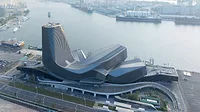
Set on a pier reaching 2,500 feet into the Atlantic to accommodate larger boats, Porto’s Cruise Ship Terminal attracts local visitors from nearby beaches with its striking oval profile and tiered rooftop lookout, reached via spiraling ramps from the ground.
Photo © Fernando Guerra

The terminal’s massing is like a looping ribbon, with ramps uncoiling from the central drum toward a marina and the shore.
Photo © Fernando Guerra

The main concourse includes ample spaces for waiting passengers.
Photo © Fernando Guerra
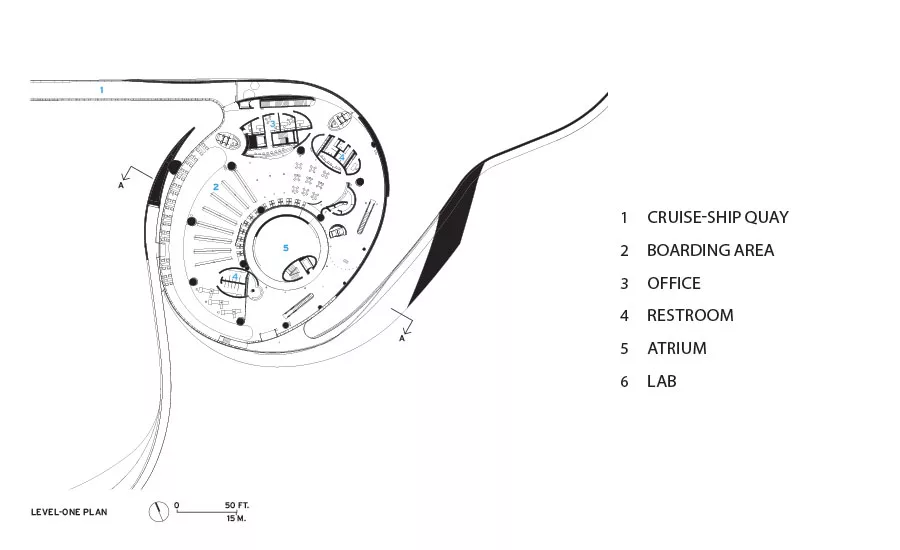
Image courtesy Luís Pedro Silva

Image courtesy Luís Pedro Silva
Architects & Firms
Porto, Portugal
To create the iconic curving forms of the cruise-ship terminal in Porto, Portugal, architect Luís Pedro Silva began working from the project’s territorial context rather than simply seeking a display of formal prowess. The powerful oval drum of its main volume, with its spiraling central atrium and exterior ramps, is charged with both centripetal and centrifugal force, gathering all the vectors of movement that come together in the terminal from sea and land, and spinning them back out again to their various destinations. Before receiving the commission, Silva, who has degrees in architecture and urban planning from Porto University, worked on a strategic plan for the entire port as a member of a team of economists, engineers, and other specialists. The building and its new dock bring together the group’s ideas for increasing the port’s efficiency, promoting a growing tourist industry, and improving connections to the area’s attractions.
Leixões, the port, occupies a small inlet on the Atlantic Ocean 6 miles north of the historic city center of Porto. It is protected by two breakwaters that reach more than 2,500 feet into the sea, each with a dock on its harbor side. The tightly confined waterway houses facilities for container ships, oil tankers, a fishing fleet, and a recreational marina. It’s a node of heavy industry that interrupts the rocky beaches of the coast, separating seaside promenades designed by Portugal’s two Pritzker Prize winners: Eduardo Souto de Moura to the south, in Matosinhos, and Álvaro Siza to the north, in Leça da Palmera, where his outdoor swimming pools and Tea House are nestled into the rocks.
In the first phase of the plan, finished in 2011, Silva and his team moved the cruise-ship dock from the inner harbor to a new pier at the end of the southern breakwater, for more direct access to the city and to accommodate ships up to 1,000 feet long. The terminal was completed in a second phase last year. In the near future, the pier and terminal will open to the general public, allowing the building, with its rooftop viewing deck, to truly function as a destination rather than just a curiosity when seen from Souto de Moura’s seaside promenade, where its dramatic forms stand out against the horizon.
Silva set the terminal in the elbow of the angled breakwater, and in plan it resembles a hinge or spring, with ramps and arms curving out in different directions toward the marina, the new pier, and the shore. Inside, these pedestrian paths come together in a spiraling oval ramp around the central atrium. The uncoiling arms diagram the different systems of movement through the building. From a cruise ship, for example, a breezeway carries passengers over the service areas of the dock to the terminal. Ramps and escalators bring them down to the ground level, where they pass through customs and baggage handling (or vice-versa), to connect to tour buses or smaller boats for trips to the city and the Douro wine region, or eventually to a tram line that is planned to run along the coast.
In the original program, the upper section of the terminal was meant to house a shopping concourse and a restaurant, but Portugal’s ongoing financial slump made investors hard to find. While Silva was developing the design, these floors were taken on by the University of Porto’s Marine Science and Technology Research Park. The architect rather awkwardly converted the commercial spaces into laboratories, with floor-to-ceiling glazed storefronts facing the atrium but with no exterior windows, and with offices on mezzanines accessed via spiral stairs. He installed a research aquarium in the basement, and converted the top-floor restaurant into a multi-use event credits space. Yet this unlikely partnership with the university does bring life to the building, as well as steady revenue, and allows the center’s scientists to be close to the sea.
Silva worked with local manufacturers to develop a hexagonal ceramic tile with a tilted face to clad the building, updating the Portuguese tradition of painted-tile facades. He rotated the tiles, placing them in varying relations to each other, like barnacles or shells, to create an uneven surface. “They give the building a human scale,” he says.
Glistening in the light, the curving walls of the building read like ribbons looping around themselves in an irregular tangle. Echoes of two Guggenheims are evident—Wright’s in New York and Gehry’s in Bilbao. Silva affirms, however, that Siza is his most important reference: “The way our bodies move in a space, and the way a space invites you forward.” Like Souto de Moura, whose early buildings were very Miesian, Silva may be using Wright and Gehry to mitigate the influence of Siza’s eccentric, rectilinear forms. Whatever the case, he develops the terminal’s looping ramps and drum with an elegant economy of means, and makes this formal repertoire his own.
PeopleArchitect: Luís Pedro Silva, Arquitecto, Lda Rua de Ceuta, 16, 3º 450-189 Porto – Portugal +351 222003944; +351 939741897
Personnel in architect's firm who should receive special credit: Responsible Architect (registered architect): Luís Pedro Silva; 6582N Project Management (registered architect): Luís Pedro Silva Principal collaborators: Registered architects: Fabien Vacelet; Helena Monteiro; João Pedro Silva; Raquel Pratas; Teresa Ferreira; André Guerreiro; Cátia Curado; Marta Vaz; Nídia Soares; Vasco Gomes Registered engineer: Ricardo Gonçalves
Architect of record: Luís Pedro Ferreira da Silva
Interior designer: Luís Pedro Silva, Arquitecto, Lda
Engineers: Structural Engineering, Hydraulic Engineering: NEWTON, Consultores de Engenharia, Lda Electrical Engineering: Rodrigues Gomes & Associados – Consultores de Engenharia, S.A Mechanical Engineering: GM Engenharia Exterior Arrangement: José Magalhães, Engenheiro
Consultants: Technical Design consultancy: Iperplano, Lda Tourism and Business Model Strategy: Quaternaire Portugal Accessibility and Mobility: gng.apb - arquitectura e planeamento, Lda Durability and Hygrothermal: Vasco Peixoto Freitas (FEUP) Maritime Work: Instituto de Hidráulica e Recursos Hídricos, Faculdade de Engenharia da Universidade do Porto (IHRI - FEUP) Fire Safety and Self-Protection Measures: Exactusensu - Consultores Associados, Eng. José Aidos Rocha Landscape: Luís Pedro Silva, Arquitecto. Lda Lighting: Luís Pedro Silva, Arquitecto. Lda Acoustical: Luís Conde Santos - dBwave.i - Acoustic Engineering, SA
General contractor: ACE
Photographers: FG+SG, + 351 916551164 Pedro de Pedra, +351 222003944 Carlos Silva
Client: Administração dos Portos do Douro, Leixões e Viana do Castelo
Size: 188,000 square feet
Completion Date: March 2015
|
ProductsExterior cladding Masonry: Transgranitos Precast concrete: Pavicentro Curtain wall: Metaloviana; Jofebar Other cladding unique to this project: Vista Alegre
Windows Metal frame: Jofebar; Metaloviana
Railings Jofebar; Metaloviana
Glazing Glass: Jofebar; VCP Skylights: Jofebar
Interior finishes Wall coverings Granite: Transgranitos Ceramic: Cinca; Vista Alegre
Furnishings Laboratory furniture: Laborial Laboratory Hottes: design - Luís Pedro Silva, Arquitecto. Lda; Laborial; supply – Laborial
Lighting Interior ambient lighting: design - Luís Pedro Silva, Arquitecto Lda; supply – Osvaldo Matos O/M; Ramos Ferreira; Exporlux Downlights: Osvaldo Matos O/M Exterior: Exporlux; Osvaldo Matos O/M Dimming System or other lighting controls: Sisint - Bose
|
Looking for a reprint of this article?
From high-res PDFs to custom plaques, order your copy today!