Baha'i Temple of South America by Hariri Pontarini Architects
Santiago, Chile

Baha’i Temple of South America
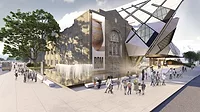
The Baha’i Temple of South America, nearing completion in Santiago, Chile, and shown here in a rendering, will be enclosed by nine petal-like elements that rise almost 90 feet to a central oculus.
Rendering courtesy Hariri Pontarini Architects

Baha’i Temple of South America
The exterior skin comprises cast-glass panel assemblies that were affixed to an aluminum frame in Germany before being shipped to Chile for installation on the building’s superstructure.
Image © Hariri Pontarini Architects

Baha’i Temple of South America
Together with a marble interior skin, the translucent glass will filter sunlight.
Photo © Hariri Pontarini Architects

Baha’i Temple of South America
About 20 percent of the temple’s exterior cladding pieces are curved.
Photo © Hariri Pontarini Architects

Baha’i Temple of South America
The curved glass pieces were made by slumping flat glass over shotcrete-covered polystyrene shapes in a kiln.
Photo © Hariri Pontarini Architects

Baha’i Temple of South America
The curved glass pieces were made by slumping flat glass over shotcrete-covered polystyrene shapes in a kiln.
Photo © Hariri Pontarini Architects

Baha’i Temple of South America
Image courtesy Hariri Pontarini Architects
Architects & Firms
In 2003, the Toronto firm Hariri Pontarini Architects won a competition for the Baha’i Temple of South America in Santiago, Chile, with a nine-sided design featuring petal-like elements that twist and rise to a central oculus. Thirteen years later, the project is nearly complete—and its innovative cast-glass skin is a victory for the architects, engineers, fabricators, and contractors who sweated every detail to make sure it could withstand the rigors of its mountainside location.
With its light-bathed interior, the temple embodies the Baha’i principle of light as a unifying element. “It’s designed to last 400 years, and, in keeping with the faith’s history and philosophy, we looked for an ancient, durable material that would filter light from outside or within,” says Doron Meinhard, project manager and associate in charge. Principal Siamak Hariri’s original scheme was clad on the interior and exterior in alabaster, a stone that’s translucent when cut thin enough.
But aesthetic and maintenance concerns precluded that choice. The building sits in the foothills of the Andes, where harsh sun, summer temperatures that can soar past 100 degrees Fahrenheit, and daily temperature swings as wide as 64 degrees are the norm. Alabaster loses its translucency above 104 degrees, and it’s somewhat soft, so it can be damaged by air pollution or water, says Meinhard. The architects, along with engineering firm Simpson Gumpertz & Heger (SGH), began to consider glass cladding instead, and settled on marble panels for the interior.
After many rounds of testing for strength, seismic performance, and thermal stresses, patterned cast glass was chosen for its light-filtering qualities and durability over laminated or annealed glass. The architects worked with glass artist Jeff Goodman on the one-of-a-kind formulation. They opted for borosilicate glass instead of soda-lime glass, because the latter cracked during thermal stress testing, making it unsuitable for a locale with such extreme temperature variations, says James Parker, SGH principal.
The building’s nine petals are identical, each one roughly 88 feet tall and 33 feet wide and comprising about 1,100 subpanels of 1.25-inch-thick glass. The panels, about 20 percent of which are curved, are attached with undercut anchors to an aluminum planar frame. The design of this frame and of the steel superstructure arose from multiple discussions among Hariri Pontarini, SGH, and Gartner Steel and Glass of Germany, which fabricated the aluminum and steel elements.
Making and assembling the parts was a multinational feat of collaboration. The glass was handmade in a kiln in Toronto in two sizes, 4 feet by 6 feet and 4 feet by 5 feet. The glass pieces that would become flat panels were shipped to Germany so that Gartner could cut them via water jet to the needed shapes and dimensions. In contrast, the curved panels were cut and shaped entirely in Toronto before arriving in Germany. These pieces were also cut with a water jet, to the “flattened” shapes, determined with the help of the project’s 3-D model. Gartner made 150 unique polystyrene positives in Germany and shipped them to Canada, where the glassmakers sprayed them with shotcrete so that they could withstand the kiln’s heat. Each of these elements was placed in the kiln, and the corresponding pre-cut glass panel was slumped over it to acquire its finished shape.
In its facility in Bavaria, Gartner anchored all the panels—both flat and curved—to the aluminum frame, adding a structural silicone sealant where the glass meets the frame for extra durability and water- proofing. Assemblies that make up each of the facade’s petals were packed in more than 100 containers and sent to Chile, where, at last, they were assembled and affixed to the superstructure.
Though the architects altered their original vision for the temple’s cladding, they believe they’ve met its intent. “Through technological innovations we were able to make cast glass, an ancient material in itself, into something as durable and low-maintenance as stone,” says Meinhard. “And it turns the entire temple into a skylight.”
PeopleArchitect: Hariri Pontarini Architects - Siamak Hariri, partner in charge; Doron Meinhard, project manager; Justin Ford, job captain
Consultants: Simpson Gumpertz & Heger, Halcrow Yolles, EXP, Patricio Bertholet M. (structural); Simpson Gumpertz & Heger (cladding); MMM Group, Videla & Associates, The OPS Group (m/e/p)
Client: National Spiritual Assembly of the Baha'is of Chile, National Spiritual Assembly of the Baha'is of Canada
Size: 26,000 square feet
Cost: withheld
Completion Date: under construction |
ProductsSuperstructure and Cladding Gartner Steel and Glass
Glass Casting Jeff Goodman Studio, CGD Glass
|
Looking for quick answers on architecture and design topics?
Try Ask RECORD, our new smart AI search tool.
Ask RECORD →
Looking for a reprint of this article?
From high-res PDFs to custom plaques, order your copy today!