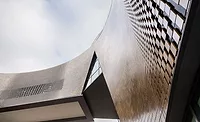
Waterdown Library and Civic Centre by RDHA
Hamilton, Ontario

The main floor cantilevers slightly over the sloping site.
Photo © Tom Arban

The west facade is clad in 4-inch-thick panels of locally sourced limestone, installed at an angle over select portions of the exterior wall to shade windows of staff offices and a reading room.
Photo © Tom Arban

Inside, a series of large scooped skylights bathe the stacks and reading areas in sunlight.
Photo © Tom Arban

The street-facing side of the building is completely glazed and features an outdoor terrace above the entrance.
Photo © Tom Arban

Inside, a series of large scooped skylights bathe the stacks and reading areas in sunlight.
Photo © Tom Arban

Inside, a series of large scooped skylights bathe the stacks and reading areas in sunlight.
Photo © Tom Arban

Most visitors to the library enter from the parking lot at the rear of the building, where an atrium offers seating and access to the library on one side and municipal offices on the other.
Photo © Tom Arban

Image courtesy RDHA
Architects & Firms
Following its award-winning renovation and addition to the historic Bloor Gladstone Library in central Toronto in 2009, RDHA finds that libraries have become something of a calling card. The nearly hundred-year-old architecture firm, based in Toronto, has completed five more libraries in and around the provincial capital since then, with two others currently under construction—including one that will be entirely without books.
Additional Information:
Jump to credits & specifications
Waterdown is a small community in the city of Hamilton, 50 miles southwest of Toronto. Its location along the Niagara Escarpment—a massive rock ridge overlooking Lake Ontario—inspired RDHA’s design for the new 23,500-square-foot Waterdown Library and Civic Centre, which replaces a much smaller municipal building. The new building reads as a one-story structure, and it is essentially just that, but one that that skillfully incorporates six levels. Within those levels, spaces for traditional library functions exist side by side with community recreation rooms, offices for a heritage society archive, and local government and police service outlets.
Whether entering at the street-facing facade or from the parking lot at the rear of the building—landscaped with a flowering orchard and bioswales as part of the building’s sustainable strategies—the interior’s design, with its sequence of ramps, offers an “architectural promenade,” according to RDHA principal and design director Tyler Sharp. It culminates in an elevated reading atrium with south-facing views that, on a clear day, extend to the lake beyond. During summer months, an outdoor reading terrace, linked to a small, sloping green roof, offers similar views and connection to the site.
The topography of the building, which is situated at a high point where the ridge begins to drop down toward the lake, reflects the geography and is marked by a series of stepped program areas. The architects enhanced the site—it slopes over 8½ feet from the back of the building to the street—with engineered fill to lift the slablike structure. Its southwestern corner cantilevers over 10 feet in two directions like a rocky outcrop. Large 4-inch-thick locally quarried limestone panels clad the exterior wall on one side of it, punctuated by 16-foot-high fins, suspended at an angle to provide shade to the fenestration behind them. “The language of facets and heavy stone came from the escarpment,” says Sharp.
Despite that monolithic presence, most of the rest of the building— constructed to be both energy-efficient and economical—features long swaths of floor-to-ceiling glazing that, along with three generous sawtooth-type skylights above the open stacks and reading atrium, create an expansive, daylight-filled interior. (Light-harvesting keeps the slim-profile fluorescent tubes that are artfully incorporated throughout the ceiling turned off for much of the day.) A ceramic frit pattern on the double-glazed, argon-filled, low-E glass facade panels provides some solar shading, while long planks of solid Douglas fir mounted like baffles on the interior side of the curtain wall provide additional sun protection along the south facade.
The Douglas fir was repurposed from the now demolished Hamilton Central Library. (Recycled, low-VOC, and local materials are thoughtfully integrated throughout the building, as are off-the-shelf products that the architects customized for specific uses.) The same wood was also used to clad select interior walls, including the one lining the staff offices and reading room along the west side of the building, and to create the bookcases and custom benches. More than that, its orange hue determined the distinctive color palette for the interior finishes.
The cheery furnishings, which were selected by the architects and include classic pieces designed by Pierre Paulin and Verner Panton, dot both the adult and children’s areas. The playful children’s section, closest to the rear entrance, offers child-friendly technology and activities, but is not enclosed or physically separated from the rest of the library. It is, however, acoustically isolated by the ceiling that dips above it. Its dramatic pyramidal form not only conceals material that dampens sound but scales the space to the kids.
Within the large, open main space, RDHA has carved out a number of intimate areas. The children’s section represents the first of four terraces, each slightly higher than the last. The remaining three, for the teen collection, the adult collection, and the reading atrium, at the highest point, are punctuated by the scooped skylights above them. Quiet study rooms in both the teen and adult terraces have load-bearing, laminated glass walls that support seemingly heavy ceilings, which block sound while preserving sight lines.
People of all ages mingle within the building—whose various spaces are reached through accessible, sloping walkways, covered in polished concrete like the rest of the floors. A multipurpose room (which features a demountable glass partition) beside the children’s area, a computer lab at the opposite end of the building, and a large, flexible community room at the lower, street-level entrance, are mainly occupied by seniors, who come to read, socialize, or even take a yoga class.
The number of visitors to the library has, in fact, increased significantly since the new building opened last year. “Membership has already grown by 3,000,” according to Dawna Wark, the manager of this and nearby branches. The collection, too, grew slightly when the library acquired the materials of a rural branch that closed. A state-of-the-art book sorter, located beside the staff offices but controlled remotely by the manufacturer in Germany, keeps all the circulating books in order.
Libraries have become places that contain much more than books— and in some cases, no books at all. The Waterdown branch, by combining a variety of functions—educational, civic, and social—within a bright and welcoming space, has become a significant center for its small community, and the greater region.
CreditsArchitect: RDH Architects (RDHA)
Engineers: WSP Halsall (structural); Jain and Associates (m/e); Valdor Engineering (civil)
Consultants: NAK Design Group (landscape)
General contractor: Bondfield Construction
Client: The City of Hamilton
Size: 23,500 square feet
Cost: $6.1 million
Completion date: August 2016
|
SpecificationsStructural steel Gensteel Limestone Betz Cut Stone Glass partitions, railings and entrances C.R. Laurence Curtainwall Aerloc Industries Skylights Slimlite Slylights Acoustical ceilings Armstrong Furniture Teknion; Vitra; Artifort; Nienkamper; Plan B Lighting Bocci (downlights); Bartco (interior ambient); Philips (exterior) Carpet tile Interface |
Looking for a reprint of this article?
From high-res PDFs to custom plaques, order your copy today!