Rolex Learning Center by SANAA
Lausanne, Switzerland
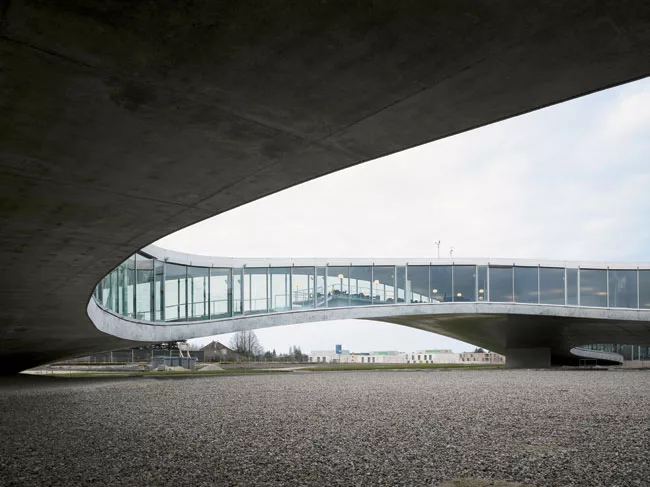
The curving, elevated forms of SANAA's Rolex Learning Center in Lausanne, Switzerland, defy traditional ideas about building.
Photo © Roland Halbe
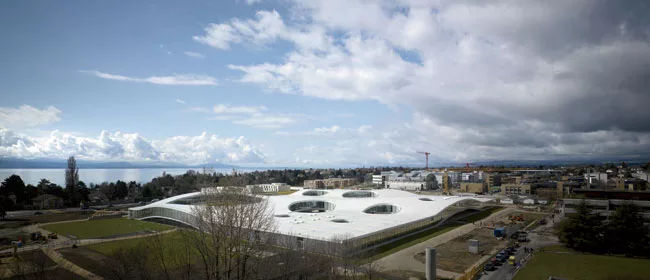
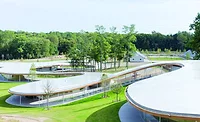
Seen from the northeast, the one-story structure is the new center of EPFL's small campus.
Photo © Christian Richters
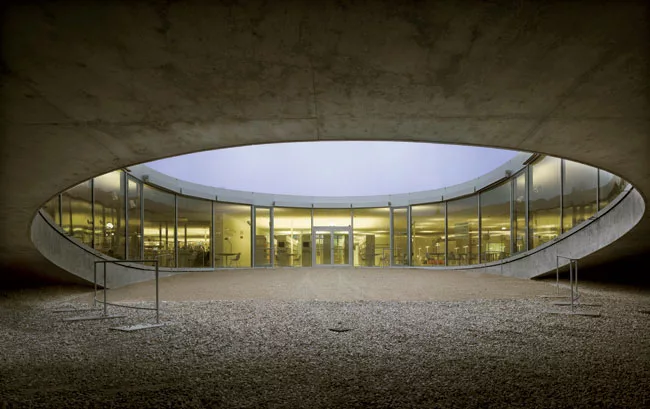
The larger patios serve as entrances where their sloping forms touch the ground.
Photo © Roland Halbe
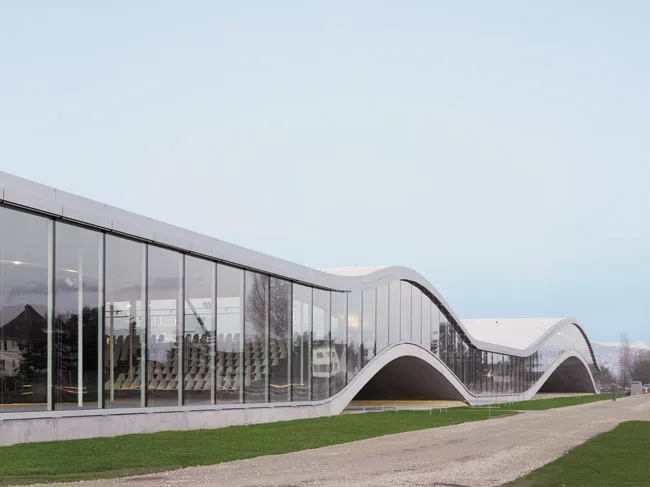
The south façade is the most complex structurally. A pair of hills corresponds to the auditorium and the largest patio.
Photo © Roland Halbe
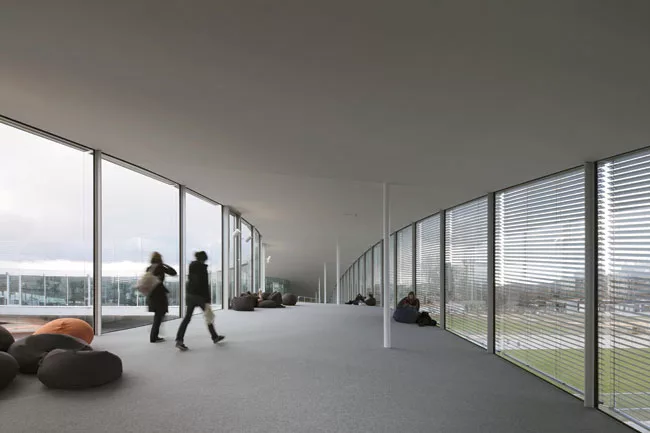
The overhead plane curves in harmony with the sloping floor. Sunshading louvers are located along the south, east, and west facades, and inside the patios. The sensor-controlled louvers descend automatically. The beanbaglike chairs SANAA developed with IDEE are used extensively by students.
Photo © Christian Richters
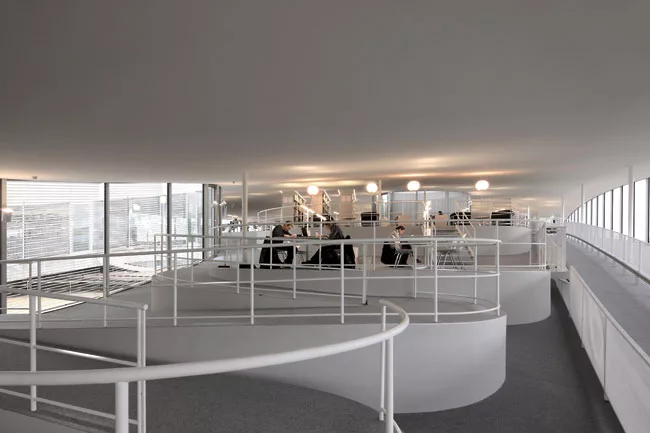
Terraces provide flat surfaces for tables in the library, seen here, and restaurant. The library contains more than 500,000 volumes.
Photo © Christian Richters
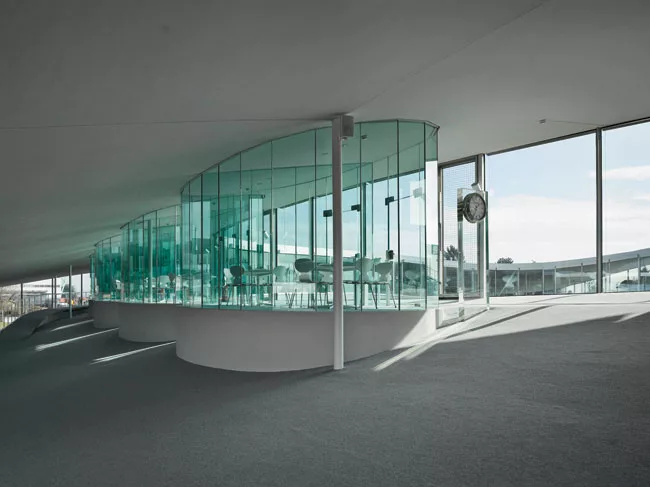
Glass-enclosed work areas, referred to as “bubbles,” allow students private space for group study and debate.
Photo © Roland Halbe
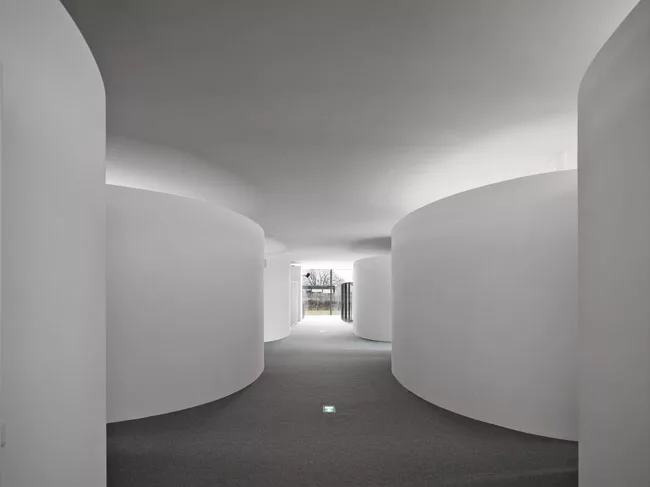
Enclosed circular spaces act as research and administrative offices.
Photo © Roland Halbe
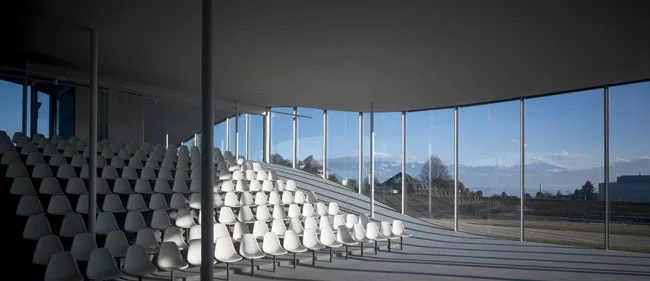
Located in the southwest corner of the building, the multipurpose hall, or auditorium, takes advantage of the structure's sloping floor to position its 600 seats. While the rest of the building maintains a consistent 11-foot ceiling height, the ceiling in this space, called the Rolex Forum, reaches a 16-foot height. The Alps are visible in the distance.
Photo © Christian Richters
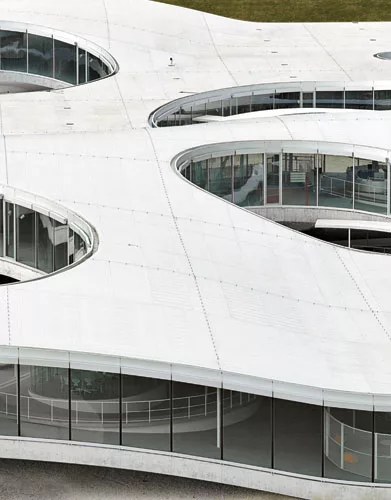
The roof runs parallel to the waves of the concrete floor slab below. Laser-cut wood beams, each unique, form the curving portions of the roof.
Photo © Roland Halbe
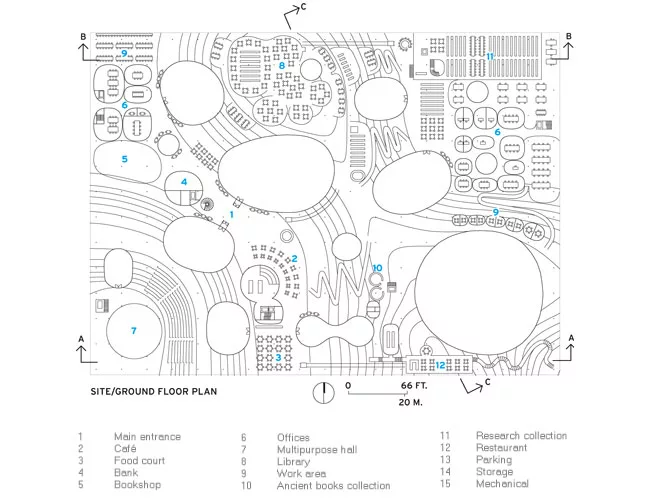
Image courtesy SANAA
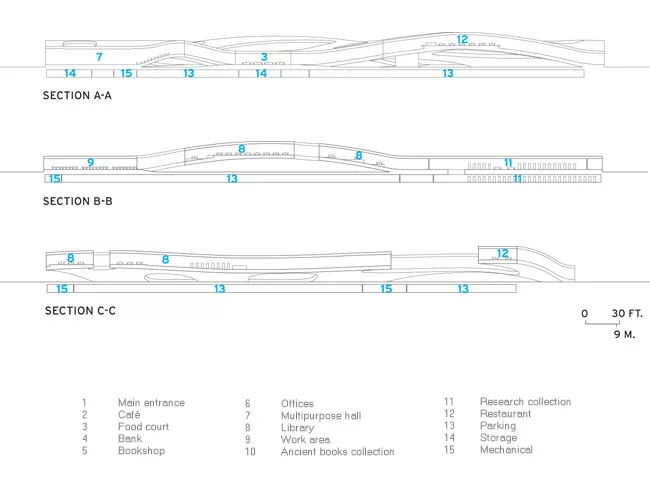
Image courtesy SANAA
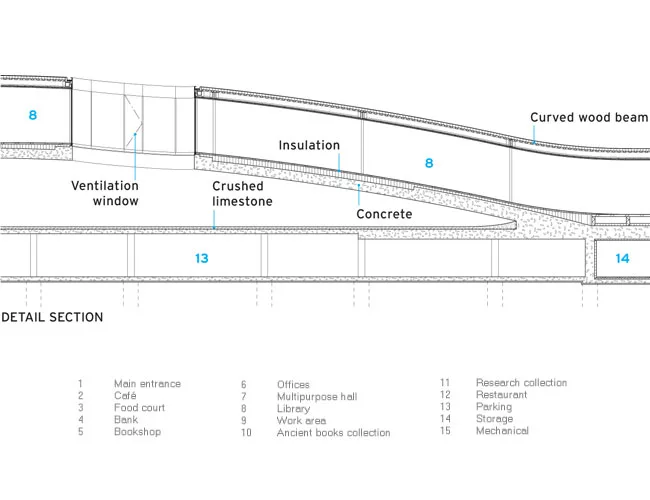
Image courtesy SANAA
Architects & Firms
What makes a great building? The ancients seemed to think it had something to do with proportion and symmetry. That belief pretty much persisted through to the last century, when some of the most memorable buildings were the ones that broke completely with those Classical tenets.
Fast forward to a new decade of a new century, and the completion of SANAA’s otherworldly Rolex Learning Center. These days, any number of things can make a building great. Some point to the use of groundbreaking technologies and materials to create jaw-dropping forms. Others will argue for a building’s green attributes. And if you agree with a certain oft-quoted Modern master, it’s all in the details.
Back to Rolex. On the heels of the Pritzker Prize, awarded to SANAA partners Kazuyo Sejima and Ryue Nishizawa last month, it seems almost blasphemous to imply that the enigmatic firm’s latest building is anything but great. And much of what has already been written about the low, undulating structure heralds it as a masterpiece—despite some very obvious flaws. Is it structurally and spatially innovative? Most definitely. Is it sustainably built? Arguably. Is it impeccably finished? Not by a long shot.
Envisioned as a hub for the prestigious École Polytechnique Fédérale de Lausanne’s (EPFL) small campus of mostly nondescript buildings in Lausanne, Switzerland, the new Learning Center houses a library, student work spaces, offices, a restaurant, and a café spread out over 215,000 square feet on one open, rolling level. A basement level contains parking and additional stacks.
It’s hard to resist likening the structure to a thick-cut slice of Swiss cheese, its rectangular form punctuated by a dozen or so variously-sized holes, or patios, as the architects call them. The patios bring daylight to all areas of the building, and the larger ones serve as entrances where their sloping forms touch the ground. To access them, visitors walk past the impenetrable glass facades and slip beneath one of the building’s peaks. It’s an unorthodox, but strangely evocative procession that also exposes the glossy underside of the rippled floor slab’s concrete.
The concrete—in some areas almost 3 feet thick—was poured over a precise formwork of sloping geometries created from 1,400 individual molds. The complex curvatures are supported by 11 highly reinforced arches, with spans as great as 280 feet. Prestressing in the slab over the basement provides added support, though the curving form around the largest patio in the building’s southeast corner required a structural wall and column.
A steel-and-wood roof billows in response to the concrete waves for a consistent 11-foot ceiling height (except in the taller multipurpose hall). Between floor and ceiling—the former blanketed by a mousy gray carpet, the latter a stark white sound-absorbing surface—is a remarkable space that’s a hybrid of built and natural environment that takes its cues from the nearby Alps, visible from inside. The building, a flowing landscape, is unencumbered by walls, allowing views across its interior and through the patios; overhead is a continuous plane.
Looking for quick answers on architecture and design topics?
Try Ask RECORD, our new smart AI search tool.
Ask RECORD →
Herein lies the building’s greatest strength. The experience of meandering through the space is magical, and one that challenges traditional notions of movement through man-made constructions as strictly vertical or horizontal. But this singular experience is also the source, somewhat counterintuitively, of the building’s main drawbacks. The single-story, sloping structure is not the exemplar of accessible design one might expect it to be. To use hiking terms—which the promenade through this building brings to mind—some of the hills might be classified as moderate to expert. So while it may be free of doors and walls, the building is chock full of ramps and elevators, both inclined and vertical.
The lack of partitions gives way to alternate methods of separating functions, some better than others (the cage surrounding the bookshop comes to mind as a less than desirable alternative). Tables in both the library and restaurant are raised on terraces and encircled by the same bulky railings that line the ramps. Circular “cubicles” enclose offices, creating awkward residual spaces between closely positioned cubicles, and between the covered tops of the cubicles and the ceiling. The sloping terrain itself is supposed to act as a divider, but since this is not abundantly clear, some areas are roped off. One large area behind the auditorium is just too steep to serve any purpose at all. Apparently, the efficient floor plan is so last century.
A series of student work spaces, referred to as “bubbles,” use glass to create privacy. Unfortunately, it’s not the precisely curved glass of SANAA’s Glass Pavilion at the Toledo Museum of Art in Ohio [record, January 2007, page 78] or the swirling acrylic of its Derek Lam Shop in New York City [record, September 2009, page 78]. Cost constraints dictated that the bubbles be fitted with less expensive, less transparent, straight panels—a surprise, given the list of donors who funded the $100 million project, led by the Learning Center’s illustrious namesake.
Cost-cutting measures are evident throughout the building, most noticeably in all the off-the-shelf components that draw attention in a structure that is anything but. Skylights, for instance, were necessary to keep the building naturally ventilated and help it achieve Switzerland’s strict Minergie label for energy efficiency—despite all the concrete. Yet the standard bubble type used here, glaringly visible from the ground, flagrantly disrupts the flowing overhead plane both inside and out.
Most visitors to the building, including a very curious public, are able to look past these flaws. Students from the EPFL and a nearby university have completely embraced it, consistently filling the libraries and work spaces and creating ad hoc study areas by variously arranging the beanbaglike chairs that dot the floor.
The Learning Center is obviously an inspiring place for its users, but that in itself cannot make the building great, and it is far from SANAA’s best. The firm’s ambitious design was scaled back almost from the start, leaving the architects to make one concession after another. Which leaves us with the perennial question: Is building a worthwhile pursuit when it may be impossible to reconcile the purity of a concept with the realities of construction and limitations of budget? As long as we want to have great buildings in the future, the answer to that is yes.
PeopleArchitect Team: Yumiko Yamada, Rikiya Yamamoto, Osamu Kato, Mizuko Kaji, Naoto Noguchi, Takayuki Hasegawa, Louis-Antoine Grego Client Total service contractor Local Architect Engineers BG Ingénieurs Conseils SA Losinger Construction SA Mechanical/HVAC Engineer : Electrical Engineer: Consultants Energy Concept: Acoustic Consultant: Measurement, Control Regulation (MCR): Geotechnical Services: Surveyor:
|
ProductsStructural System Concrete for “shell” provided by: Holcim SA, (Bussigny, Switzerland) Pre-stressed cables: Freyssinet SA (Moudon, Swizerland) Roof steel beams, columns, braces: SOTTAS SA (Bulle, Switzerland) Roofwood beams: Ducret-Orges SA (Orges, Switzerland) Technical Electrical: Etablissements Techniques Fragnière SA (Bulle, Switzerland) Ventilation and Measurements, Controls, Regulation: Consortium Alvazzi / Atel (Crissier, Switzerland) Floor heating: Baruchli SA (Lausanne, Switzerland) Sanitary, Plumbing: Riedo Clima SA (Bulle, Switzerland) Architectural lighting on main level:Zumtobel Lumière SA (Romanel-sur-Lausanne, Switzerland) Exterior Louver sun protection: WAREMA Schweiz GmbH (Littau, Switzerland) Sika Sarnafil flexible waterproof membrane roof surface: Pilatus Flachdach AG (Samstagern, Switzerland) Concrete walkway covers: Losinger Construction SA (Bussigny, Switzerland) Interior Carpet flooring: Interior Services SA – Pfister (Etoy, Switzerland) BASWAphon mineral plaster acoustic ceiling: Clément Peinture SA (Fribourg, Switzerland) Plasterboard + paint on “bubbles”: DUCA SA (Cheseaux-sur-Lausanne, Switzerland) Expanded metal partitions: R. Morand & Fils SA (La Tour-de-Trême, Switzerland) Steel railings with polycarbonate, or expanded metal infill: R. Morand & Fils SA (La Tour-de-Trême, Switzerland) Curved glass for Credit Suisse and flat glass for meeting rooms: GLAS TRÖSCH AG (Bützberg,Switzerland) Inclined elevator: Weiermann Systems AG (Wynigen, Switzerland) Furniture Anodized aluminum library bookshelves with lamps: Unifor Spa (Turate, Italy) Student work tables with lamps: Developed by Schoch Werkhaus AG (Winterthur, Switzerland) Glass precious books collection case:Bodenmann J. SA (Le Brassus, Switzerland) SANAA Flower Chair: Vitra AG (Birsfelden, Switzerland) Vitra office furniture: Teo Jakob Tagliabue SA (Geneva-Carouge, Switzerland) Fritz Hansen tables and chairs: Batiplus SA (Lutry, Switzerland) Mobile cushions: IDEE (Tokyo, Japan) |
Looking for a reprint of this article?
From high-res PDFs to custom plaques, order your copy today!