Ring House
A country retreat outside Tokyo, TNA’s Ring House opens itself to vertical forest views through horizontal stripes
Record Houses 2007
VilLA NM  Ring House Brown House Casa Poli Ohana Guest House Christ Church Tower Loblolly House
A product designer with a young family was so taken with photos of the Ring House that he bought the place before ever visiting it. “Even the developer was shocked,” exclaims Makoto Takei, a principal of Takei-Nabeshima-Architects (TNA), the architects who designed the striking mini-tower on spec for a planned community in the town of Karuizawa, some 185 miles northwest of the Japanese capital.
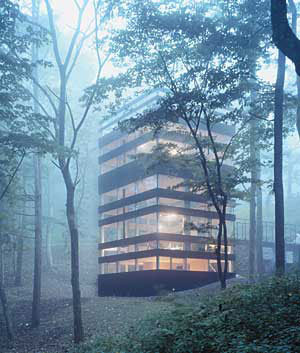

“Despite the flaws, we thought it was a great site,” recalls TNA principal Chie Nabeshima. The 1⁄3-acre property was not merely large by Japanese country-house standards, but also dotted with pine, cherry, and a host of other trees. Besides, the architects were confident they could make the slanted ground plane work to their advantage. Though code-stipulated setbacks defined the lot’s buildable area, the forest guided the placement of the structure. “We cut down only three trees,” boasts Takei, “the fewest number of any house in this entire development.”
The team created a mini-tower at the maximum height, skinned in alternating bands of wood and glass—an irregularly striped sheath that evenly balances transparency and opacity, acting more like a screening filter than a bona fide barrier. As sunlight floods into the interior by day (or electric illumination glows from within the volume by night), the wrapper allows views straight through the house. With three 20-foot-square floors, including a basement partially embedded in the hillside, the architects provided entrances at the lowest and middle levels.
PeopleOwner:
Hill Karuizawa Architect:
Makoto Takei & Chie Nabeshima Assistant: Ryousuke Fujitani Engineer(s): Structural engineers: Akira Suzuki /ASA Assistant: Yuuki Kuroiwa Consultant: Lighting: Masahide Kakudate/Lighting Architect & Associates General contractor:
Niitsu-gumi Co. Photographer(s): Daici Ano
FWD INC.
|
ProductsStructural system
Wooden ramen structure/ Laminated lumber(E170) Exterior cladding
Burnt cedar, Roofing Built-up roofing: Fiber Reinforced Plastics Windows Hiba, pushing out window, Naito Co, LTD Glazing Glass: Pair glass/8mm+air12mm+8mm, Oxa Matex Co,LTD Wall coverings Wall and ceiling, Acrylic Emulsion Paint Resilient flooring Birch flooring floor heater, Tokyo Mokuzai Kigyou Co,LTD Furnishings Tables: dining table L1600/W800/H700(TNA original design) side table 450/H320 (TNA original design) Beech, Koutarou Nakamura Kanako Nakamura/plots Firewood stove: TNA original design, Shinji Kodama/ Sanrinsha Lighting Interior lighting: dining light and stand light, Kunio Satou /Lighting Crew.inc Plumbing Sinks: CATALANO Tubs: KLDEWEI Showerheads/Faucets: CRESTIAL, Tform (Japanese agency) Toilets: SATIS, INAX Co,LTD |
Looking for quick answers on architecture and design topics?
Try Ask RECORD, our new smart AI search tool.
Ask RECORD →
Looking for a reprint of this article?
From high-res PDFs to custom plaques, order your copy today!