Architectural Record
search
cart
facebook twitter linkedin youtube
  • Sign In
  • Subscribe
  • Sign Out
  • My Account
Architectural Record
  • NEWS
    • Latest News
    • Awards
    • Interviews
    • Obituaries
    • Podcasts
      • Design:Ed Podcast
      • Sponsored Podcasts
  • OPINION
    • Book Reviews / Excerpts
    • Exhibition Reviews
    • Forum
  • EXCLUSIVES
    • Videos
    • Design Vanguard
    • Top 300 Firms
    • Sponsored Content
    • Sponsored eBooks
    • From the Archives
  • CONTINUING ED
    • Editorial Continuing Ed
    • CE Center
    • CE Academies
  • PROJECTS
    • Buildings By Type
    • Reuse & Renovation
    • Museums & Arts Centers
    • Colleges & Universities
    • Multifamily Housing
    • Interiors
    • Lighting
    • Kitchen & Bath
  • HOUSES
    • Record Houses
    • House of the Month
    • Featured Houses
  • PRODUCTS
    • Products by Category
    • Record Products of the Year
    • Latest Products
  • EVENTS
    • Dates & Events
    • Record on the Road
    • Innovation Conference
    • Sustainability in Practice
    • Women In Architecture
    • Webinars
    • Ad Excellence Awards
    • Submit an Event
  • CONNECT
    • Ask RECORD AI
    • Newsletters
    • Contact
    • Advertise
    • Editorial Calendar
    • Store
    • Customer Service
  • SUBMIT
    • Submission Guidelines
    • RECORD Competitions
  • MAGAZINE
    • Subscribe
    • My Account
    • Digital Edition
    • Current Issue
    • Firm Pass
    • Historic Archive
Architectural Technology

Behind SANAA's Illusion of Weightlessness

By Joann Gonchar, FAIA
0803
March 16, 2008

Now that the New Museum on Manhattan’s Lower East Side is complete, and its structure enclosed, there is little evidence of the system that supports the seven-story building that seems to be made up of nothing heavier than precariously stacked cardboard boxes. But here and there, through its expanded metal-mesh facade, and from behind windows, architects Kazuyo Sejima and Ryue Nishizawa of Tokyo-based SANAA have provided an occasional glimpse of a diagonal brace.
0803
Diagrams courtesy Guy Nordenson and Associates

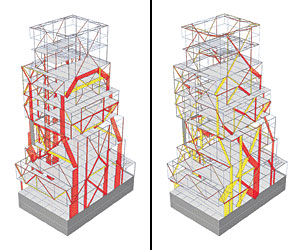
The engineers analyzed the structure to understand how it would react to conditions such as gravity loads (above left), or lateral loads from the east (above right). The red members are in compression, while the yellow are in tension.

The diagonals are part of story-deep perimeter trusses devised by engineers Mutsuro Sasaki from Tokyo and New York City–based Guy Nordenson, with the Manhattan office of Simpson Gumpertz & Heger [SGH] as structural engineer of record. These trusses are the primary components of the gravity- and lateral-load-resisting system for the $50 million museum, open since December. By “wrapping forces around corners,” explains Nordenson, the trusses permit the museum’s volumes to shift relative to one another, allow perimeter skylights at setbacks, and provide column-free galleries spanning up to 40 feet.

Most of the stacked boxes shift in only one direction relative to the one below. There is an exception, however: The third floor slips diagonally, allowing for skylights at both the west and north edges of the second floor. In the early stages of design, this setback was supported by a truss exposed on the interior that crossed the northwest corner of the gallery. But the condition later seemed out of place to the engineers, so they eliminated the truss and instead used the core and the side truss walls to anchor the cantilevered street-facing wall, creating what Nordenson refers to as the “floating corner.”

The team meticulously analyzed the whole structure to understand how to resolve and resist various loads, but this area was particularly challenging. The engineers needed to ensure sufficient strength and stiffness and carefully plan the sequence of construction, says Kevin Poulin, SGH senior project manager.

Two levels above this seemingly floating element, another detail gives the impression that the building is made up of little more than paper. Here, the volume housing the fifth-floor education center slides to the north creating an exterior overhang. This level has a stepped slab and a partial raised floor, providing a very practical cavity for computer terminal cabling. But viewed from the exterior, the underside of the overhang seems to be at exactly the same level as the top of the slab, creating the illusion that the building envelope has no thickness. Of course, Sejima and Nishizawa, the architects of the Glass Pavilion at the Toledo Museum of Art, in Ohio, are known for their fascination with lightness and immateriality. Nordenson, also part of the pavilion’s design team, jokes that “Sejima and Nishizawa can never have things too thin.”


Looking for quick answers on architecture and design topics?
Try Ask RECORD, our new smart AI search tool.
Ask RECORD →

KEYWORDS: New Museum New York City

Share This Story

Looking for a reprint of this article?
From high-res PDFs to custom plaques, order your copy today!

Joann gonchar

Joann Gonchar, FAIA, LEED AP, is deputy editor at Architectural Record. She joined RECORD in 2006, after working for eight years at its sister publication, Engineering News-Record. Before starting her career as a journalist, Joann worked for several architecture firms and spent three years in Kobe, Japan, with the firm Team Zoo, Atelier Iruka. She earned a Master of Architecture degree from the University of Pennsylvania and a Bachelor of Arts from Brown University. She is licensed to practice architecture in New York State.

Post a comment to this article

Report Abusive Comment

Subscription Center
  • Create an Account
  • Start a Subscription
  • Manage My Account
  • Sign Up for Newsletters
  • Visit Customer Service
  • Update Preferences

More Videos

Sponsored Content

Sponsored Content is a special paid section where industry companies provide high quality, objective, non-commercial content around topics of interest to the Architectural Record audience. All Sponsored Content is supplied by the advertising company and any opinions expressed in this article are those of the author and not necessarily reflect the views of Architectural Record or its parent company, BNP Media. Interested in participating in our Sponsored Content section? Contact your local rep!

close
  • TAMLYN XtremeTrim Exterior Trim
    Sponsored byTamlyn

    Designing Cleaner Panel Facades: Why Exterior Trim Details Matter

  • Building with Vapor Barriers
    Sponsored byReef Industries, Inc.

    Vapor Barriers Help Control Moisture in Tighter Building Designs

  • Duct Interior with Prodeq System
    Sponsored byHenry, a Carlisle Company

    Designing Resilient Water Containment Systems

DESIGN:ED Podcast
Listen to Architectural Record’s DESIGN:ED Podcast

Events

June 10, 2026

Rethinking Stormwater – The Power of Porous Paving

Credits: 1 AIA LU/HSW; 1 AIBD P-CE; 0.1 ICC CEU

Learn how porous paving systems support stormwater management, reduce heat island effects, and enhance sustainable site design performance.

June 11, 2026

Very Early Warning Fire Detection for Mission-Critical Facilities

Credits: 1 AIA LU/HSW; 1 AIBD P-CE; 0.1 ICC CEU

Examine advanced fire detection strategies that support uptime and enhance safety in data centers and other mission-critical facilities.

View All Submit An Event

Products

2026 Architect's Square Foot Costbook

2026 Architect's Square Foot Costbook

See More Products

Popular Stories

Practice Matters illustration

What’s in a (Firm’s) Name? Thinking About Succession and Legacy

Practice Matters illustration

By the Numbers: Counting America's Architects

House on a Hill

Design Vanguard 2026: Forma

Crane Cove, ONO

Design Vanguard 2026 Winners

House A on a Hill

Design Vanguard 2026: Santiago Valdivieso

Broader Sustainability of CMU - Free Webinar - May 21, 2026

Related Articles

  • Art Gallery of New South Wales

    SANAA’s New Sydney Landmark at the Art Gallery of New South Wales

    See More
  • Light Fall

    In a New York Office Building, Loisos + Ubbelohde’s Fiber-Optic Sculpture Glows with the Light of the Sun

    See More
  • 270 Park Avenue

    With 270 Park Avenue, Foster + Partners Creates the Workplace of the Future for JPMorgan Chase

    See More

Related Products

See More Products
  • 1118522532.gif

    Future Details of Architecture

  • reuse.jpg

    Resource Salvation: The Architecture of Reuse

  • Architectural Record - February 2026

    Architectural Record February 2026 Issue

See More Products
×

The latest news and information

#1 Source for Architectural Design, News and Products

SUBSCRIBE
  • RESOURCES
    • Advertise
    • Contact Us
    • Submit
    • Store
  • ACCOUNT CENTER
    • Create an Account
    • Start a Subscription
    • Manage My Account
    • Sign Up for Newsletters
    • Visit Customer Service
    • Update Preferences
  • PRIVACY
    • PRIVACY POLICY
    • TERMS & CONDITIONS
    • DO NOT SELL MY PERSONAL INFORMATION
    • PRIVACY REQUEST
    • ACCESSIBILITY
  • SERVICES
    • Marketing Services
    • Reprints
    • Market Research
    • List Rental
    • Survey/Respondent Access
  • STAY CONNECTED
    • Linkedin
    • Facebook
    • Instagram
    • YouTube
    • X (Twitter)

Copyright ©2026. All Rights Reserved BNP Media, Inc. and BNP Media II, LLC.

Design, CMS, Hosting & Web Development :: ePublishing