Toyo Ito Libraries in Japan and Taiwan
The Pritzker Prize-winning architect entices visitors to both explore and linger at a pair of libraries in different countries.
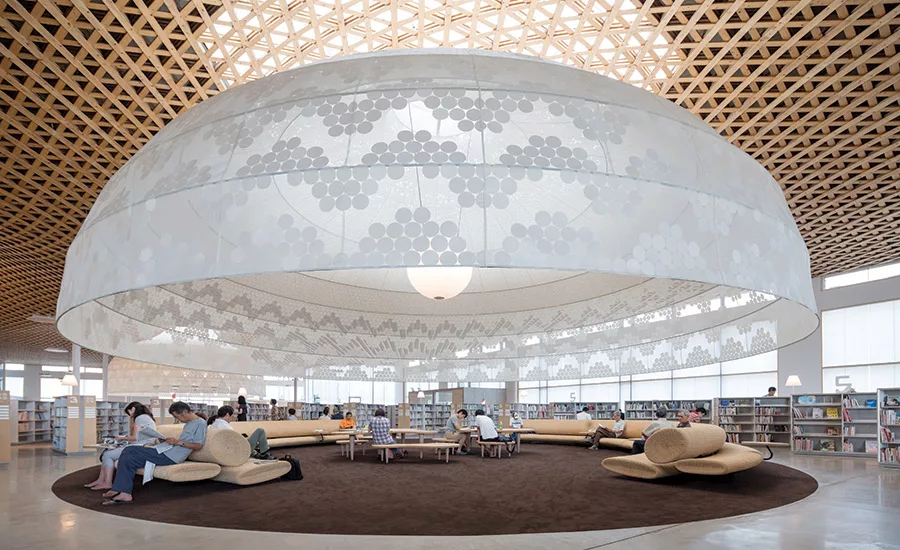
Each library is essentially one large room topped by a soaring ceiling. Hanging from a wavy wood roof, lightweight domes define functional areas at the Gifu Media Cosmos in Gifu, Japan.
Photography © Iwan Baan
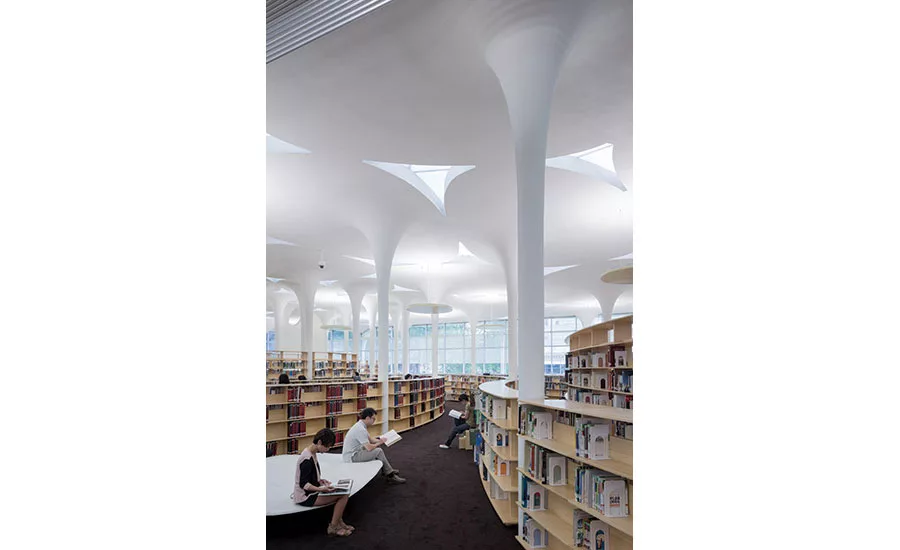
Column placement determines open seating areas at the National Taiwan University College of Social Sciences in Taipei, Taiwan.
Photography © Iwan Baan
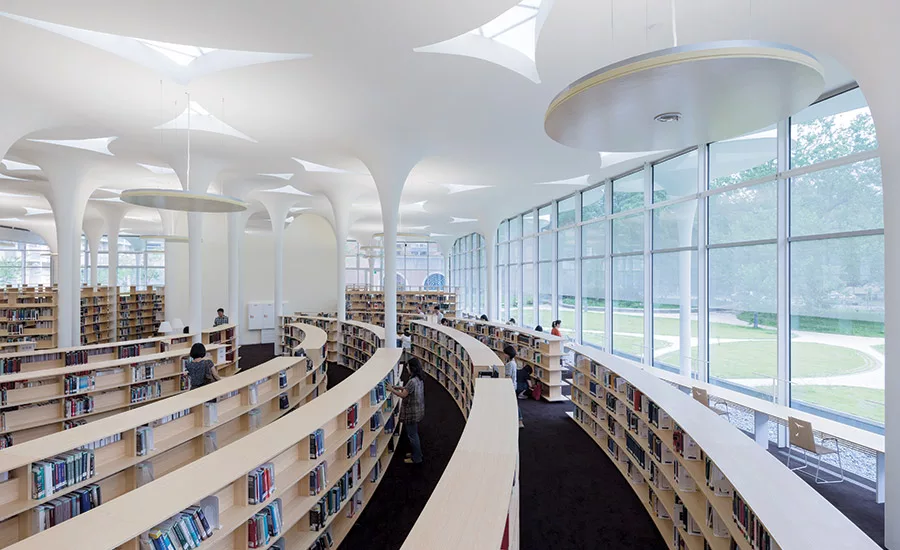
Glass and polycarbonate inserts between the capitals bring daylight into the reading room.
Photography © Iwan Baan
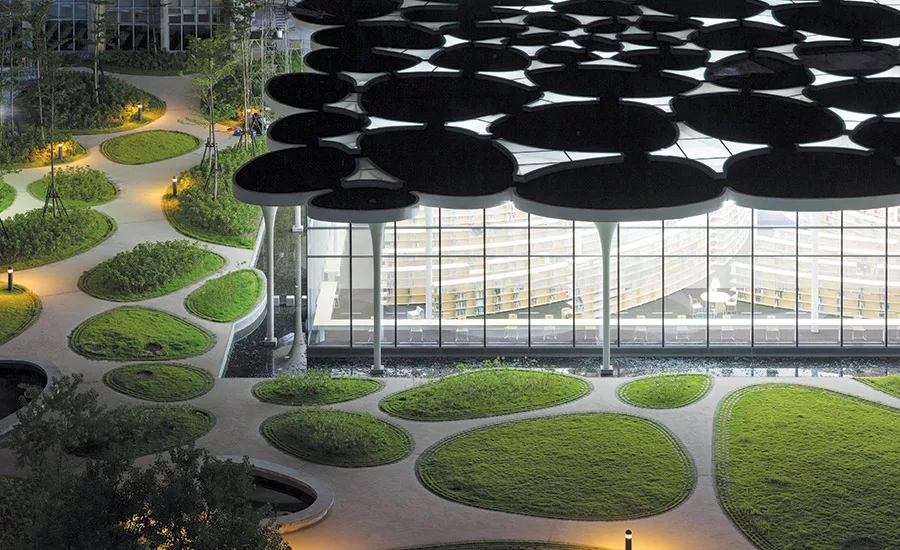
Blurring the line between inside and out, flaring capitals double as roof slabs and extend past the Taipei building’s glass skin.
Photography © Iwan Baan
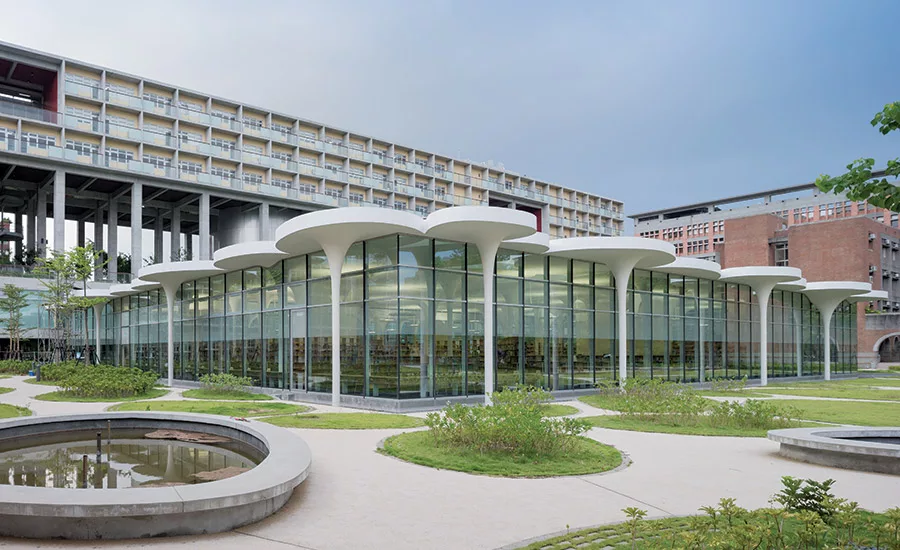
Blurring the line between inside and out, flaring capitals double as roof slabs and extend past the Taipei building’s glass skin,
Photography © Iwan Baan
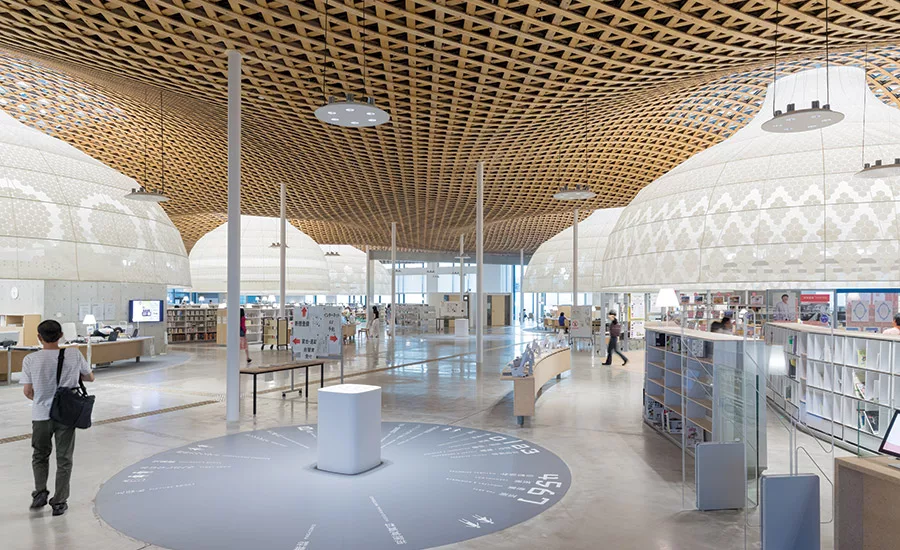
Made of polyester mesh supported by glass fiber reinforced plastic rings, the domes in Gifu are adorned with patterned appliqués created by graphic designer Kenya Hara and textile designer Yoko Ando.
Photography © Iwan Baan
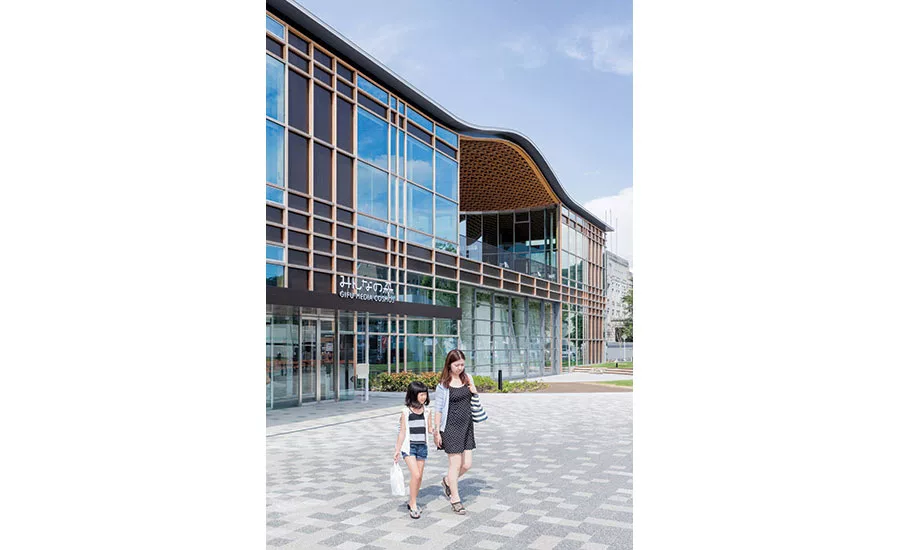
Extending beyond the exterior walls, the woven ceiling covers terraces on the building’s front and east sides.
Photography © Iwan Baan
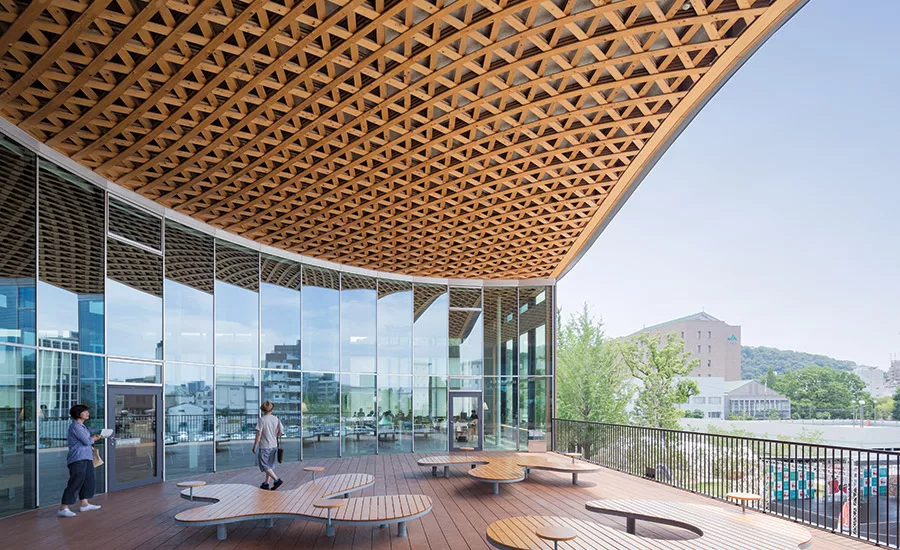
Extending beyond the exterior walls, the woven ceiling covers terraces on the building’s front and east sides.
Photography © Iwan Baan
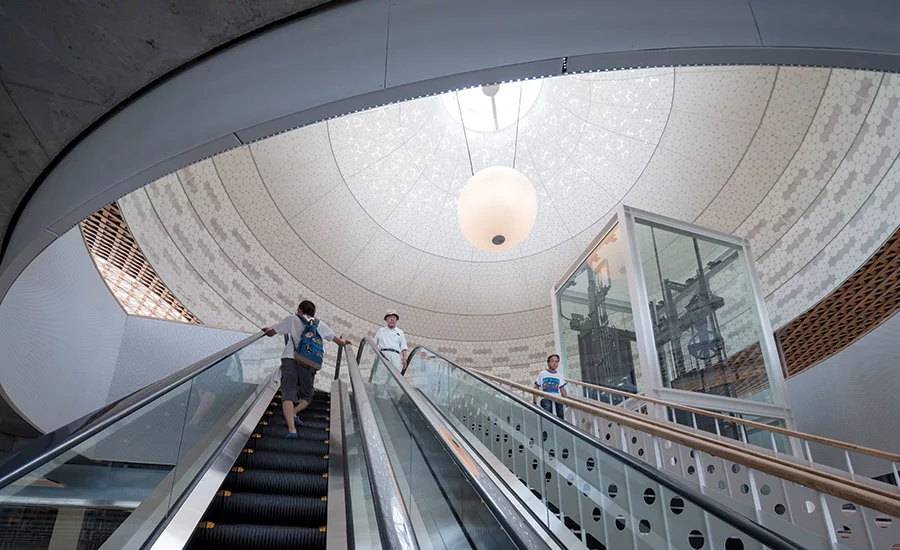
An escalator leads to the library on the second floor.
Photography © Iwan Baan
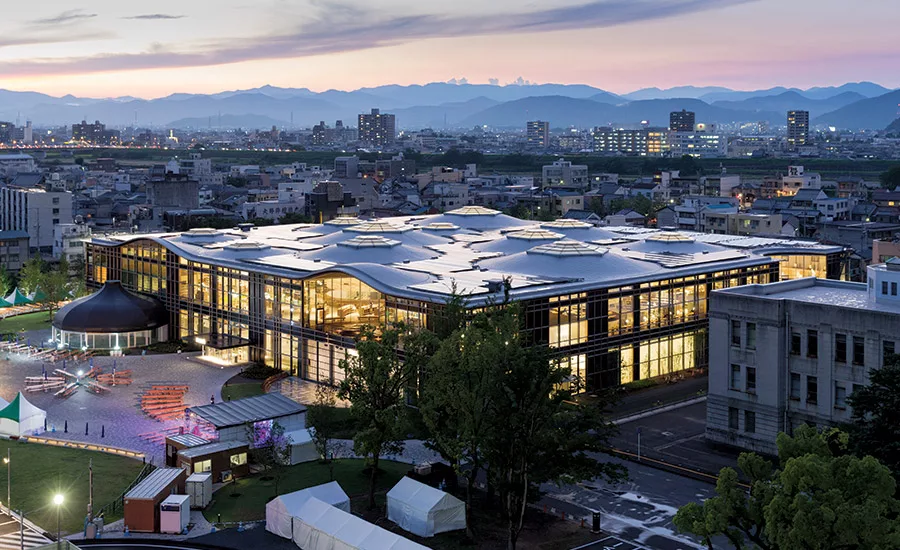
At dusk, the Gifu building glows like a lantern.
Photography © Iwan Baan
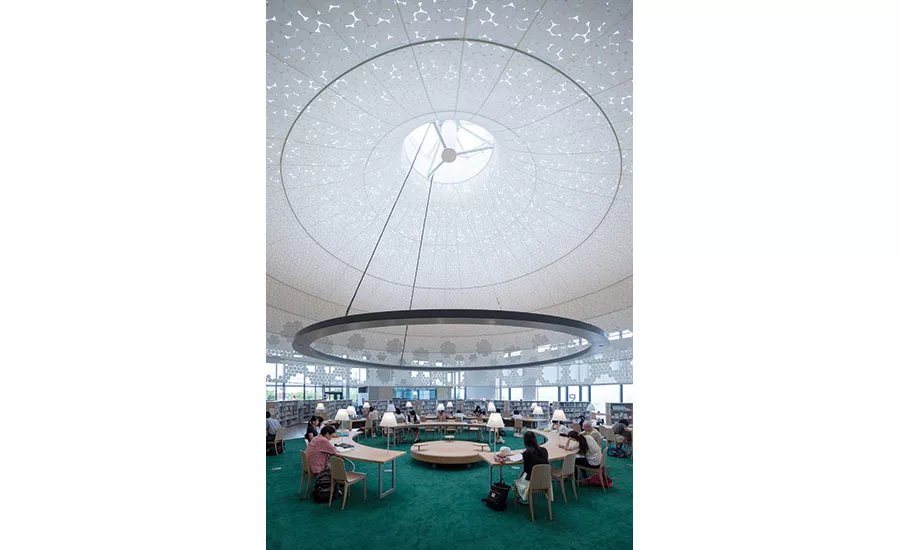
Inside, domes reflect daylight onto the ceiling, while suspended fixtures provide electric light to particular spaces, such as a reading area. Ito created the furnishings with designer Kazuko Fujie.
Photography © Iwan Baan
Architects & Firms
National Taiwan University College of Social Sciences, Taipei
Gifu Media Cosmos, Gifu City, Japan
With the proliferation of digital data, the private laptop has been taking a toll on the public library. But two recent buildings by the Pritzker Prize laureate Toyo Ito suggest that the traditional typology is not heading for the archives anytime soon. “In terms of public facilities, the library is actually quite a contemporary building type,” says Ito. The Tokyo-based architect’s library at the National Taiwan University College of Social Sciences in Taipei and the Gifu Media Cosmos in Gifu City, Japan, are as much communal gathering places, where people interact face-to-face, as places to gather information.
Celebrating the bound book, these two libraries refuse to kowtow to the ever-changing landscape of electronic media. In both buildings, visitors may come with particular quests in mind, but the flowing space, easy shelf access, and inviting furniture entice them to stay longer, search deeper, and mix with others. Yet the architectural expression of both buildings is forward-looking, even futuristic. Their defining elements—sensuously funnel-shaped columns in Taipei and softly patterned suspended domes in Gifu—effortlessly mask underlying geometric complexity. That’s not surprising from the designer of the Sendai Mediatheque, the multistory media center in Japan that blended structure and design in an entirely unprecedented way. Opened in 2000, that building features irregularly shaped, eccentrically placed hollow columns that serve as structural elements, but also connect floor levels vertically and channel circulation horizontally.
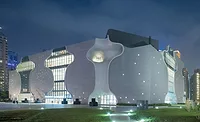
As in Sendai, columns dominate the library in Taipei, a single-story structure designed in tandem with an eight-story bar building directly behind it. The taller building holds teaching facilities and forms the fourth side of an enclosed courtyard whose centerpiece is the jewel-like library. Embedded in and entered through the classroom building, the library greets visitors with its information and digital media sections, where computers provide access to the Internet and the university’s growing digital resources. Next come study and storage areas housed in a single glass-encased room. The main space is articulated by columns and arc-shaped bookshelves; the only full-height dividers are the freestanding wall panels for lateral bracing.
Supporting the vertical load, the reinforced-concrete columns measure 10 inches in diameter and 20 feet in height, and are arranged using a double-spiral algorithm. “Usually columns are organized with an orthogonal grid, but here we wanted a more natural way,” explains Ito. So the column plan propagates from three centers in the ground plane, each one encircled by five points. From every point, two sets of curved lines extend outward in opposite directions, as if tracing the petals of a lotus flower. Ito placed columns at their cross points. As the lines spin outward, the distance between intersections grows, and the concentration of columns disperses, creating pockets of open space reminiscent of clearings in a forest.
Overhead, the columns culminate in flared capitals that spread like tree canopies. Though they invite comparison with the circular capitals in Frank Lloyd Wright’s Johnson Wax Building, Ito’s versions are organically shaped and positioned off-center in relation to the columns. The quirky forms of these mini-roofs stem from a Voronoi diagram used to divide the ceiling space evenly among trios of adjacent columns. Between slabs, laminated-glass and polycarbonate inserts admit soft daylight from above.
Each roof pad is topped with artificial turf, relating the architecture to the landscape. Beyond the building envelope, patches of grass dotting the ground plane extend the roof’s cell-like pattern into the courtyard. As at Mediatheque, glass walls define the perimeter of the library’s rectilinear volume. “It was simply cut to fit the site,” says Ito. Together, the continuation of the greenery and the clear enclosure merge inside and out, an idea the architect pushed even further at Gifu.
For Ito, creating indoor space with an outdoor character is a recurring theme. But at Gifu, he not only evoked the natural environment, he actually brought it inside, through a permeable skin and an assertive energy conservation agenda. A hybrid municipal building, it contains a variety of public amenities on its ground floor, including galleries, a lecture hall, and a civic activity center, as well as the library upstairs. Again, the library is one large reading room, but this time it is supplemented with additional stacks contained within a transparent, two-story open glass box. Embedded in the center of the rectangular floor plan on both levels, it makes a bold visual statement that places books at the heart of the building.
Looking for quick answers on architecture and design topics?
Try Ask RECORD, our new smart AI search tool.
Ask RECORD →
Within the reading room, 11 suspended domes designate the library’s subject and functional divisions. Though all of the domes start 8 feet from the floor, they vary in height and range in diameter from 26 to 46 feet. The smallest ones hover protectively over the children’s sections, while the biggest ones cover the literature and entrance areas. Made of lightweight polyester mesh adorned with bold graphics, the domes are topped by operable skylights. Working in conjunction with the building’s operable transom windows, as well as doors that open onto terraces and covered porches, the openings release hot air in summer, contain it in winter, and fill the room with daylight year-round. Additional energy savings come from using the site’s underground water for the radiant heating and cooling system.
Below the domes are open areas, many ringed with desks or seating. Spiraling out beneath the domes, wooden bookshelves have concrete tops to prevent the spread of flames in case of fire. Ito chose concrete, too, for columns downstairs, and steel for the ½-inch-thick shear panels embedded in the exterior walls and columns upstairs. Positioned in relation to the domes, these slender supports, 7 inches in diameter, practically disappear into the woodwork–especially the building’s distinctive woven ceiling.
Designed to harmonize with mountains in the distance, the ceiling is made with layered strips of local cypress arranged in a triangulated pattern. The undulating form, which behaves like a shell structure, is expected to hold up well in an earthquake, yet over half of its area is actually flat, since the ceiling only rises up around the domes. Like periods at the ends of sentences, the domes punctuate the space, while the dynamic ceiling conveys a sense of movement that extends out to the terraces.
For an architect known for slender proportions and sharp edges, as exemplified by the library in Taipei, wood is an unlikely material of choice. Yet the Great East Japan Earthquake of 2011 has had a profound impact on Ito’s architecture in the blighted region and elsewhere. Considering the area’s survivors’ comfort, he used this warm and familiar material in his reconstruction projects. Those works dovetailed with the Gifu library, commissioned just a month before the tragedy. Open and inviting, a library built with timber expands our understanding of this typology. More than a receptacle for books, it demonstrates the timeless value of community-oriented buildings, even as technology zooms ahead.
Looking for a reprint of this article?
From high-res PDFs to custom plaques, order your copy today!