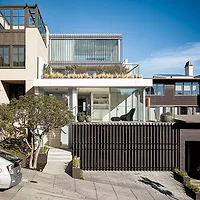
Close up: David Ireland's 500 Capp Street Project by Architectural Resources Groups and Jensen Architects
San Francisco
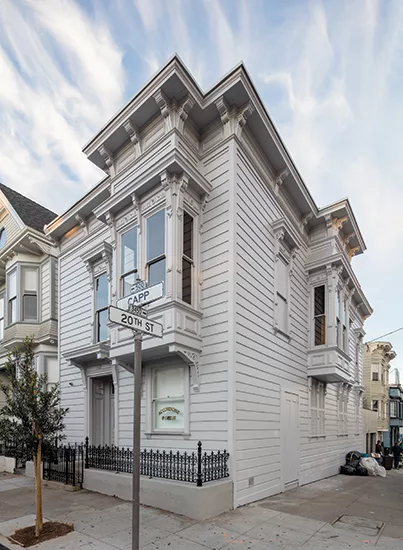
The house as seen from the corner of Capp Street and 20th Street.
Photo © Henrik Kam
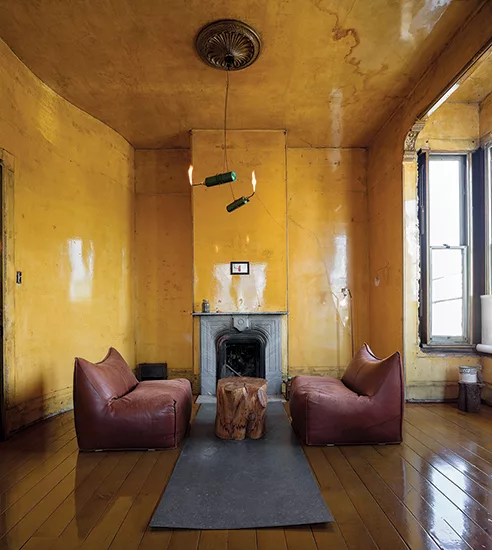
The living room features custom-made couches, a blowtorch chandelier, and honey-colored polyurethaned walls.
Photo © Henrik Kam
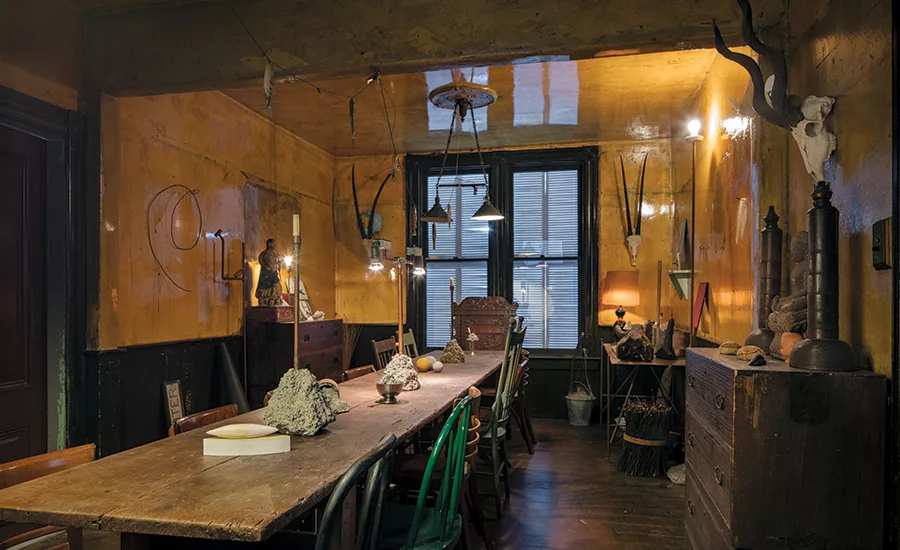
The dining room with animal skulls is “everybody’s favorite” room.
Photo © Henrik Kam
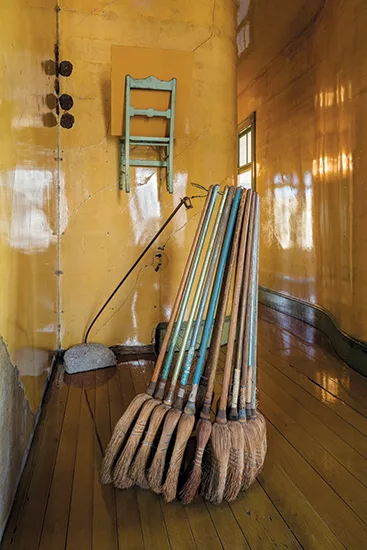
A hallway is animated by a sculpture David Ireland made of brooms found on the premises.
Photo © Henrik Kam
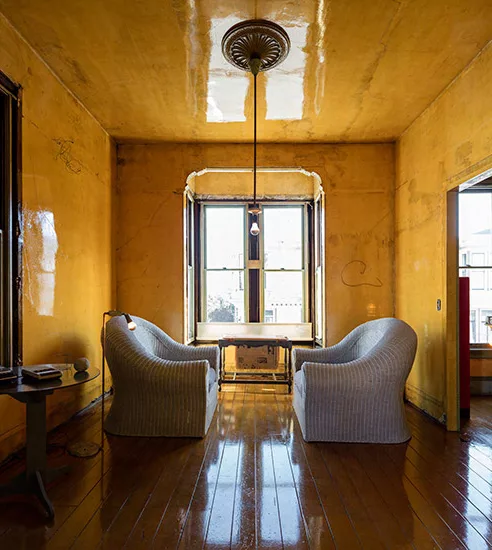
The front parlor, with South China Chairs.
Photo © Henrik Kam
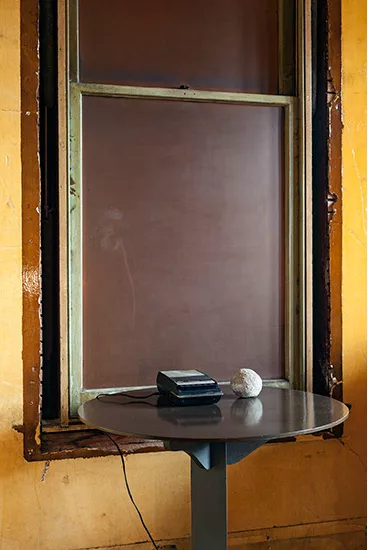
Some of Ireland’s installations become part of the architecture, such as Copper Window (circa 1978).
Photo © Henrik Kam
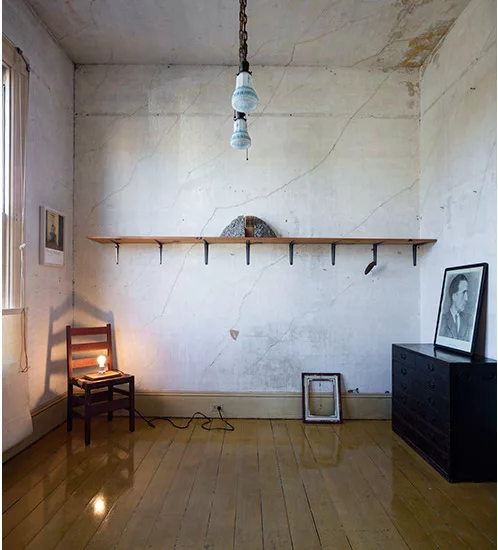
A second floor rear room.
Photo © Henrik Kam
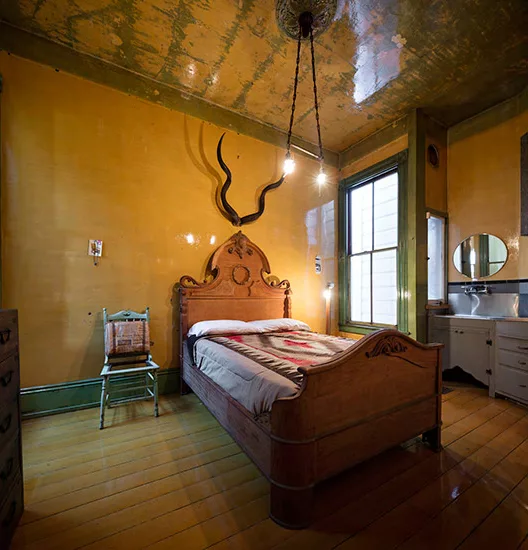
Bedroom.
Photo © Henrik Kam
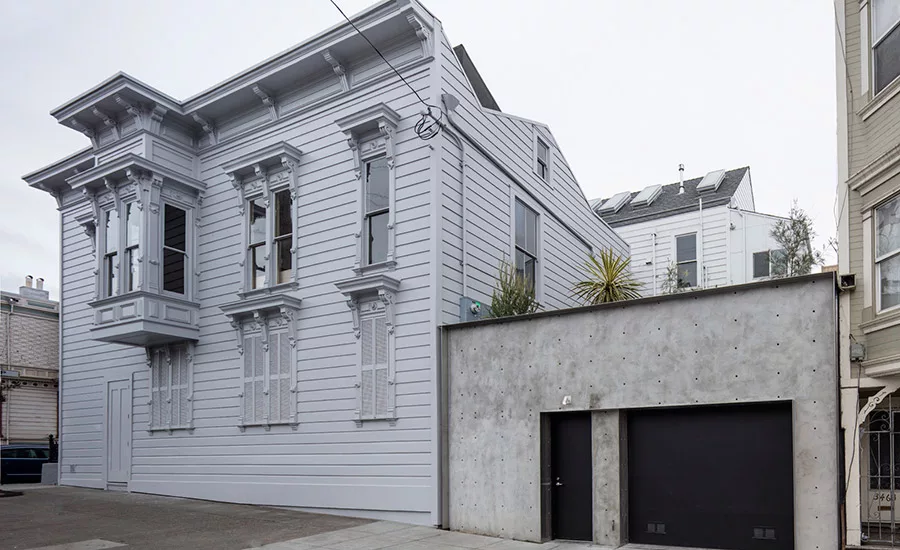
Jensen Architecture’s addition at the back of the house contains an archive and gallery space, with a rooftop deck.
Photo © Henrik Kam
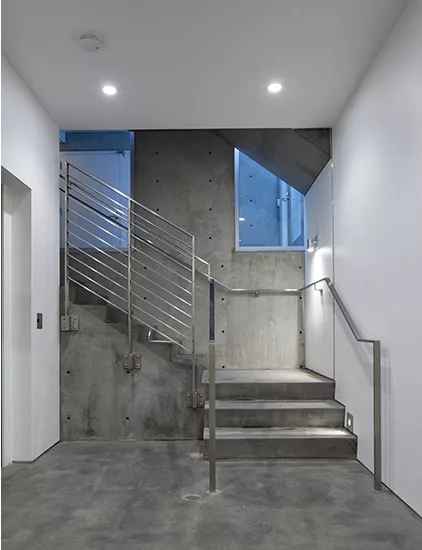
A stair in the new addition leads down to the archive.
Photo © Henrik Kam
It’s like restoring a pair of carefully distressed Levi’s,” said someone who’d been given a preview tour of David Ireland’s 500 Capp Street Project, where a thorough restoration and addition have just been completed. “You don’t want to take them back to their original state, but you do want to shore them up enough so that there’s no unintended further changes.”
Additional Content:
Jump to credits & specifications
Ireland’s Gesamtkunstwerk—or “total work of art”—is an 1886 wood frame Victorian house in the Mission District of San Francisco, purchased by the artist in 1975 for $50,000 and then lived in and worked on for most of the rest of his life. (He died in 2009, at the age of 78.) Ireland adhered to an artistic philosophy of, “Why do we have to fabricate a stretcher, a canvas—why not just make art out of an environment?” He was a conceptualist just a material step or two this side of compatriot Tom Marioni, whose 1970 work of social art, “The Act of Drinking Beer with Friends is the Highest Form of Art,” is still a weekly event in the city. Ireland not only transformed his house into an enveloping and ongoing metasculpture, but also made it a gathering spot for local artists, and even opened it to the public in 1978.
Moving to the Bay Area from his birthplace in Bellingham, Washington, Ireland earned a bachelor’s degree from the California College of Arts and Crafts (now without “Crafts” in its name) in 1953. After serving as a draftee in the army, he traveled extensively in Europe and Africa and, returning to Bellingham, set up an imported-artifacts business called Hunter Africa. The 6-foot-5 Ireland, who led safaris for several years (Henderson the Rain King comes to mind), spent a year or so in New York painting Minimalist canvases along the lines of early Brice Marden, then came back to San Francisco to get an MFA from the San Francisco Art Institute (SFAI), a school practically synonymous with obliterating artistic boundaries.
Solid enough to have survived the 1906 earthquake, 500 Capp Street would later withstand the 1989 temblor. Ireland, a professional-grade carpenter, initially set about making the house more livable, but with his polymath’s temperament and SFAI-nurtured outlook on art as infinitely expandable, began to turn the whole house into a work of art.
The artist peeled off multiple layers of paint and wallpaper, right down to the plethora of cracks and pits in the plaster, which he then lovingly— some might say perversely—preserved with coats of polyurethane. (Being inside this golden-walled house feels like swimming in a jar of honey.) He removed baseboards and the trim around windows but left the exposed sash weights and much of the original ripply glass. When accidents happened— such as heavy exiting objects crashing into a wall—he honored them with plaques: “The Safe Gets Away for the First Time, November 5, 1975”; “The Punch Press is Dragged Away, November 5, 1975.” Ireland added his own offbeat works of art: a blowtorch chandelier, a cement-and-wire sculpture that’s either van Gogh’s ear or a map of Africa or both, a semiwearable gown made out of brooms that he found in the place, and an apparently unironic shrine to Natalie Wood.
The dining room—everybody’s favorite—boasts a long, roughhewn table at which the artist’s friends sat for countless dinners, amidst a surround of animal skulls, totems, memorabilia, and photos. Because of health problems, Ireland left the house in 2005, and 500 Capp Street remained practically untouched until it was purchased three years later for $895,000. It was a bit of a philanthropic whim on the part of Carlie Wilmans, granddaughter of legendary San Francisco art benefactor Phyllis Wattis. Wilmans, who admired Ireland and wanted to save the house from destruction by developers, set up a charitable foundation.
She then engaged San Francisco–based conservation firm Architectural Resources Group and Jensen Architects to keep the place from falling down and to preserve it as a major work of art that arguably ranks right up there with Kurt Schwitters’s various Merzbau (room-size abstract sculptural environments) and Simon Rodia’s Watts Towers. View additional content at architecturalrecord.com. Predictably, says Jensen principal Dean Orr “the paperwork was a long process, and, because the structure was deemed a historic resource, there was an additional layer of review.”
Surprisingly, bringing the building up to code was not as arduous as it could have been; the plumbing and wiring were in fairly good shape, say the architects, and only the addition of a wheelchair-accessible elevator from the kitchen to the basement required a variance. The foundation was the biggest challenge, largely because Ireland’s excavations beneath the house left it sitting atop unstable bricks. Since the house couldn’t simply be lifted on cribbing, workers had to remove dirt by hand until they could get a small backhoe underneath and put in temporary shoring.
The new concrete foundation was poured in sections that hopscotched around the perimeter until they all connected. Meanwhile, everyone crossed their fingers against even the smallest earthquake. The architects then repaired some of the wood framing (going voluntarily beyond code mandate), inserted adhesive between the lath and plaster, and installed waterproofing.
The most visible contribution—to a project in which the invisibility of post-Ireland improvements is its signal virtue— is Jensen’s gorgeous, minimal concrete-and-steel addition at the back, which houses a small gallery displaying some of Ireland’s hand-drawn floor plans, a basement archive and office, and is topped by a small deck Preservation was just as touch-and-go. All the movable art—some of it only marginally more portable than the safe and punch press—was packed and taken off-site. “What couldn’t be moved,” says David Wessel of ARG, “was protected in place.”
Then the conservators dealt with old wood damaged by moisture, and deteriorated windows—leaving the ones where Ireland had simply replaced the glass with metal plates or plywood. The major task, emphasizes Wessel, was restoring Ireland’s variations on the house without disturbing or worsening the original building. In the end, the project was—and this is not an overstatement— a triumph. From the outside, the house is an intact Victorian, with the name of a previous tenant (ACCORDIONS – P. GREUB) still in gold on the front window. Inside, it’s a fascinating amalgam of Duchampian irreverence and the preciousness of Joseph Cornell; 500 Capp Street is a deceptively unmonumental monument to an eccentrically San Franciscan communal aesthetic
CreditsArchitect: Jensen Architects 833 Market Street, 7th Floor San Francisco, CA 94103 T: 415.348.9650 F: 415.348.9651
Personnel in architect's firm who should receive special credit: Principal: Mark Jensen Project Architect: Dean Orr / Steven Huegli
Project Team: Andy Lin, Orit Goldstein-Mayer
Engineers: Structural Engineer: Città Structural Engineering
Consultant: Landscape: 7x7 Construction Conservation Consultant and Contractor: ARG Conservation Services
General contractor: Oliver and Company, Inc.
Photographer: Henrik Kam
|
SpecificationsStructural system Existing House: Wood frame construction New Addition: Cast-in-place concrete/shotcrete and steel
Exterior Cladding Moisture barrier: Grace Preprufe 300R Plus
Windows Metal frame: (Interior) Arcadia storefront system
Doors Metal doors: Stiles Steel Door Systems Fire-control doors, security grilles: U.S. Smoke & Fire – SD60GS Smoke and Fire Door Upswinging doors, other: Roll-up Garage Doors: Americana Garage Doors Manufacturing.
Hardware Locksets: Hagger Mortise Lockset Closers: LCN Concealed Closer Pulls: Hagger William Style Door Handle
Interior Finishes Cabinetwork and custom woodwork: Jensen Architects designed conference table Perimeter counter: Bleached hickory top with powder coated steel legs Shelving: Jensen Architects designed shelving: Bleached hickory Shelving standards: Rakks “C” style wall mounted standard, clear anodized aluminum.
Paints and stains Interior: Benjamin Moore Aura Interior Paint (Egg Shell, Super White) Exterior: Benjamin Moore Aura Exterior Paint (Satin, Custom Ireland Grey)
Special interior finishes unique to this project: Ground/polished concrete slab
Furnishings Office furniture: Jensen Architects Designed conference table, built-in perimeter counter and shelving. Fabricated by METRO Caseworks.
Lighting Interior ambient lighting: RESOLUTE Solutions Purity Ceiling/Wall 6” RESOLUTE Solutions Purity Rigid Drop BIRCHWOOD LIGHTING Jake Recessed Linear Fluorescent Fixture Downlights: HALO 4-inch LED Recessed Downlight Exterior: No Eight MPT-S Monopoint Surface Mount-Square (LED) B-K LIGHTING Louvered Square Step Star (LED)
Conveyance Elevators/Escalators: GARAVENTAL LIFT Elvoron LU/LA
Plumbing W.C.: American Standard Madera FlowWise 1.28 GPF Lavatory + Faucet: Salvaged from demolished upper level bathroom
|
Looking for a reprint of this article?
From high-res PDFs to custom plaques, order your copy today!