The Linde Center for Global Environmental Science by Architectural Resources Group
Pasadena, California


Architects & Firms
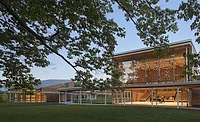
When California Institute of Technology (Caltech) officials decided to renovate an elegant Spanish Colonial Revival laboratory building and make it into a center for climate-change research, they were determined to create a facility that reflected the ideals of its occupants. For the Linde Center for Global Environmental Science, they decided to go beyond LEED Gold certification, the campus standard for new construction. They set their sights on Platinum, a level of certification that the designers maintain is unprecedented for the rehabilitation of a historic laboratory building.
Additional Content:
Jump to credits & specifications
The $25 million project, completed in January 2012, preserves the character and fundamental organization of the 45,000-square-foot former home of the university's astronomers and astrophysicists, with its two stories of public spaces and faculty offices above three levels of below-grade laboratories. The 1932 structure designed by Mayers, Murray & Phillip, a successor firm to Goodhue Associates (the architect responsible for many of the buildings on Caltech's predominantly Mission-style Pasadena campus), now serves as a model of energy efficiency.
After housing the astronomers for nearly eight decades, most of the building's important original features were 'tired' and worn, although largely intact, says Aaron Hyland, a principal with Architectural Resources Group (ARG), the San Francisco firm that led the renovation. ARG called for careful patching, cleaning, and refurbishment of elements such as the handsome stucco-and-cast-stone facades, with ornament alluding to the sun and the stars, and a groin-vaulted corridor with original brass and frosted-glass pendant light fixtures. The firm also devised sensitive insertions including floor-to-ceiling glass partitions that transform a former library into a pair of seminar rooms without disturbing distinctive elements like a stenciled barrel-vaulted ceiling made of board-formed concrete.
The subterranean research spaces, on the other hand, required a complete overhaul. Haphazard modifications had left the laboratories with circuitous circulation and very low ceilings. 'They felt like caves,' says Paul Wennberg, a Caltech professor of atmospheric chemistry.
Even in its pre-renovated state, Linde possessed several qualities that would help it meet Caltech's ambitious performance targets, according to team members. They cite inherently sustainable features common in buildings constructed before World War II, including the significant thermal mass provided by its concrete structure, which reduces peak cooling and heating demands, and the deeply recessed windows, which make up only about 15 percent of the building envelope and help mitigate solar gain. As part of the renovation, designers have retained the windows' historical steel casement frames, but have improved the glazing's shading coefficient and its visible-light transmittance by replacing the original single-pane glass with laminated glass. In addition, the team added interior light shelves to the windows — a feature intended to create the effect of a baseball cap, says George Loisos, principal of Alameda, California-based Loisos + Ubbelohde, the project's daylighting consultant. Their purpose is to reduce glare rather than bounce daylight farther into the room, he explains.
The glazing's performance still isn't optimal from a thermal standpoint, says San Francisco-based Peter Rumsey, managing principal of Integral Group, the project's mechanical and plumbing engineer. 'But there isn't very much of it.'
Linde's most unusual original feature is its coelostat (pronounced seel-o-stat), an astronomical instrument with flat mirrors that turn slowly to reflect a beam of light continuously into a fixed telescope. (Such a device produces a stationary image of the sun and differs from a heliostat, which creates a rotating image.) But by the time the astronomers moved out of the building, the apparatus, which sits on the roof under a domed enclosure, hadn't been used for at least two decades, and there was no longer anyone on campus with the expertise to operate it. The new occupants wanted to remove the apparently obsolete device and increase available floor area by demolishing the coelostat's approximately 8-foot-diameter octagonal shaft that extends from the roof and through the structure.
But the design team lobbied hard for retaining the solar telescope, since it had been integral to the original program, eventually convincing the client to return the apparatus to working order. 'The story of the coelostat is part of the story of the building,' says Loisos, who helped design the coelostat's overhaul. He adds that Linde had also served as the base for the development of the famous 200-inch Hale Telescope at the university's Palomar Observatory, near San Diego. And at one time, the building's roof had housed several other historically significant instruments for study of the heavens, including a working 1:10 prototype of the Hale Telescope under a second dome.
The now-refurbished coelostat is used to produce a real-time image of the sun through a window into the part of the shaft that runs through the library. Here the image, created by means of a 6-inch-diameter telescope and a rear-projection screen suspended in the shaft, serves as an almost 'tactile' reminder of the building's history, says Loisos, who points out that details such as sunspots and the passage of clouds are visible.
The renovated building also includes seven fiber-optic fixtures, designed and built by Loisos's firm, that route the sunlight into the labs. Unfortunately, due to difficulties restoring the coelostat's mirrors and the lingering presence of construction dust, the fixtures are only about half as bright as expected — making them an instructive demonstration of a fiber-optic application but a poor source of general illumination.
Even though the client initially resisted retaining the coelostat, several faculty members have incorporated the device into their research. For example, Wennberg uses the instrument to direct sunlight into a spectrometer in the building's subbasement. He then analyzes the resulting spectra to identify greenhouse gases and other pollutants in the air in the Los Angeles basin.
The project team found other innovative uses for parts of the solar telescope's infrastructure. For instance, a pit that extends the coelostat shaft 60 feet below the lowest laboratory level once housed research equipment now considered unnecessary. The pit has been repurposed as a 60,000-gallon storage tank and incorporated into Linde's mechanical system. The tank holds water that is circulated at night through a rooftop cooling tower to produce medium-temperature chilled water for the building's cooling system without a compressor. In Pasadena's dry climate, the design team estimates, it will be able to keep Linde's occupants comfortable for about half of the year without the need for supplemental cold water from the campus-wide chiller system.
As part of a holistic approach to indoor climate control, the water cooled on the rooftop is delivered to the building's occupied spaces through radiant panels and chilled beams. Because of the reliance on water for cooling, fan energy is required only for moving the air needed for ventilation. And because water is a vastly more efficient medium for transferring heat than air is, Linde's mechanical system occupies far less space than a conventional variable-air-volume (VAV) system and is quieter, explains Rumsey, who estimates that a 1-inch water pipe provides the same amount of cooling as an 18-inch-diameter duct. This space savings is especially advantageous at Linde, where laboratory floor-to-floor heights are only 11 feet 6 inches, compared with a height of about 16 feet for a typical new laboratory building.
The designers have further maximized the available room height by eliminating suspended ceilings in the laboratories and leaving the radiant panels and other utilities and services exposed. The omission of the hung ceilings should also facilitate the inevitable replacement of equipment and the reorganization of the laboratories, points out Wennberg. 'Research is by nature dynamic,' he says.
Linde takes advantage of several nontraditional sources of energy. It has a 100-kilowatt biogas-fired fuel cell — one of several connected to the campus grid — and a 50kW natural-gas-fired fuel cell that serves as a backup power source in case of outages. A 30kW photovoltaic array is also planned for Linde's roof.
Although the building displays a variety of unusual generation sources, the project team and the client focused their attention on reducing the building's power demand rather than increasing supply. Toward that end, Caltech commissioned a study of the building's plug loads (those loads not associated with lighting or the HVAC systems), including those attributed to the lab equipment. 'Typically, this equipment is not ours to design, but these users were very engaged,' says Rumsey.
Working with manufacturers and the client, engineers from Integral Group identified opportunities for replacing some of the less-specialized research-related equipment. For example, they determined that heat exchangers relying on the water chilled by the building's rooftop tower could be substituted for the dedicated chillers for the laboratory's mass spectrometers. By instituting such measures, Linde has already achieved a 40 percent reduction in plug loads in comparison to a typical lab. Rumsey expects an additional 20 percent savings over time as outmoded equipment is gradually replaced with more energy-efficient models.
Taking into account all its conservation strategies, Linde is designed to operate using only about 30 percent of the energy of a typical lab in the same climate zone. The project earned its LEED Platinum designation earlier this year — an achievement that has given Caltech administrators the confidence to consider even more ambitious projects. Bradley Smith, senior project manager for the school's design and construction department, says he hopes to take on the Living Building Challenge — a 'beyond LEED' certification program with a host of tough-to-achieve requirements, including net-zero energy and water operations — for a 250-bed residence hall slated to start construction in 2014.
Completion Date: January 2012
Gross square footage: 45,000
Total construction cost: $25 million
CreditsOwner: California Institute of Technology
Architect: Architectural Resources Group Bruce Judd, FAIA, Partner-in-Charge;
Special Credit for Engineers: Custom Fiberoptic Fixtures: Loisos + Ubbelohde, George Loisis
Engineer(s): Structural Engineer – John A. Martin & Assoc.
Consultant(s): Landscape: Korn Randolph
General contractor: Del Amo Construction
Photographer: David Wakely, 415-861-7503
CAD system, project management, or other software used: Autocad |
SpecificationsRoofing Built-up roofing: GAF Materials Corporation Other: Roof Walkway Pads: John Mansville Windows Metal frame: Torrance 1900 Series
Glass: Exterior: Laminated Clear Glass Units by Glaspro Inc w/ XIR 72-47 Interlayer by Southwall Technologies
Doors Metal doors: Door Components, Inc. Wood doors: Oregon Door Pocket door: Door Components, Inc. Access Doors: KARP Associates Inc. Accordian Door: Modernfold 800M
Hardware Locksets: Accurate Lock and Hardware Closers: LCN and Glynn-Johnson Exit devices: Von Duprin Pulls: Trimco
Interior finishes Acoustical ceilings: Armstrong Suspension grid: Armstrong Plastic Ceiling (Clean Rooms only): KEELGRID Architectural Millwork: JTI Jeffrey Trott Industries, Inc Paints and stains: Sherwin Williams Wall coverings: Tech-Wall Epoxy Resin Flooring: Sika Corporation Floor and wall tile (cite where used): Restrooms: Bow Tile Corp Resilient flooring: Forbo and Mannington Window Shades: MechoShade Systems, Inc. Laboratory Casework: ISEC, Inc. Lighting Interior ambient lighting: Phillips, Elliptipar
Conveyance Hydraulic Elevator: Specialized Elevator Lift Table: Advance Lifts Plumbing Urinal: Zurn
Energy Instrumentation and Control Devices: ControlWorks, Inc.
Other unique products that contribute to sustainability Custom Fiberoptic Fixtures: Loisos + Ubbelohde, George Loisis |
Looking for a reprint of this article?
From high-res PDFs to custom plaques, order your copy today!