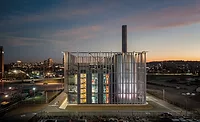
Stanford University Central Energy Facility
Power Play: A state-of-the-art complex fuels a campus while serving as a teaching tool.

A trellis of solar panels shades the building and supplies more than enough electricity for the center’s offices. The lightweight arcade is also a nod to Stanford’s historical quadrangle.
Photo © Matthew Anderson

Three monumental water tanks help store energy that would otherwise be lost.
Photo © Steve Proehl

To protect the hot-water tank, the architects interspersed stainless-steel perforated panels with aluminum ones to create a glittering screen.
Photo © Tim Griffith

The courtyard features a central stair that can be used for gatherings.
Photo © Robert Canfield

The wide landing on the second floor serves as an outdoor meeting area.
Photo © Robert Canfield

Visitors can peer through the glazing at the enormous heat-recovery chillers, painted orange and red to show the change in water temperature.
Photo © Robert Canfield

Image courtesy ZGF Architects

Image courtesy ZGF Architects
Architects & Firms
Palo Alto, California
Stanford University’s Central Energy Facility has a lot of serious technology, but much of it is presented in the lively hues more typical of a children’s museum. Doubling as a teaching tool, the low-slung building showcases the university’s innovative new heating and cooling system with ample glazing and equipment painted in vibrant shades, like orange and aqua, so that visitors can clearly see which parts carry hot water and which ones cold. At night, the bright red surface of a hot-water storage tank is lit so it glows like a giant ember at the heart of the complex.
“We worked to make architecture out of something that, at first glance, didn’t have a lot of potential,” says ZGF principal Toby Hasselgren. “Stanford has an obligation to be efficient and sustainable in its operations, but it also has a mission to educate. Why not do both?” adds Joe Collins, partner at ZGF.
In 2009, the school began considering alternatives to its aging gas-fired power plant. An earlier technology for conserving energy, its cogeneration plant generated electricity and used the by-product heat to warm its buildings. However, a careful analysis revealed that yet more efficiencies could be gained. During much of the year, the campus needed nearly as much heating as it did cooling (since incoming air had to be cooled first to remove humidity and then reheated to comfortable temperatures, particularly at night). This meant that excess heat discharged during evaporative cooling could be reused, instead of lost to the atmosphere. So the school designed an extensive heat-recovery loop, which they say is the first such system on this scale. Reducing the campus’s total energy use by a third, the nearly $500 million system includes a 22-mile network of pipes and three giant holding tanks for hot and cold water. (The university also switched to an off-site solar farm as its primary source of energy.)
Of course, the tanks, related machinery, and offices could have been housed in a nondescript facility. But, given the radical switch in energy use that the project represented, campus architect David Lenox saw the benefit in highlighting it rather than hiding it from view. ZGF, which had previously designed a stem-cell research building at Stanford, was hired to create an appropriately outward-facing design.
On the nearly three-acre site, the architects designed a surprisingly grand complex of buildings organized around the water tanks. The Central Energy Facility faces the main campus to the east and is aligned with its grid. Its centerpiece is the hot-water tank, nearly 70 feet in diameter and protected by a 64-foot-tall screen whose stainless steel and aluminum perforated panels shimmer in the sun. Meanwhile, the two larger cold-water tanks have been lowered 25 feet below grade to reduce their visual impact.
The two main volumes that house the heat-recovery equipment are simple steelframed structures with cast-in-place concrete walls, integrally colored as a nod to the university’s historic sandstone buildings. A welcoming canopy of solar panels, supported by steel pipe columns, unifies the front and wraps around the corner. To the northeast is a two-story, 10,000-squarefoot L-shaped building for staff and visitors. On its ground level, a large conference room, which often serves as the starting point for tours of the facility, doubles as an extra classroom. A courtyard offers another prime spot to congregate, with its bleacher seating looking out onto the hot-water tank. At the top of this stair, a spacious breezeway provides a protected outdoor space for small gatherings and leads to the offices for the 16-person staff, in a narrow, 25-footwide bar with daylight flooding through its glass curtain walls.
The architects’ creative material palette lends the complex a visual richness. The “people” building is clad in weathering steel, a nod to the site’s former agrarian life. The use of maple on the soffits, as well as the cross-laminated timber underpinning the solar panels, provides a warmth and subtly suggests that this is a safe place to be, with no threat of combustible gases. Finegrained metal screening adds a sense of lightness. The two larger cold-water tanks are delicately masked by perforated box-ribbed aluminum, while the courtyard is shielded from the sun by a trellis topped with steel grating. “Power plants are typically the worst part of a campus—they’re ugly and smelly,” says Joe Stagner, executive director of Stanford’s department of sustainability and energy management. “When people come here, they are immediately disarmed. As with the rest of campus, the investment in architecture has helped to make a good impression; it helps to open minds and excite the imagination.”
PeopleArchitect: ZGF Architects LLP 1223 SW Washington Street, Suite 200 Portland, Oregon 97205
Personnel in architect’s firm who should receive special credit: Joseph Collins, partner in charge, FAIA, LEED AP BD+C Toby Hasselgren, senior designer, AIA Renee Kajimoto, project architect, AIA, LEED AP Design Team: Bradley Iest, Glen Justice, Curtis Williams, Sienna Hill, Christopher Flint Chatto, Kelvin Ono, Michael McGale, Nicholas Robertson
Interior designer: ZGF Architects LLP
Prime Contractor/ Lead MEP Engineer: Affiliated Engineers, Inc.
Structural Engineer: Rutherford & Chekene
Civil Engineer: BKF Engineers
Consultants: Landscape: Tom Leader Studio Lighting: Affiliated Engineers, Inc. Acoustical: Colin Gordon Associates, Inc.
General contractor: The Whiting-Turner Contracting Company
Photographers: Robert Canfield Courtesy of ZGF Architects, LLP; © Robert Canfield (415) 897-7636
Tim Griffith Courtesy of ZGF Architects, LLP; © Tim Griffith (415) 642-5740
Matthew Anderson Courtesy of ZGF Architects, LLP; © Matthew Anderson (818) 252-9525 matt@matthewandersonphotography.com
Steve Proehl Courtesy of ZGF Architects, LLP; © Steve Proehl, Proehl Studios 1-800-361-1837
Size: 125,600 square feet (gross)
Project cost: $485 million
Construction cost: $120 million
Completion date: March 2015 |
ProductsStructural system Concrete, steel frame, cross-laminated timber Manufacturer of any structural components unique to this project: Structurlam Products Ltd. (cross-laminated timber)
Exterior cladding Metal Panels: Morin Corp., Metal Sales Metal/glass curtain wall: Walters & Wolf Rainscreen (terra cotta, composite, etc.): Morin Corp., Metal Sales Precast concrete: N/A Wood: Geometrix, TerraMai, Stucturlam Products Ltd (cross-laminated timber) Moisture barrier: Henry Manufacturing, Inc. Curtain wall: Walters & Wolf
Roofing Built-up roofing: N/A Elastomeric: Firestone (Thermoplastic polyolefin roofing)
Windows Metal frame: Walters & Wolf (Curtain wall)
Glazing Glass: Viracon Skylights: Metcoe
Doors Entrances: Walters & Wolf Metal doors: Walters & Wolf Sliding doors: Raumplus North America Special doors (sound control, X-ray, etc.): Olsen Steel, Crown Industrial Supply Inc.
Hardware Locksets: Schlage, Accurate Closers: LCN Exit devices: Von Duprin Pulls: Ives Security devices: Von Duprin, Schlage, LCN
Interior finishes Acoustical ceilings: Armstrong Suspension grid: Armstrong Demountable partitions: Modernfold, Inc. Cabinetwork and custom woodwork: Imperial Woodworking Paints and stains: Sherwin Williams, Benjamin-Moore, TNEMEC Wall coverings: Forbo (Tackboard panels) Paneling: Terramai, Imperial Woodworking Plastic laminate: Formica Solid surfacing: Corian Floor and wall tile (cite where used): Royal Mosa (restrooms and work areas) Carpet: Bentley Mills Special interior finishes unique to this project: Reclaimed wood (Terramai)
Furnishings Office furniture: Knoll Reception furniture: Knoll Chairs: Source, Office Master, Hightower Group, Knoll, Keilhauer Tables: KI, WCI, Inc. Upholstery: Source, Knoll Other furniture: Humanscale, Workrite Ergonomics
Lighting Interior ambient lighting: Lumenpulse, OCL Architectural Lighting Downlights: Essentia Exterior: Gardco Lighting, Luxrail, Selux, Ecosense Lighting Dimming System or other lighting controls: nLight
Conveyance Elevators/Escalators: KONE
Plumbing Sloan, Zurn Products, Kohler
Energy Energy management or building automation system: Johnson Controls
Other unique products that contribute to sustainability: Radiant flooring, operable windows, fans, phase change material in ceiling
Additional building components or special equipment that made a significant contribution to this project: Thermal Storage Tanks (Pacific Tank) |
Looking for a reprint of this article?
From high-res PDFs to custom plaques, order your copy today!