The Ohio State East Regional Chilled Water Plant
Chilling Out: A new chiller facility at Ohio State University satisfies rigorous infrastructure demands while maintaining a delicate presence on campus.
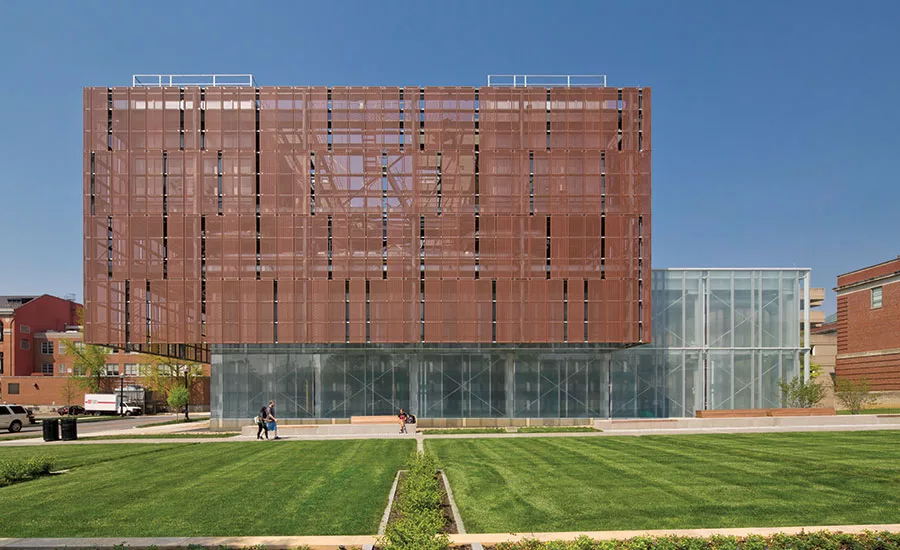
At once a piece of infrastructure and a campus gateway, OSU’s East Regional chiller is composed of two airy volumes.
Photo © Brad Feinknopf
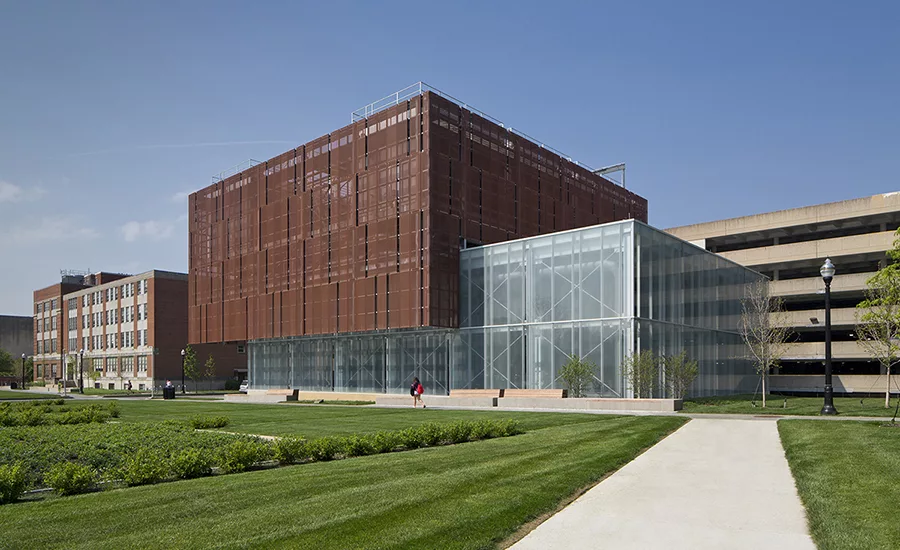
At once a piece of infrastructure and a campus gateway, OSU’s East Regional chiller is composed of two airy volumes.
Photo © Brad Feinknopf

The glazed lower level is covered in a translucent frit to conceal the hulking machinery inside. An aluminum screen, meanwhile, shields a series of rooftop cooling towers.
Photo © Brad Feinknopf

Rather than thunderous crowds, OSU’s former football field now hosts five booming chillers; a sixth will be added later. The architects included an overhead crane to assist maintenance crews.
Photo © Brad Feinknopf

An aluminum screen shields a series of rooftop cooling towers.
Photo © Brad Feinknopf

Steel braces support the facility’s dramatic cantilever. The dotted ceramic frit shields the glass, except where it meets the columns.
Photo © Brad Feinknopf
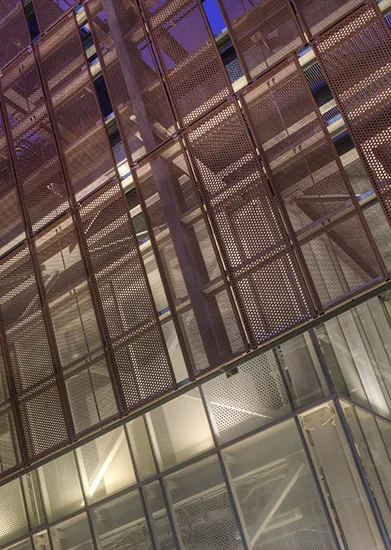
LEDs are embedded in the floors so that at night the entire facility glows.
Photo © Brad Feinknopf
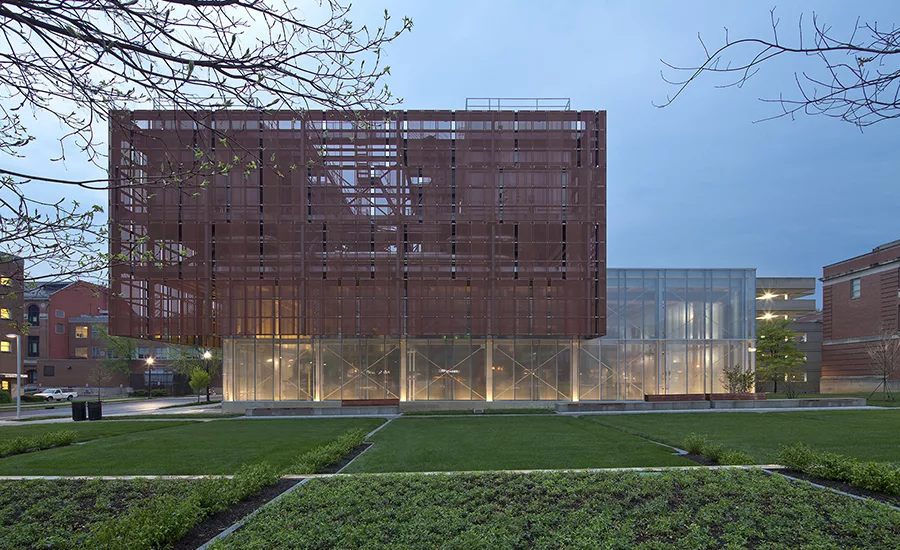
“You don’t see everything going on inside, yet it isn’t gloomy or forbidding,” architect Jane Weinzapfel says. “It’s delicate, like a lampshade.”
Photo © Brad Feinknopf
Architects & Firms
Columbus
In 1908, Estelle Clark Thompson, the wife of Ohio State University’s fifth president, stood on the Columbus campus’s new football field and, with a flask only of water, christened it in the name of “clean athletics and manly sport.” The benediction worked all too well: less than two decades later— with five conference championships and crowds exceeding 50,000 spectators—OSU football was compelled to relocate to a roomier stadium alongside the Olentangy River.
The old football field may be long gone, but Mrs. Clark Thompson’s temperance-era rite was oddly prophetic. More than a century later, on the footprint of its grandstands, Ohio Field has been reincarnated as a new chilled-water facility. And counter to its cumbersome name and heavy-duty program, the East Regional Chilled Water Plant, designed by Boston-based firm Leers Weinzapfel Associates and completed last April, is an exercise in both elegance and efficiency.
“On a campus, there is a place for electrifying buildings that have to do with the campus mission,” says firm principal Jane Weinzapfel. “This kind of building is often a supporting player. It’s quieter.” With 58,663 students on its main campus, OSU is one of the nation’s largest universities—and growing. Six years ago, administrators launched a 100-year campus plan that called for, among other directives, increased investment in infrastructure. The university identified the need for two new chiller plants, facilities whose water is used to cool and dehumidify air supplied to campus buildings. One of the chillers, completed by Ross Barney Architects in 2013, accommodates a medical district on the south end of campus; the other, on the east side, would serve a new chemistry building, residence halls, and a future arts district. The university ultimately brought on Leers Weinzapfel for the new project because it was impressed by other plants in the firm’s portfolio, including a massive curved facility at the University of Pennsylvania.
The new 23,000-square-foot building sits among others in a range of architectural styles—including a concrete parking garage and a Beaux Arts brick structure—along North High Street, the easternmost edge of campus and a major commercial corridor connecting the University with downtown Columbus. The architects were faced with the challenge of preserving green space, creating a hospitable environment for technicians, and pleasing the university’s board, which was wary of putting an industrial plant on a rapidly developing thoroughfare.
Rather than placing a bulky structure along the sidewalk, the architects wanted to make the building as compact as possible, so, working with Baltimore-based RMF Engineering, they opted to locate pumps and water filters in a basement level. They also chose to contain unsightly rooftop cooling towers in an open-air second level.
The result is an interplay of volume, materials, and light. The plant is a composition of two stacked rectilinear forms; the glazed ground floor, measuring 120 by 80 feet, contains the chillers, while the 100-by-100-foot upper story is enmeshed in a graceful screen of anodized and coated aluminum panels to conceal the cooling towers. This veil, colored bronze to match the surrounding campus buildings and perforated with a rhythmic pattern, cantilevers dramatically over the lower level. Unlike other chillers on college campuses, which can be monumental and otherworldly (take Helmut Jahn’s futuristic facility at the University of Chicago, or Ross Barney’s OSU plant, decked out in prismatic fins), Leers Weinzapfel’s is discreet. A translucent polka dot frit on the glazing conceals the equipment from the outside, allows plenty of daylight for maintenance crews, and reduces glare and heat gain. LEDs are embedded in the floors so that at night the entire facility glows. “You don’t see everything going on inside, yet it isn’t gloomy or forbidding,” Weinzapfel says. “It’s delicate, like a lampshade.”
Inside, however, the chiller is anything but delicate. On a recent afternoon, Weinzapfel, along with campus architect Bernard Costantino, passed a row of five roaring centrifugal chillers on the ground level lined up like a row of locomotives across a polished concrete floor. Each is approximately 100,000 pounds. The architects left a generous lane in front, to allow trucks and forklifts to pass by for repairs. A mezzanine overlooking this array accommodates electrical equipment and a control room (although much of the monitoring is conducted remotely).
The plant may appear weightless but, according to the engineers, one of the trickiest design elements was the upper-level cantilever, which hangs approximately 20 feet off the south end of the building. “This plant is unusual because we had to locate all of this enormous rotating, vibrating equipment on a ledge,” explains RMF vice president Robert Smith. In order to support six cooling towers and thousands of pounds’ worth of piping, they transferred the load onto the building’s main steel structure through braces and a horizontal truss system.
The plant has a 15,000-ton cooling capacity at full strength; to put that into perspective, a typical home requires between 2 and 3 tons. When the cooling cycle is complete, the water flows toward a myriad of university buildings at a chilly 42 degrees. Back at the plant, the sleek glazed facade reflects the campus activities around it. It also mirrors an acre patch of green in front, striated with thin paved lines every 10 yards, a separate project intended to memorialize the old OSU football field. “It’s sacred land now,” Costantino, the campus architect, joked. Weinzapfel laughed: “Genuflect as you walk by.”
PeopleArchitect: Leers Weinzapfel Associates 75 Kneeland Street, Suite 301 Boston, MA 02111 p: 617.423.5711 f: 617.482.7257
Personnel in architect's firm who should receive special credit: Jane Weinzapfel, FAIA, Principal-in-Charge (Registered Architect) Andrea P. Leers, FAIA, Principal (Registered Architect) Joseph Raia, AIA, LEED, Project Manager (Registered Architect) Chien Hung-Yang, Designer Juliet Chun, Designer
Architect of record: GBBN Architects 332 E 8th Street Cincinnati, Ohio 45202 P: 513.241.8700 F: 513.241.8873
Joe Schwab, AIA, LEED AP, Principal-in-Charge (Registered Architect) Marcene Kinney, AIA, LEED AP, Director of Arts and Education (Registered Architect) Mark Lee, AIA, LEED AP, Project Architect (Registered Architect) Shawn Feigh, AIA, LEED BD+C, Project Architect (Registered Architect)
Engineers: Structural Engineer: RMF Engineering MEP Engineer: RMF Engineering Civil Engineer: Korda
Consultants: Landscape: Reed Hilderbrand Lighting: Francis Krahe & Associates, Inc. Construction Manager: Shook Construction Electrical Contractor: The Superior Group Mechanical Contractor: Sauer Group Inc.
Photographer: Brad Feinknopf 104 N 3rd Street Columbus, Ohio 43215 P: (614) 225-0414
Client: Ohio State University
Size: 23,160 square feet
Cost: $39 million
Completion Date: April 2015
|
ProductsStructural system Steel Manufacturer of any structural components unique to this project: Fiedeldey Steel
Exterior cladding Metal Panels/glass curtain wall: American Architectural Glass, Inc.
Doors Upswinging doors: Schweiss Door (16’-0”h x 17’-6”w bi-folding door)
Lighting Interior ambient lighting: EcoSense (in-slab light fixtures)
Additional building components or special equipment that made a significant contribution to this project: Cooling Towers: Tower Equipment, Co. Chillers: Trane Transformers: Square D
|
Looking for a reprint of this article?
From high-res PDFs to custom plaques, order your copy today!