Architectural Record
search
cart
facebook twitter linkedin youtube
  • Sign In
  • Subscribe
  • Sign Out
  • My Account
Architectural Record
  • NEWS
    • Latest News
    • Awards
    • Interviews
    • Obituaries
    • Podcasts
      • Design:Ed Podcast
      • Sponsored Podcasts
  • OPINION
    • Book Reviews / Excerpts
    • Exhibition Reviews
    • Forum
  • EXCLUSIVES
    • Videos
    • Design Vanguard
    • Top 300 Firms
    • Sponsored Content
    • Sponsored eBooks
    • From the Archives
  • CONTINUING ED
    • Editorial Continuing Ed
    • CE Center
    • CE Academies
  • PROJECTS
    • Buildings By Type
    • Reuse & Renovation
    • Museums & Arts Centers
    • Colleges & Universities
    • Multifamily Housing
    • Interiors
    • Lighting
    • Kitchen & Bath
  • HOUSES
    • Record Houses
    • House of the Month
    • Featured Houses
  • PRODUCTS
    • Products by Category
    • Record Products of the Year
    • Latest Products
  • EVENTS
    • Dates & Events
    • Record on the Road
    • Innovation Conference
    • Sustainability in Practice
    • Women In Architecture
    • Webinars
    • Ad Excellence Awards
    • Submit an Event
  • CONNECT
    • Ask RECORD AI
    • Newsletters
    • Contact
    • Advertise
    • Editorial Calendar
    • Store
    • Customer Service
  • SUBMIT
    • Submission Guidelines
    • RECORD Competitions
  • MAGAZINE
    • Subscribe
    • My Account
    • Digital Edition
    • Current Issue
    • Firm Pass
    • Historic Archive
Architecture NewsCommentary & CriticismOpinion

Critique

What Exactly Does Trump’s Triumphal Arch Commemorate?
By Barry Bergdoll
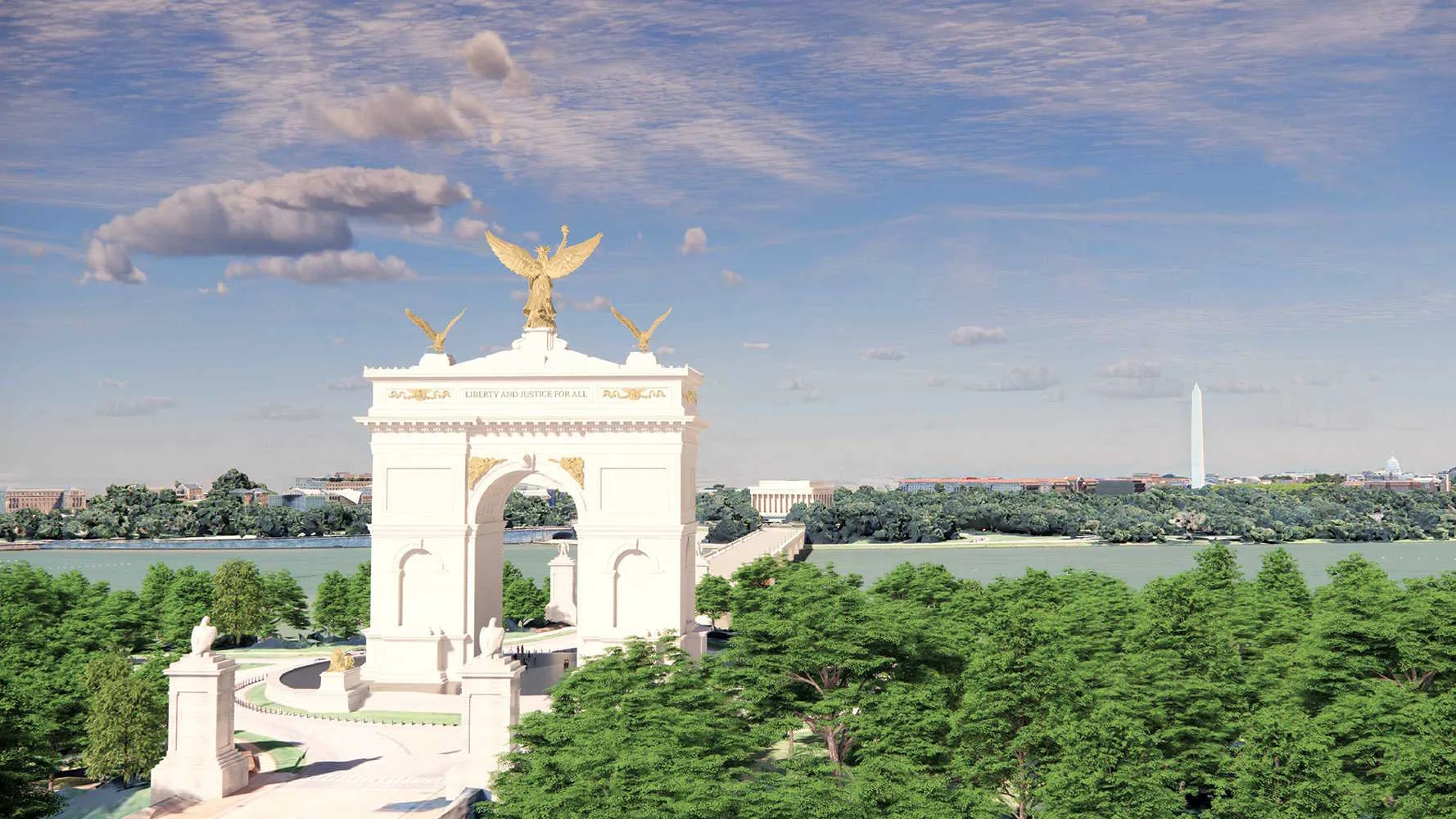
Trump's triumphal arch
Image: © U.S. Commission of Fine Arts / public domain
July 6, 2026

In antiquity, monumental triumphal arches, generally built following a vote by the ancient Roman senate, symbolized the return of a victorious army and consecrated the memory of its passage as a permanent entrance into a city. Many were built in marble to replace a temporary wooden arch that served the victorious military procession, to become a path to be taken by daily users. The Arch of Constantine at the edge of the Roman Forum, for instance, finished in 315 AD, commemorates the victory of Constantine over Maxentius at the Battle of the Milvian Bridge. 

The Roman practice was revived from the late 17th to early 19th century in Europe as territorial boundaries were expanded and defined through warfare. Louis XIV, Frederick the Great, Napoleon I, and Tsar Alexander I defined entry into their capitals and commemorated significant victories by the construction of triumphal arches modeled on ancient Roman prototypes. In the decade after he crowned himself emperor, Napoleon had two triumphal arches built in Paris: the Arc du Carrousel, which featured bas-reliefs commemorating victories most recently in the German lands, and the Arc de Triomphe de L’Étoile, a monument of a size that far surpassed any ancient Roman prototypes. At 164 feet tall, the latter was not only scaled to the horizon at the crest of the Champs-Élysées, and visible from the emperor’s apartments, but also dominated the view westward from the Place de la Concorde. Having presided over great national events, like the funeral procession for Victor Hugo in 1885, it has often been the backdrop to commemorative military parades. It was during the parade there on Bastille Day 2017 that Donald Trump, during his first term as president, seems to have formed his obsession with tanks in the street and for towering triumphal arches.

Already in antiquity some triumphal arches were built with the aim of self-aggrandizement by one or another emperor, a type that historians more commonly refer to as memorial rather than triumphal arches. So, Trump’s proposed 250-foot-tall arch (a size no one has ever seen before) is not without precedent, even if he is not known, unlike many an authoritarian before him, to be versed in history, like, for instance, Napoleon III, who spent many evening hours reading ancient Roman military history.  

In the late 19th and early 20th century, there was popular support for the building of arches, not to perpetuate memory of victory but rather of sacrifice. The most powerful expression given to the triumphal-arch tradition is the example at the British War Cemetery (1932) at Thiepval, France, conceived according to a radically abstract geometrical design by Sir Edwin Lutyens. This brilliantly original reinterpretation of the ancient type was created by intersecting two arches to form a complex arch that frames views in four directions. Devoid of any literal markers of revived classicism, it represented, almost exactly a century ago, the possibility that an ancient tradition could be continued to powerful artistic effect and to moving commemorative intent without recourse to literal imitation. 

Precisely the opposite is the case of the current design for Washington, D.C. It seems to have been tweaked with various settings on a photocopier to try to keep up with Trump’s quest for dominance through sheer size. Crowned by two gilded eagles and a winged figure of uncertain significance, and situated perfectly to block the long-cherished open vista between the Lincoln Memorial and Arlington Cemetery, Trump’s arch fits best into the category of self-aggrandizement, although its height refers to America’s semi-quincentennial. Like so much that Trump does, it manages to create division and dissent rather than to build consensus. It was granted approval by the Commission of Fine Arts—now entirely composed of Trump appointees—in the same week that the Department of Justice (DOJ) announced a $1.776 billion fund intended to compensate those said to have been unjustly treated by the last administration, including presumably those who stormed the U.S. Capitol. Given that their criminal records have recently been quietly removed from the DOJ website, future historians will have to look instead to the daily press to coordinate the construction of the arch with an event worthy of commemoration. Scanning the headlines of the first year and a half of Trump’s presidency, no military victory has been achieved, unless it’s the kidnapping of former Venezuelan president Nicolás Maduro. At this writing, the war in Iran is far from over and has wreaked havoc worldwide. A cynical chronicler of triumphal arches might suppose that this decidedly neo-Roman Imperial arch represents the triumph of a single person’s will over the American populace. It is clearly, even without any illustrative program to elucidate what it commemorates, a monument to, by, and for Trump, a former real-estate developer become president intent on remaking the Federal City in his image.

Looking for quick answers on architecture and design topics?
Try Ask RECORD, our new smart AI search tool.
Ask RECORD →

KEYWORDS: Trump Washington D.C.

Share This Story

Looking for a reprint of this article?
From high-res PDFs to custom plaques, order your copy today!

Architectural historian Barry Bergdoll is the Meyer Schapiro Professor of Art History and Archaeology at Columbia University.

Post a comment to this article

Report Abusive Comment

Subscription Center
  • Create an Account
  • Start a Subscription
  • Manage My Account
  • Sign Up for Newsletters
  • Visit Customer Service
  • Update Preferences

More Videos

Sponsored Content

Sponsored Content is a special paid section where industry companies provide high quality, objective, non-commercial content around topics of interest to the Architectural Record audience. All Sponsored Content is supplied by the advertising company and any opinions expressed in this article are those of the author and not necessarily reflect the views of Architectural Record or its parent company, BNP Media. Interested in participating in our Sponsored Content section? Contact your local rep!

close
  • 3D configurator
    Sponsored byDoorBird

    How DoorBird’s 3D Configurator Is Redefining Customization Across Residential and Commercial Design

  • interior of modern office
    Sponsored byCurrent

    The Downlight's Second Life: Why Below-Ceiling Serviceability Is the Specification Detail That Matters Most

  • cold storage facility
    Sponsored byCarlisle SynTec Systems

    How Architects Can Design More Continuous Cold Storage Envelopes

DESIGN:ED Podcast
Listen to Architectural Record’s DESIGN:ED Podcast

Events

July 8, 2026

Co-Intelligence: The Architect's AI Advantage

Credits: 1 AIA LU/Elective; 1 AIBD P-CE; 0.1 ICC CEU

Examine how AI is reshaping architectural practice and how architects can elevate their role from task execution to directing design intent.

July 14, 2026

Designing Toilet Partitions for User Comfort and Utility

Credits: 1 AIA LU/HSW; 1 AIBD P-CE; 0.1 ICC CEU

Evaluate emerging restroom design strategies, materials, and specification options that enhance functionality, inclusivity, user comfort, and sustainability.

View All Submit An Event

Products

2026 Architect's Square Foot Costbook

2026 Architect's Square Foot Costbook

See More Products

Popular Stories

Under Armour Global  Headquarters

In a Former Industrial Area in Baltimore, Gensler Builds an Office Building that Broadcasts its Client’s Ambitions

Shelter Island Residence by Studio Modh Architecture

Shelter Island Residence by Studio Modh Architecture

Iga City Hall Transformation

Maru Architecture Turns a 1960s Government Building in Iga, Japan, into a Library and Hotel

Hudson Street Loft

Hudson Street Loft by AlexAllen Studio Architects

Most Significant Works of American Architecture

For the Semiquincentennial, Practitioners and Scholars Survey 250 Years of American Architecture

Co-Intelligence: The Architect's AI Advantage - Free Webinar - July 8, 2026

Related Articles

  • What Does House Democrats' Stimulus Plan Mean for A/E/C Industry?

    See More
  • What Does a U.S.– Cuba Détente Mean for Architecture?

    See More
  • The ArchRecord Interview: Tom Kundig

    See More
×

The latest news and information

#1 Source for Architectural Design, News and Products

SUBSCRIBE
  • RESOURCES
    • Advertise
    • Contact Us
    • Submit
    • Store
  • ACCOUNT CENTER
    • Create an Account
    • Start a Subscription
    • Manage My Account
    • Sign Up for Newsletters
    • Visit Customer Service
    • Update Preferences
  • PRIVACY
    • PRIVACY POLICY
    • TERMS & CONDITIONS
    • DO NOT SELL MY PERSONAL INFORMATION
    • PRIVACY REQUEST
    • ACCESSIBILITY
  • SERVICES
    • Marketing Services
    • Reprints
    • Market Research
    • List Rental
    • Survey/Respondent Access
  • STAY CONNECTED
    • Linkedin
    • Facebook
    • Instagram
    • YouTube
    • X (Twitter)

Copyright ©2026. All Rights Reserved BNP Media, Inc. and BNP Media II, LLC.

Design, CMS, Hosting & Web Development :: ePublishing