National Taichung Theater by Toyo Ito & Associates
Taichung City, Taiwan

Approached from a parkway in front, an open plaza leads up to the National Taichung Theater’s main entrance. The building’s hourglass-shaped glazed and concrete inserts create an intriguing sequence of solids and voids on its four elevations.
Photo © Iwan Baan

In addition to a pond-like fountain, the plaza contains a rivulet that continues inside the building.
Photo © Iwan Baan

Surrounded by newly planted greenery, the building may be approached from all sides. A circular drive at the rear enables cars to pull up to one of the entrances. Encased in glass on two sides, a ground-floor café occupies the corner of the building.
Photo © Iwan Baan

Within the ground-floor lobby, one cavernous space segues into the next.
Photo © Iwan Baan

Red and blue cores aligned with the Grand Theater and Playhouse help orient visitors as they move through the space while benches designed by Fujie Kazuko Atelier give them somewhere to pause and reflect.
Photo © Iwan Baan

Red and blue cores aligned with the Grand Theater and Playhouse help orient visitors as they move through the space.
Photo © Iwan Baan

From the foyer, curving stairs lead up to the retail, office, gallery, and restaurant spaces on the fifth floor.
Photo © Iwan Baan

From the foyer, curving stairs lead up to the retail, office, gallery, and restaurant spaces on the fifth floor.
Photo © Iwan Baan

A standard horseshoe shape, the Grand Theater contains 2,000 seats upholstered with red fabric designed by Yoko Ando.
Photo © Iwan Baan

Adorned with colorful murals, the foyer preceding the Grand Theater soars to 56 feet.
Photo © Iwan Baan

The tubular spaces contained within the building poke out through the roof garden as well as from the elevations.
Photo © Iwan Baan

Inside, a glass wall and doorway separate the offices.
Photo © Iwan Baan

On the fifth floor, one tube leads out to a balcony shielded by a low glass partition.
Photo © Iwan Baan

Image courtesy Toyo Ito & Associates, Architects

Image courtesy Toyo Ito & Associates, Architects

These diagrams illustrate the basic conceptual steps taken to configure the catenoids that organize the building.
Image courtesy Toyo Ito & Associates, Architects

Inserted within the catenoids, the green, blue, and red cores denote the Black Box, Playhouse, and Grand Theater, and their related spaces.
Image courtesy Toyo Ito & Associates, Architects

The Black Box Theater opens on to an amphitheater on the grounds adjacent to the theater.
Photo © Iwan Baan

Photo © Iwan Baan

Photo © Iwan Baan

On the fifth floor, one tube leads out to a balcony shielded by a low glass partition.
Photo © Iwan Baan

Approached from a parkway in front, an open plaza leads up to the National Taichung Theater’s main entrance.
Photo © Iwan Baan

The building’s hourglass-shaped glazed and concrete inserts create an intriguing sequence of solids and voids on its four elevations.
Photo © Iwan Baan

The plaza contains a rivulet that continues inside the building and meanders alongside one of the NTT’s retail offerings.
Photo © Iwan Baan

Red and blue cores aligned with the Grand Theater and Playhouse help orient visitors as they move through the space. Ticket and information counters are centrally located in the ground-floor lobby.
Photo © Iwan Baan

Photo © Iwan Baan

Photo © Iwan Baan
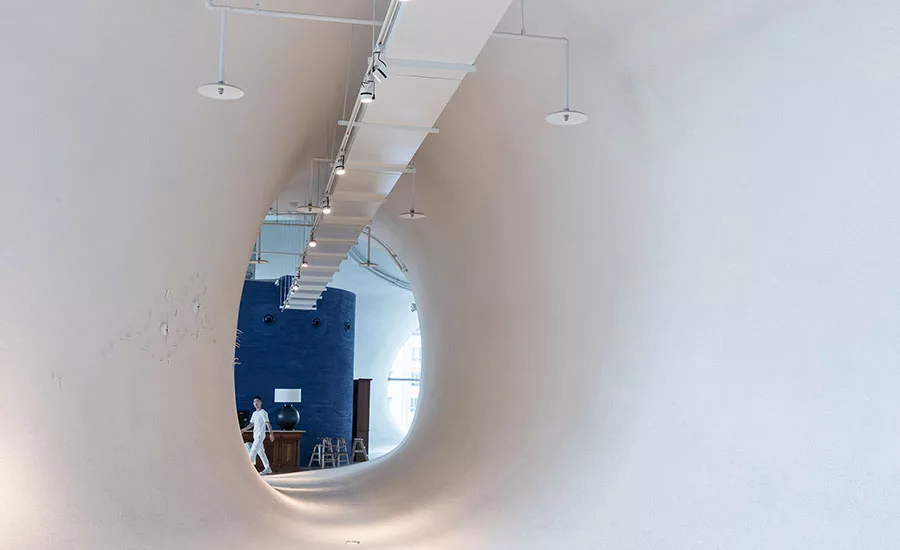
Photo © Iwan Baan

Photo © Iwan Baan

Photo © Iwan Baan

The Playhouse
Photo © Iwan Baan

Photo © Iwan Baan

Image courtesy Toyo Ito & Associates, Architects

Image courtesy Toyo Ito & Associates, Architects

Image courtesy Toyo Ito & Associates, Architects

Image courtesy Toyo Ito & Associates, Architects

Image courtesy Toyo Ito & Associates, Architects

Image courtesy Toyo Ito & Associates, Architects
Architects & Firms
When it comes to structural daring, few architects can top the Tokyo-based designer and 2013 Pritzker laureate Toyo Ito. After 11 years and $135 million, his most ambitious work to date has finally opened in Taichung City, a metropolis of 2.75 million people in central Taiwan. Situated majestically at the end of a tree-lined parkway, the 551,000-square-foot National Taichung Theater (NTT) is the city’s new center for opera and theater of all sorts. Though the NTT’s main attractions are its three theaters, these are upstaged by the drama of its architecture everywhere in between. Barely contained by the boxy enclosure of its concrete-and-glass skin, hourglass-shaped volumes define the interior of Ito’s building. These sinuous forms cinch in and balloon out with remarkable plasticity, the inside wall of one doubling as the outer surface of the neighboring space. Together these tubelike elements create a spectacular interior dreamscape of deep caverns and soaring canyons within the building.
Additional Information:Jump to credits & specifications
In elevation, Ito expresses these tubes in silhouette, which accounts for the structure’s bold appearance. Conceptually, the building shell simply contains the interior, as if the system of tubes would continue were it not for the enclosure. In theory, says Ito, the four facades are not really facades: “They are sectional cuts.” And while the serpentine shapes dominate the otherwise rectilinear exterior, it is indoors where visitors are immediately swept up by the experience of Ito’s architecture, with dynamic, curving surfaces that pull you in, and a mysterious play of light and dark that makes you stop and wonder.
Picking up where the landscaped boulevard leaves off, a monumental plaza leads to the NTT’s main entrance, but additional doorways draw visitors from multiple directions. All open onto the lobby, a vast hall that seems like an extension of the city in scale and function. Filling the entire ground level, its tunnel-like spaces segue from one to another. Furniture designates administrative and commercial areas, including the ticket desk, café, and an open marketplace. Separate stairways lead to each of the building’s three venues: the 2,000-seat Grand Theater and 800-seat Playhouse, both entered from second-floor foyers, or the basement-level Black Box, a 200-seat theater that opens to an outdoor amphitheater via sliding doors. On the fifth floor, there is a gallery, restaurant, retail area, and office space, topped by the roof garden, where the tubular forms, some holding HVAC equipment, poke out from the building.
Behind this structure’s bold expression is a complex story, one that began in 2004 when Ito entered a competition for the Ghent Music Forum. Inspired by the texture of that medieval Belgian city, he proposed a labyrinth of caves composed of a continuum of spaces, both horizontal and vertical. Though Ito lost that commission, he won the NTT competition the next year with a scheme based on the same visionary strategy.
Ito and his team adapted the Ghent concept for the NTT’s complex program, utilizing a malleable matrix of metal mesh tubes to devise a study model. They manipulated these tubular forms by hand to incorporate the spatial needs of the program. The final result of this study was a composition of 58 irregularly shaped tubes, which Ito calls catenoids, that eventually became the building’s curvaceous volumes. To translate these catenoid shapes into a quantifiable form, Ito’s team created what the architect terms an “emerging grid,” which consisted of five two-dimensional grids overlaid on each other, each one shifted slightly. This enabled the team to identify 423 control points. They then used these points to formulate a 3-D matrix that defined a planar shape and a position for each catenoid, breaking them down into connected flat planes. The architects then rounded the flat sides of the hollow forms and the whole confluence blended together. “The geometry came first, and then we forcibly introduced the theaters,” explains Ito.
Just finding a willing contractor took a year and a half. “No one wanted to do it,” laughs Ito. The construction team began to build the catenoids using a truss wall system, developed in Japan by the Asahi Building Wall Company, to provide the reinforcement. First they created two-dimensional trusses, each one curved differently. These ribs were upended, spaced 8 inches apart, and tied together into three-dimensional units that were joined. The assemblies were then sandwiched between layers of steel mesh, which replaced the typical concrete formwork. After a period of partial curing, the mesh forms were removed to minimize surface irregularities. Also intended to mask flaws, thin layers of mortar and textured white paint were applied to finish the 18-inch-thick walls on each side. Serving as both the building’s support and space-articulation systems, the walls are a complete integration of architecture and structure.
To maximize floor area, horizontal plugs made of steel deck and concrete were placed within the resulting volumes. Since the cross-sections of the tubular elements are variable, the desired ceiling heights and floor area determined the locations of the inserts, which are supported by supplemental beams. Vertical concrete plugs were also used to add walls where needed and to fortify the weakness inherent in the cut edges visible on the elevations. Plugs within the plugs—circular glass disks set into the exterior concrete panels—admit a modicum of daylight, while downlights embedded in the suspended ceilings softly illuminate the interior.
A direct reference to Ito’s design for the Ghent Music Center, the NTT is also an extension of the architect’s earlier built work. Both the cut elevations and the catenoids are reminiscent of his Sendai Mediatheque (RECORD, May 2001) whose undulant, hollow columns revealed by the building’s glass elevations made big waves when the project opened in 2001. Yet the National Taichung Theater pushes all of those ideas to much greater extremes. So, if an over-the-top operatic performance of Carmen or Rigoletto dosn’t transport patrons to another world, the building’s architecture surely will.
CreditsArchitect: Toyo Ito & Associates
Personnel in architect's firm who should receive special credit: Toyo Ito, Yoko Izumi, Takeo Higashi, Toyohiko, Kobayashi, Masahiro Gono, Kenichi Shinozaki*, Wataru Fujie, Keisuke Sawamura*, Yasuyuki Mizunuma, Hiroyuki Shinozaki*, Atsushi Ito*, Kenta Sano*, Junji Ooga, Kozo Ikeda, Yugo Yamada,Takuji Aoshima*, Takayasu Hirayama*, Kentaro Maeda*, Florian Bush*, Michiko Okano*, Miya Ito, Toshimitsu Minami, Andy Sun, Weiya Fang, Design/Site supervision (*Former staff member)
Architect of Record: Da-Ju Architects & Associates: Yang Yi-Yung, Yang Lih-Hwa, Yu Hui-Chen, Wang Che, Chen Chi-Wei, Chen You-Ni, Chang Ling-Yen, Li Chia-Sui, Eathan Cheng, Fang Yin-Ping, Wang Jian-Zhong, Sun So-Le, Tsai Tun-Hsu, Ku I-Chun, Chen Ching-Wen, Lo Hsien-Chi, Fan Pai-Chia, Hsu Shih-Yang, Chen Si-Ying, Chen Chiu-Ming, Chien Chiung-Fen, Huang Ta-Wen, Chang Nien-Chung
Building Contractor: Lee Ming Construction Co., LTD
Specialized Stage Equipment: Top Design Futurity International Co., LTD. Chin Shu Construction Company LTD (JV)
Air conditioning Contractor: Nextekco Engineering Co., LTD.
Sanitary / Electrical Contractor: Long Cheng Co., LTD.
Structural Design Consultants: ARUP Evergreen Consulting Engineering Inc.
Equipment Consultants: Takenaka Corporation I.S.LIN & Associates Consulting Engineers Handar Engineering & Construction Inc.
Theater Consultant: Shozo Motosugi
Acoustic Consultants: NAGATA ACOUSTIC National Taiwan University of Science and Technology
Lighting Consultant: Izumi Okayasu Lighting Design
Fire Safety Consultants: ATAKA Disaster prevention design Taiwan Fire Safety Consulting Ltd.
Furniture Design: Kazuko Fujie Atelier
Stage Machinery Consultant: Bears Engineering
Stage Lighting Consultant: AKARIGUMI
Fabric Design: Yoko Ando Design
3D Modeling: Lead Dao Technology and Engineering Ltd.
|
SpecificationsLightning: Innotek Photoelectric Technology Corp. Curtain Wall: Sanunity Co. Ltd. Theatre Seats: Top Design Futurity International Co., Ltd. Carpeting: Tang Lun Industrial Co., Ltd Other Flooring: Dong Lon International CO., LTD Wall Treatments: Kikusui Chemical Industries Co.Ltd. |
Looking for a reprint of this article?
From high-res PDFs to custom plaques, order your copy today!