Frank Lloyd Wright’s Darwin D. Martin House Complex
Buffalo, New York

The Darwin D. Martin House and the George Barton residence are part of an enclave constructed between 1903 and 1905. The cluster has just been painstakingly restored and partially reconstructed as a museum with a strong educational and events program.
Photo © Biff Henrich

Wright connected the carriage house and adjoining conservatory (both reconstructed) to the main house, by means of a masonry-piered pergola.
Photo © Biff Henrich

In 2009, a new glass-and-steel orientation center, the Eleanor and Wilson Greatbatch Pavilion designed by Toshiko Mori Architect, was added.
Photo © Iwan Baan

Next to it is a smaller house for Martin’s sister, Delta, and her husband, George Barton. As with most of the structure, its horizontality is articulated by Roman bricks with raked profiles and concrete cappings.
Photo © Biff Henrich
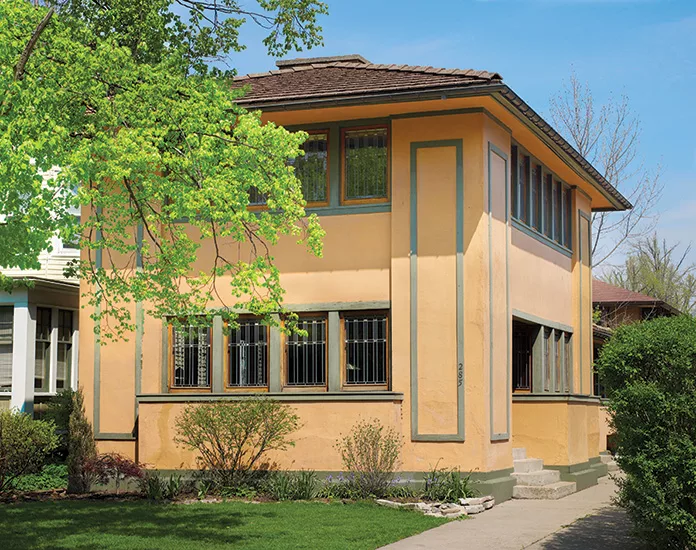
Wright also designed a stucco-walled gardener’s cottage in 1909.
Photo © Biff Henrich

Wright designed all the furniture and fittings, including the piano bench for the custom Steinway. The finishes, furnishings, fabrics, and fixtures were either restored or reproduced.
Photo © Biff Henrich
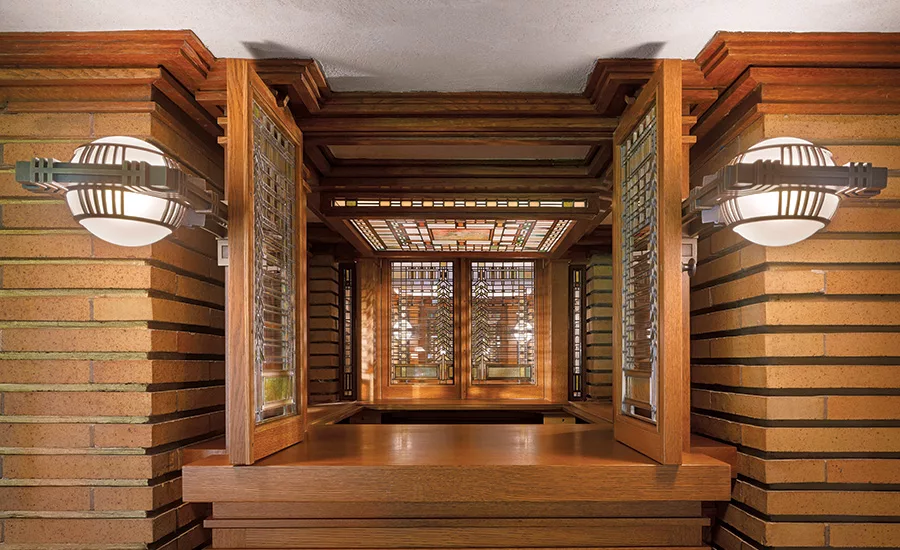
Inside, Wright created niches and alcoves with freestanding brick piers, built-in oak cabinetry, art-glass windows, and lighting fixtures.
Photo © Biff Henrich

The library, dining, and living rooms were differentiated from each other by the cabinetry and clusters of piers as well as by raised and lowered ceilings with wood beams, to create an open spatial unit.
Photo © Biff Henrich

From the main hall of the Martin house, a long, brick-piered pergola leads to the conservatory on the north end.
Photo courtesy Martin House Complex
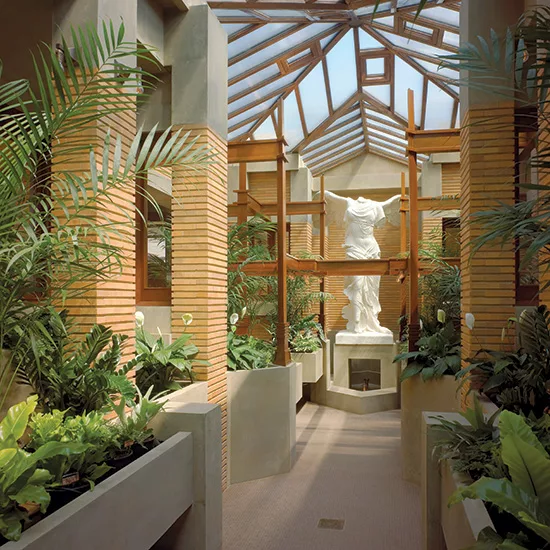
Here a cast of the Victory of Samothrace takes its place at the terminus of the axis within the 2,700-square-foot reconstructed setting.
Photo © Biff Henrich

Pergola and Conservatory
Photo courtesy Darwin Martin House

Conservatory Interior looking toward Carriage House
Photo courtesy Darwin Martin House

Barton House Dining Room
Photo © Biff Henrich

Barton House Dining Room (detail)
Photo courtesy Darwin Martin House
Architects & Firms
Frank Lloyd Wright called the grand complex he designed for Darwin D. Martin in Buffalo (1903–05) his “opus,” as he wrote in 1954 to a prospective buyer of the property. And it was a major opus—even if just one among many. Now, in time for the celebration of Wright’s 150th birthday in June, a 20-year, five-phase restoration and reconstruction process is wrapping up on the residential complex, with six structures by the architect. Its 1.5 acres include the main house for Martin and his family; a smaller one for Martin’s sister Delta and her husband, George Barton; a pergola, conservatory, and carriage house, as well as a gardener’s cottage that was added in 1909. Today it is hard to tell that it endured years of abandonment and neglect, not to mention actual demolition of three of its structures.
Additional Information:Jump to credits & specifications
Martin and Barton both worked for the Larkin Company, a mail-order soap business. As a top executive, Martin helped bring Wright in to design the groundbreaking office building in downtown Buffalo (RECORD, March 1908; April 1908), which unfortunately was demolished in 1950. As the client for his own and his brother-in-law’s houses, Martin proved to be surprisingly generous in letting his headstrong designer create a remarkable gesamtkunstwerk where architecture, interior fittings, furnishings, objects, and landscape came together in a splendidly integrated whole. (Nevertheless, Martin did chide Wright for not being punctual or paying enough attention to budget, specifications, and drawings.)
Built in the city’s stately Parkside section, which was planned by Frederick Law Olmsted, the gracious enclave demonstrates Wright’s early Prairie-style principles with long, low, horizontal volumes hugging the earth, sheltered under hipped roofs with deep overhangs. The elongated lines of the walls are emphasized by a reddish-tan Roman brick, with light concrete caps delineating parapets, sills, and the plinthlike base of the house. Red roof tiles attest to Wright’s commitment to natural materials and colors.
The unity of the compound owes much to its axial planning: the pergola, extending from the 15,000-square-foot main residence on the south to the 2,700-square-foot conservatory on the north defines one axis, while the 5,500-square-foot carriage house and the 4,400-square-foot Barton House each flank the conservatory on a cross axis. Such intersections of axes determined the interior plans, which are based on a modular grid.
Not everything functioned: the kitchen, placed on the opposite side of the entrance hall from the dining room, made the transport of dishes awkward for the staff. Some parts of the house were dark, owing to those overhanging eaves. But despite being large enough for eight bedrooms and four baths upstairs, the place was cozy: when Wright conceived the first-floor dining/living area and library as a single unit, he divided the flowing spaces into alcoves and niches with built-in oak cabinetry and masonry piers, along with lifted and lowered plastered ceilings and wood beams. Nearby, the Barton House’s simpler cruciform plan, while less lavish, proved easier to keep up.
After Martin died in 1935, the main house stood vacant—and untended—for 17 years. Eventually the city took it over for nonpayment of property taxes, while the Barton House remained in private hands. In 1954, a local architect, Sebastian Tauriello, bought the Martin House, but sold off the land containing the pergola, carriage house, and conservatory, all of which were razed to build a 20-unit apartment complex in three structures.
In 1967, the State University of New York at Buffalo purchased the Martin House for its president’s living quarters, and the then-provost bought the Barton House. By the early 1990s, with the state’s backing, the nonprofit Martin House Restoration Corporation (MHRC) was created to raise money to buy the Barton House and restore both it and the main residence as a museum under the aegis of the state’s Parks, Recreation, and Historic Preservation Department. The ambitious plans included demolishing the apartment buildings and reconstructing the pergola, the conservatory, and the carriage house. The MHRC also acquired the picturesque stucco-and-wood gardener’s cottage, which had belonged to other owners in the post-Martin years.
By 1997, HHL Architects, a Buffalo firm, began its work. The architects brought in the engineers Robert Sillman Associates to solve such problems as the sagging overhangs of the cantilevered roofs—the structural steel roof members weren’t that structural, because they had not been attached completely around the perimeter. Now they were joined as one entity, and the wood rafters beefed up with engineered lumber.
The house’s reinforced-concrete floors, resting on steel spanning beams, required patching on the second level, while the basement floor was raised for new mechanical equipment beneath the slab. Interior fittings, finishes, and small ceramic mosaic tiles on the ground floor and porches of the house received particular attention. Upstairs, the magnesite (a poured-cement material Wright also used in the Larkin Building) had to be replaced with a mix that contained no asbestos. Some of Wright’s original movable furniture surprisingly remained intact, along with some of the sumptuously tinted art glass, but many windows had gone missing only to reappear in the art markets. They needed to be reproduced, as did most of the built-in furniture and casework.
The most difficult part of the project was sourcing the materials and finding trades to execute the work, says the late Theodore Lownie of HHL. It took some effort to find a manufacturer—in France—that would produce the red clay roof tiles, and eight years to locate a company willing to match the Roman-style brick with iron spotting.
With strong public and private support, the Martin House now functions as an active educational arts center, with tours, classes, events, and a shop in the carriage house, even as some restoration work finishes up. In 2009, the MHRC opened a 7,775-square-foot glass-and-steel orientation pavilion, designed by Toshiko Mori. Her concept follows Wright’s general lines, but without the solid masses: it’s as if a ghost of one wing of the house is gracefully poised at the edge of the site.
The completion of the Martin House restoration comes at a time when Buffalo has undertaken a remarkable overhaul of its architectural legacy. The once-affluent city still retains stellar examples of architecture: besides the works by Wright (including a 1929 weekend house on Lake Erie for the Martin family), it is the home of Louis Sullivan’s Guaranty Building (1896) and H.H. Richardson’s Buffalo State Asylum for the Insane (1880), part of which is being converted to a hotel by Deborah Berke. The Beaux-Arts Albright-Knox Art Gallery, with its addition by Gordon Bunshaft of Skidmore, Owings & Merrill (1962), will soon have another wing by the Office of Metropolitan Architecture. Within this impressive collection, Wright’s residen- tial contribution serves as a testament to the power of design. Says Mary Roberts, director of the MHRC, “The Martin House is at the center of Buffalo’s reinvention. It is the renaissance of a Rust Belt city as something new and exciting based on its architectural legacy.”
CreditsArchitect: Frank Lloyd Wright (original); HHL Architects — Matt Meier, partner in charge; Theodore Lownie, project architect; Jamie Robideau, designer and project manager (restoration, reconstruction)
Robert Sillman Associates (structural); Landmark Facilities Group (m/e/p/fp); Watts Architecture & Engineering (civil, environmental); Convergent Technologies Design Group (audiovisual, telecommunications, security)
Eifler & Associates Architects — John Eifler, principal (architectural restoration); Robert Furhoff (historic finishes); U.S. Heritage Group (historic masonry restoration)
Client: Martin House Restoration Corporation,
29,100 square feet (main house, pergola, conservatory, carriage house, and Barton House connection)
$40 million
1907 (original); January 2017 (restoration); Spring 2017 (landscaping) |
SpecificationsRoman brick Belden Brick Koramic Winerberger (formerly
Oakbrook Esser Studios
Jamestown Bronze Works
Hulley Woodworking
American Restoration Tile
Yamagiwa
Vintage Bathroom
Chicago Architectural Arts |
Looking for a reprint of this article?
From high-res PDFs to custom plaques, order your copy today!