Huma Klabin by Una Arquitetos
São Paulo

The building, two towers connected by an elevator core, plays with solid and void.
Photo © Nelson Kon

The double-height lobby is visible through its glass front and looks out onto the landscaped garage entry.
Photo © Nelson Kon

Huma Klabin is surrounded by similarly scaled apartment buildings and private houses.
Photo © Nelson Kon

Generous glazing frames a communal living room and a well-appointed laundry.
Photo © Nelson Kon
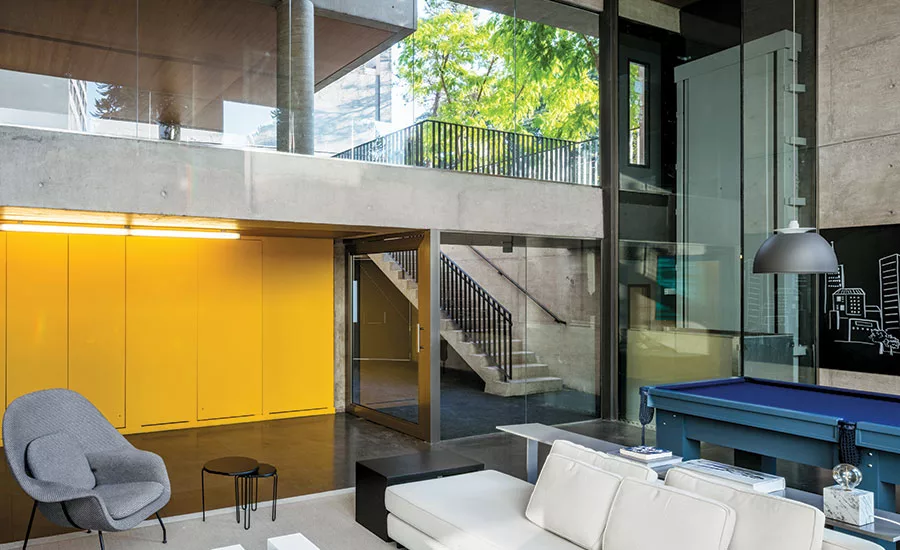
The main entry opens to a double-height lounge and to stairs leading to more shared spaces.
Photo © Nelson Kon

Tiling on an open elevator landing was designed by Paulo Mendes da Rocha, whose concrete work inspired the architects at Una.
Photo © Nelson Kon
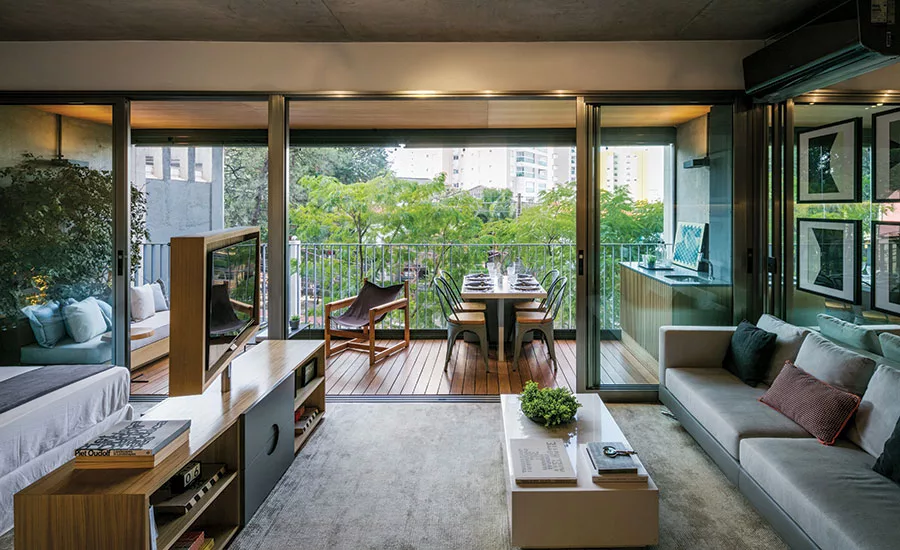
The small apartments are maximized by ample glazing and outdoor space.
Photo © Nelson Kon

Top-floor apartments have their own roof decks with stunning views of the city.
Photo © Nelson Kon
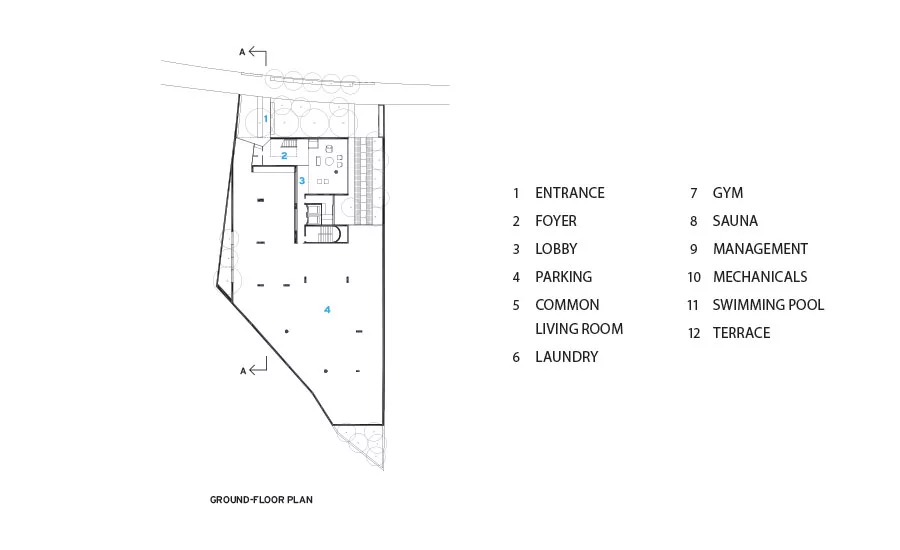
Image courtesy Una Arquitetos
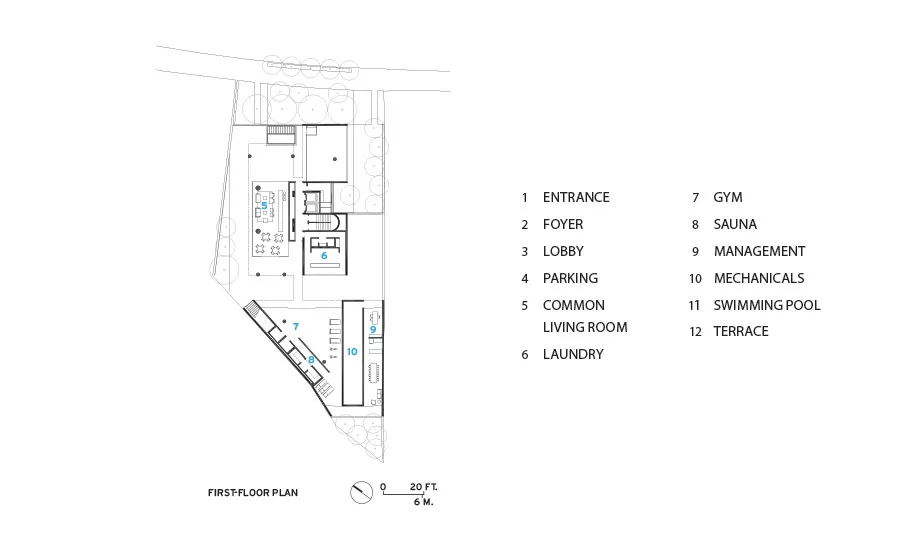
Image courtesy Una Arquitetos
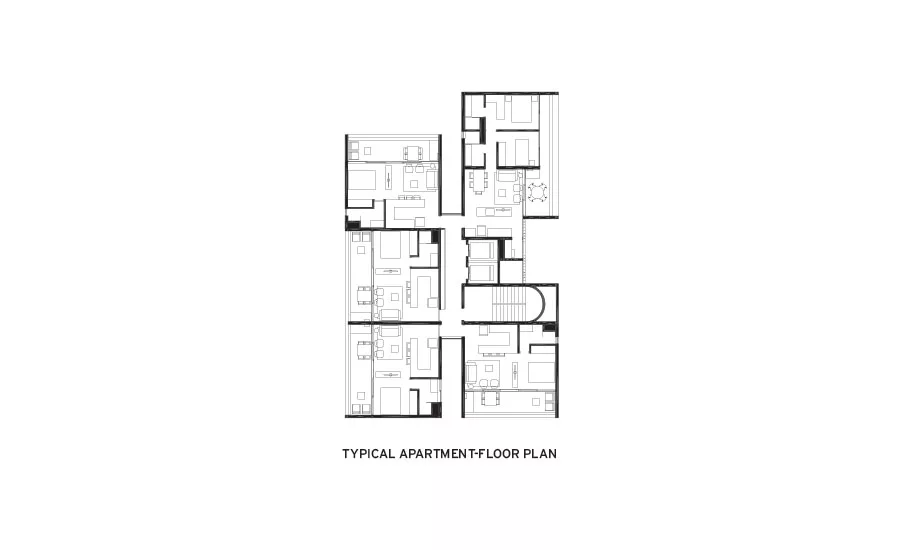
Image courtesy Una Arquitetos

Image courtesy Una Arquitetos
Architects & Firms
With its first foray into São Paulo’s high-rise residential market, local architecture practice Una has daringly rethought the role of this signature building type in Brazil’s biggest metropolis. In recent decades, most apartment complexes built in São Paulo sought to isolate residents from their wider environment. But Una’s latest project, Huma Klabin (a moniker that combines the real-estate developer’s name with that of the surrounding neighborhood) instead strives for harmonious integration with it. With this goal in mind, its creators have delivered a 12-story concrete tower that is a built expression of an exciting cultural moment when paulistanos are rethinking their relationship with the city.
Huma Klabin’s unique approach announces itself immediately. Defying the paranoia about crime and security that demands the typical apartment building be cut off from the sidewalk by intimidating walls and fences, the building instead offers a welcoming gesture. In front of its discreet entrance, a small tree-shaded public courtyard provides an inviting space for both residents and neighbors. In another urbanistically astute move, the architects carefully sited the building—which is composed of two towers joined by an elevator core—on its irregularly shaped lot to best take advantage of the breathing space offered by the adjacent properties’ gardens and access routes. By doing so, the team could be generous with balconies and windows on all four sides of the building— no one elevation is prioritized. In addition to providing residents with better views and light, this move benefits the neighborhood by flouting the norm of anonymous facades punctured with small service windows often no bigger than ships’ portals. These sorts of sensitive solutions are not surprising coming from Una, whose work, up to this point, had focused on public and cultural projects. “We want our building to have a strong relationship with its city,” says the firm’s director, Fernando Felippe Viègas. “There is a beautiful exchange of building to the city and the city to the building.”
Additional Content:
Jump to credits & specifications
Huma Klabin targets an emerging, sophisticated market in São Paulo, professionals with no children. Most of the 52 units it contains are 475-square-foot one-bedrooms, with one 720-square-foot two-bedroom apartment on each floor. “It is a younger demographic that has a more cosmopolitan profile,” says architect Beatriz Bertho, project manager at Huma. “They are well traveled and know how other cities work. They are anxious to see a residential option like this in São Paulo, where the standard is tall walls.” While eschewing fortress-like qualities, however, the building does have features typical among the middle class here, like security cameras and a 24-hour doorman.
The team’s willingness to take risks with openness perhaps explains its willingness to take risks with materials as well. Exposed concrete is common in public buildings in São Paulo but rare in apartment blocks. Few builders have had the courage to work with it since Pritzker-winner Paulo Mendes da Rocha’s notable residential work in the 1980s. Thus Huma Klabin’s prominent use of poured-in-place architectural concrete for floors and walls manages to be daring while also paying homage to one of Brazil’s greatest modern architectural traditions. The decision to use it as the principal material throughout the building also acts as a statement of confidence in the project’s quality, since it meant the team would forgo the tricks used by many São Paulo builders to mask substandard work: plaster, paint, and tiles. On the exterior, the concrete is beautifully softened by charcoal gray roll-down shades that protect the recessed balconies from the elements, while still allowing views out. Inside the units, buyers can choose to leave the concrete exposed or have it covered in white plasterwork. Other materials used to contrast with the concrete include the tiling for the elevator landings, which was designed by Mendes da Rocha, who had supervised the thesis of Una’s Viègas when he was a student at the University of São Paulo.
While seeking greater integration with the city beyond, Huma Klabin also creates a strong sense of community within, through generous shared spaces. The ground-floor reception area doubles as a communal living room, complete with pool table. Its lofty doubleheight glass-walled space allows visitors on the floor above to gaze right through the building to the city beyond. This upper floor also contains a sequence of public areas clad with soft-yellow engineered wood. Beyond a large lounge with an open kitchen is a gym and, outside, at the back of the site, a swimming pool surrounded by a deck of cumaru tropical hardwood.
In case the building’s many amenities, its embrace of the environment, and its airiness, were not enough to attract buyers (despite Brazil’s economic crisis, the building is almost fully occupied), each apartment comes with its own bicycle—a mode of transportation that is undergoing a revival is this car-centric metropolis. In fact, authorities have recently installed a bike lane on the building’s street. This small gesture is just one more demonstration of the team’s commitment to reengaging with the community on a more human level.
In a city whose built environment has for decades been degraded by social exclusion and the response to urban violence, Huma Klabin is not just a building of striking design, but an important declaration of the belief in a better urban experience.
CreditsArchitect: Una Arquitetos Rua General Jardim 770 conj. 13a, São Paulo – Brazil +55 11 3231-3080
Personnel in architect's firm who should receive special credit: cristiane muniz, fábio valentim, fernanda barbara, fernando viégas [authors], eduardo martorelli, hugo bellini, igor cortinove, marta onofre, paula saito, pedro domingues silva, ana julia chiozza, luisa cleaver, marie lartigue, thiago benucci, julia jabur zemella [collaborators] beatriz bertho, fabio miranda, felipe de gerone, rafael rossi [huma team]
Interior designer: Triplex Arquitetura
Engineers Structure: Edatec Drilling: Damasco Penna Installations: Etip Water Proofing: Proiso Construction: Gattaz Engenharia Frames: Arqmate Landscaping: Soma Visual Comunication: Nitsche Arquitetos Lightning Design: Studio Serradura
Photographer: Nelson Kon |
SpecificationsExterior Cladding Concrete form: Doka Hollow element: Neorex Awnings: TPS persianas
Windows Metal frame: Adalume alumínio
Glazing Glass: Mansur Vidros
Interior Finishes Paneling: Parquet União Solid surfacing: Granitorre Floor tile: Rochbeton Permeable pavers: Megadreno Metalwork: Serralheria Fercap
|
Looking for a reprint of this article?
From high-res PDFs to custom plaques, order your copy today!