Interview with Lesley Lokko
The award-winning Ghanaian-Scottish architect and educator speaks to RECORD editor-in-chief Cathleen McGuigan
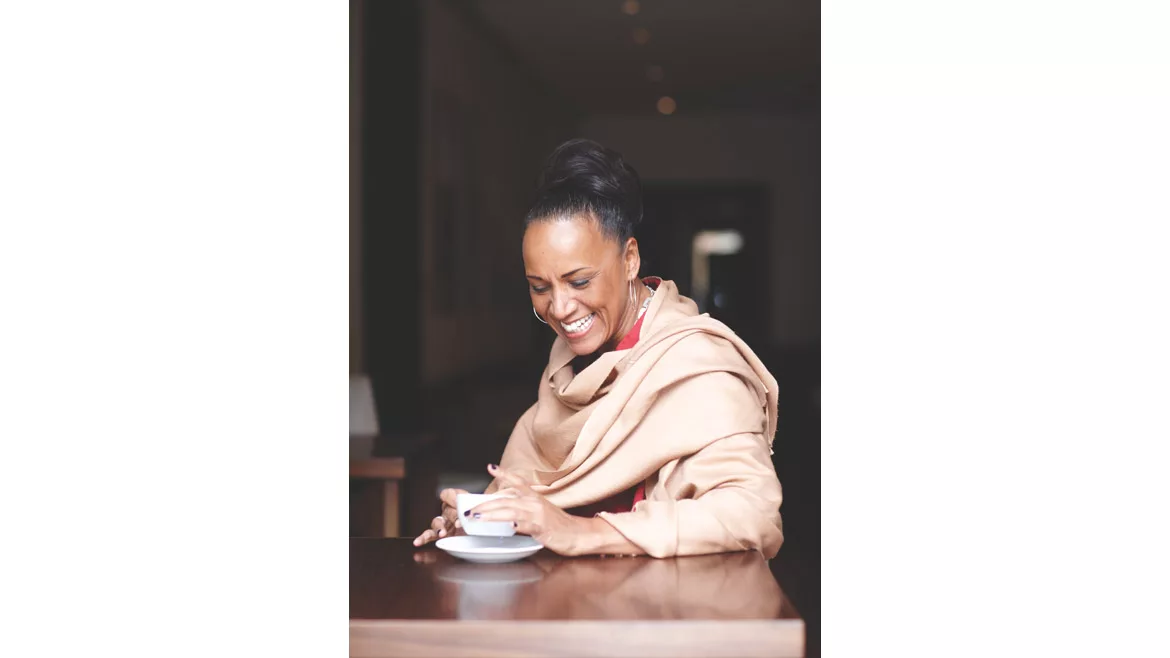
Lesley Lokko. Photography © Debra Hurford-Brown
Lesley Lokko, the award-winning Ghanaian-Scottish architect and educator, has recently been named curator of the 2023 Venice architecture biennale, the first Black architect in this role. Lokko, who founded the Graduate School of Architecture at the University of Johannesburg, later became dean of the architecture school at the City College of New York—a post she left after barely one year, citing a lack of meaningful support. Her next move: launching an architecture program in Accra, Ghana (with the active encouragement of David Adjaye, who has expanded his architectural presence there, and with support from the Ford and Mellon foundations). While her plans for the Biennale are still in formation, Lokko’s perspective on Africa and the global south will clearly affect what has been a largely Eurocentric vision of architecture at prior Biennales. She spoke with RECORD editor-in-chief Cathleen McGuigan; here are highlights from their conversation.
Venice, historically, has been a crossroads of cultures, making it a particularly apt place for the kind of Biennale you will be curating.
Yes, it's an amazing opportunity to open the Biennale and to open architecture up. But I'm taking some time to really think about how to do that in a thoughtful and profound way rather than a reactionary way.
So tell us about the architecture school you are starting in Ghana, the African Futures Institute (AFI).
First of all, it's an institute, not a school. I was very clear that it would have a public events platform, as well as an academic program—and that we got going straightway last June. We've had public programs—lectures, films, discussions, and other events. It’s become a real go-to place in Accra to find out what's going on in the world of architecture.
For example, the first annual Alero Olympio Memorial lecture kicked off in August. Olympio was a Ghanaian architect, who died in 2005, and was known for championing local materials, sustainability, the role of women, empowerment and so forth. And so we asked [Nigerien architect] Mariam Kamara, and she flew in and gave the lecture—and it was amazing. Afterwards, I saw one girl crying her eyes out. When I asked why, she said, I've waited 27 years to see someone like Mariam. That was profound.
We’re in the process of setting up the school. I'm putting together a young research team now that will help me with the Biennale, so the AFI is going to pivot into a research project, which will allow us to get involved in academic work.
Looking for quick answers on architecture and design topics?
Try Ask RECORD, our new smart AI search tool.
Ask RECORD →
Lesley, you are European and African—you bridge these vastly different cultures in your own life. How does that affect what you're doing at the AFI and what you may be doing at the Biennale?
Europe and Africa have had an intertwined relationship for millennia. For me, the space that’s coming is very much a “both/and” not an “either/or.” I'm very interested in the relationships we have across this so-called enormous cultural divide—which, when you really dig down, is not that enormous—and in the idea of Africa as a place of intense experimentation about the future. I think what happens in Africa happens to all of us. We are fond of talking about the developing world or the third world as if those worlds are somewhere else, but actually, they are part and parcel of our world. So it's both about bridging what are perceived to be gaps but being alert and sensitive to the history and the experience of those gaps—and to view both the gaps and bridges as really intense places of creation. I think the imagination is the most powerful tool that we have, so it’s also about putting forward an idea that you can live, not just out of your history, but out of your imagination.
What do you think are the two or three biggest misconceptions that Europeans—and I include Americans—have about Africa today?
The idea that we are chaotic, that we are corrupt, that we are disorganized, that we are lagging behind in some way. I see it in the opposite way—I think what happens here is very much about the future. We're the world's youngest continent—the average age is under 20—so it's an incredibly dynamic place. And it is the world's fastest urbanizing continent. But we also have the fewest schools of architecture and the fewest registered architects. So who are going to be the architects of Africa's future? On a very pragmatic level, advances in technology and connection are made more complex by the African diaspora. Questions of scale and network are really understood differently here, because almost all Africans, in addition to official languages—English, French, Portuguese—we all speak an indigenous language. So this ability to translate and to move between worlds is very much part of the African DNA, and I find it fascinating that architecture is a discipline that’s all about translation.
At the AFI, according to the website, the basis of the pedagogy are the twin poles of decolonization and decarbonization.
Yes, the two big movements of the 21st century. Somewhere in all the conversations around sustainability and the environment—this was very clear to me when I was in the U.S.—is that the first units of energy were the Black body. So there's been a relationship between race and resources that's as old as time. In thinking about the future, you can’t “de-“ one without “de-ing” the other. But also, the effects of climate change are bound to be felt the worst here on the African continent.
So we have to think not just about the science of sustainability or environmental justice but about the cultural implications, as well. What does it mean to put forward a future in which you consume less? These are big questions, and I can't purport now to have any answers to them, but I'm trying to think about ways of intelligently asking them that will generate intelligent answers or intelligent propositions.
You’re also introducing a program on architecture criticism and journalism at the AFI.
Education is absolutely the battleground for us, all the way from training right up to thought leadership. One key mistakes people on this continent make when they think about architecture is that they think only about building. So for me, to start thinking about architecture as a language, as a discourse, as something that can be written but also be performed, is key—to open up the discipline, so it’s not only about building, it's about building society, building culture, building economies. The idea is not just producing more professional architects but actually producing people who think about architecture in a different way.
So you really see the Institute as a catalyst for a next generation?
Yes, the equation between architecture and Africa for so long has been that Africa was lacking something, it wasn’t sophisticated enough or organized enough or wealthy enough. There was nothing that Africa could bring to architecture. I think the reverse is true: for the complexities that the continent throws up, architecture is not sophisticated enough to know how to deal with those complexities. So this is an idea of putting a pedagogy in place that really makes use of those complexities not only in terms of their challenges but also in terms of their opportunities. Maybe there are disciplinary combinations that in the West would be unheard of—you know, a person who is a public health official and an architect simultaneously. Or different routes to becoming a professional architect. That's why I really do see this as a laboratory of the future. It’s the testing ground for where the discipline might go.
Looking for a reprint of this article?
From high-res PDFs to custom plaques, order your copy today!