A Tale of Two Detroits
Late last month, an upscale accessories boutique designed by the Rockwell Group opened on a fashionable Tribeca street in downtown Manhattan. Shinola, as it’s called, sells its own brand of wristwatches, leather goods, and custom bicycles, and to celebrate the shop’s opening, the Detroit-based company took out a full-page ad in The New York Times that declared: “To those who’ve written off Detroit, we give you the Birdy.” The Birdy is the name of one of its watches, and if it seems ironic that the biggest municipal bankruptcy in U.S. history turned out to be a well-timed hook to market expensive timepieces, the Shinola story actually strikes a promising note in the complex and uncertain saga of where Detroit is heading.
 |
| Photo courtesy Shinola A Shinola employee in the Argonaut building in Detroit. |
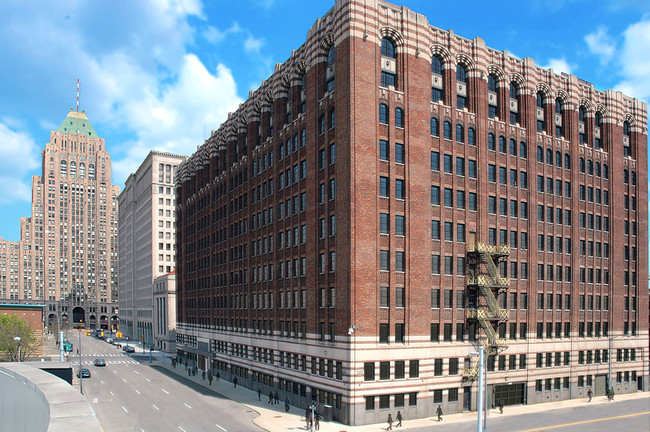
The choice of Detroit for the new company’s headquarters—Shinola’s trademark is “Where American Is Made”—was calculated. The business is the brainchild of a Dallas-based venture capital firm, and when executives visited Detroit in 2011 in search of potential sites, they found an entire vacant floor in the Argonaut Building, an 11-story landmark by Albert Kahn completed in 1930 that is now home to the College for Creative Studies. The company bought the Shinola trademark from the now-defunct shoe polish company—for the irreverent humor in the expression “you-don’t-know-sh*t from Shinola”—and set up shop in the Argonaut, where 75 employees, hired and trained locally, now meticulously assemble each watch and bike.
The Argonaut originally housed the research laboratories of General Motors, an incubator of innovation that helped transform Detroit into a 20th century manufacturing powerhouse and the fourth largest city in the U.S. before World War II. The wider impact of the area’s industrial history on design is explored in a fine exhibition at the Cranbrook Art Museum in suburban Bloomfield Hills, Michigan Modern: Design that Shaped America (through October 13), curated by Monica Ponce de Leon, dean of the architecture and urban planning program at the University of Michigan, and Greg Saldaña. The show argues that Detroit industry’s breakthroughs in standardized components and mass production fueled the ideas of a generation of modernist architects and designers—Eero Saarinen, Charles and Ray Eames, Ralph Rapson, among others. “We saw the past,” says Heath Carr, CEO of Shinola, about the company’s decision to come to Detroit, “And we found a very artistic, creative energy here today.”
That energy is evident in pockets of Detroit, as the media has reported, where young people have been moving to work as artists, designers or musicians, in tech start-ups, or other small businesses. Downtown Detroit has become such a desirable place to live that it’s hard to find an apartment. The neighborhood around the city’s thriving, historic Eastern Market is dotted with new coffee shops, wine bars, and storefront performance venues. Historic architecture—like the Argonaut—is being re-habbed to lure fledgling entrepreneurs, much of it by real estate developer and founder of Quicken Loans, Dan Gilbert, an avid promoter of Detroit’s future.
Of course, the embryonic signs of Detroit’s revitalization are at odds with the grim facts that have been re-played repeatedly since the city’s emergency manager Kevin Orr filed for Chapter 9 bankruptcy on July 18: the high murder rates, an average 58-minute wait for a fire truck, two-thirds of the city’s ambulances broken down on any given day.
Are there two Detroits? Yes, at least two. One is a cool place for urban pioneers, attracting talent and investment to dense parts of the city, and building on a history of innovation. The other Detroit includes those who live in economic privation and geographic isolation in almost abandoned neighborhoods within the sprawling 143-square-miles of the city limits. (Its grittier precincts form the dark backdrop of a new TV show, “Low Winter Sun.”)
Early this year, the nonprofit organization Detroit Works Project, largely funded by the Kresge Foundation, unveiled an ambitious long-term plan that was based on three years of research and engagement across many sectors of the city’s population. Officials behind the plan, called Detroit Future City (DFC), say that the bankruptcy filing is unlikely to derail the implementation of some of its most urgent recommendations. “This project, when it started in 2010, presupposed the city’s financial insolvency,” says DFC director Dan Kinkead. “The bankruptcy is a rough thing—people are going to lose pensions—but it also shines a bright light on key issues we have to deal with.” Among early problems to be tackled: improving water and sewage systems and beginning to eliminate blight, particularly on public land.
Over the longer term, the plan calls for building an integrated regional public transit system, identifying new centers of economic activity, and shifting land use on some open tracts, including more urban farming. The plan recognizes that the number of residents won’t grow in the decades ahead, but it aims to create opportunities for a more diverse population.
The metropolis can’t thrive in isolation, nor fail without wider implications. In the 1960s and 1970s, Detroit was the poster city for white flight. Today, it is not only surrounded by prosperous suburbs, but the recovering auto industry—aided by an $80 billion Federal bail-out—is now largely located outside its boundaries. In addition, the larger metropolitan area includes Ann Arbor, which, with its world-class university, is a hub for research and development in science and technology. The DFC plan includes this imperative: “We must pursue a collaborative regional agenda that recognizes Detroit’s strengths and our region’s shared destiny.”
Does the larger metropolitan area acknowledge its stake in the city? “We have to think regionally, with regional transit, regional water, regional services,” says Dan Pitera, the director of the Detroit Works Project’s civic engagement team. “Many people in the suburbs are seeing Detroit differently. I think there’s been a shift in the last 10 years to an understanding that there is interconnectivity.” Last year voters in three surrounding counties approved a tax on themselves to support the Detroit Institute of Arts. Detroit’s future depends not only on the burgeoning downtown “creative class,” to borrow Richard Florida’s term, but on its neighboring populations, businesses, and institutions.
Saving Detroit will be a decades-long project—one that requires the investments of many more companies like Shinola, the ongoing energy of new arrivals, and the optimistic endurance of those already there. Their shared destiny should matter to all of us who care about the future of our cities.
Anna Fixsen contributed reporting to this article.