Architectural Record
search
cart
facebook twitter linkedin youtube
  • Sign In
  • Subscribe
  • Sign Out
  • My Account
Architectural Record
  • NEWS
    • Latest News
    • Awards
    • Interviews
    • Obituaries
    • Podcasts
      • Design:Ed Podcast
      • Sponsored Podcasts
  • OPINION
    • Book Reviews / Excerpts
    • Exhibition Reviews
    • Forum
  • EXCLUSIVES
    • Videos
    • Design Vanguard
    • Top 300 Firms
    • Sponsored Content
    • Sponsored eBooks
    • From the Archives
  • CONTINUING ED
    • Editorial Continuing Ed
    • CE Center
    • CE Academies
  • PROJECTS
    • Buildings By Type
    • Reuse & Renovation
    • Museums & Arts Centers
    • Colleges & Universities
    • Multifamily Housing
    • Interiors
    • Lighting
    • Kitchen & Bath
  • HOUSES
    • Record Houses
    • House of the Month
    • Featured Houses
  • PRODUCTS
    • Products by Category
    • Record Products of the Year
    • Latest Products
  • EVENTS
    • Dates & Events
    • Record on the Road
    • Innovation Conference
    • Sustainability in Practice
    • Women In Architecture
    • Webinars
    • Ad Excellence Awards
    • Submit an Event
  • CONNECT
    • Ask RECORD AI
    • Newsletters
    • Contact
    • Advertise
    • Editorial Calendar
    • Store
    • Customer Service
  • SUBMIT
    • Submission Guidelines
    • RECORD Competitions
  • MAGAZINE
    • Subscribe
    • My Account
    • Digital Edition
    • Current Issue
    • Firm Pass
    • Historic Archive
Architecture News

Whose Vision of a Future City Will Prevail?

By Henry Ng
Whose Vision of a Future City Prevail?

Whose Vision of a Future City Prevail?

Beyer Blender Belle envisions Washington, D.C., in the year 2108 as a city whose avenues have been planted with gardens to become "greenstreets."

Image courtesy Beyer Blinder Belle
Whose Vision of a Future City Prevail?

Whose Vision of a Future City Prevail?

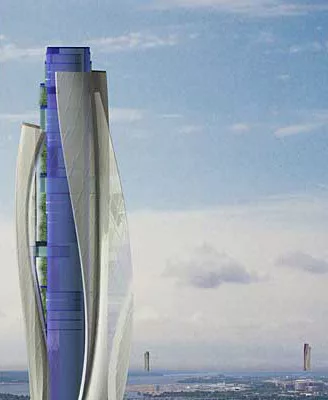
Some 28 Civil War-era forts surrounding Washington, D.C., would be transformed into "eco-towers" that harness sun and wind energy, and contain hydroponic gardens.

Image courtesy Beyer Blinder Belle
Whose Vision of a Future City Prevail?

Whose Vision of a Future City Prevail?

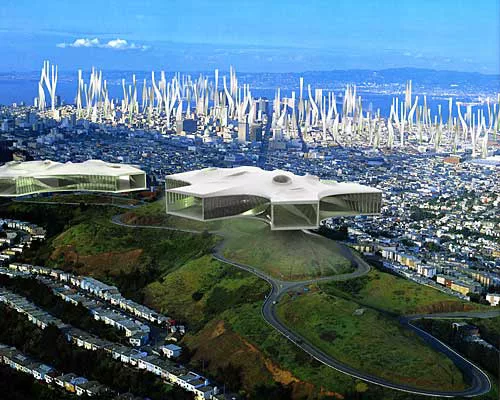
For San Francisco in the year 2108, IwamotoScott proposes a "Hyrdo-net," whose underground tubes will store hydrogen and convey people, goods, and energy throughout the city. 

Image courtesy Iwamoto Scott
Whose Vision of a Future City Prevail?

Whose Vision of a Future City Prevail?

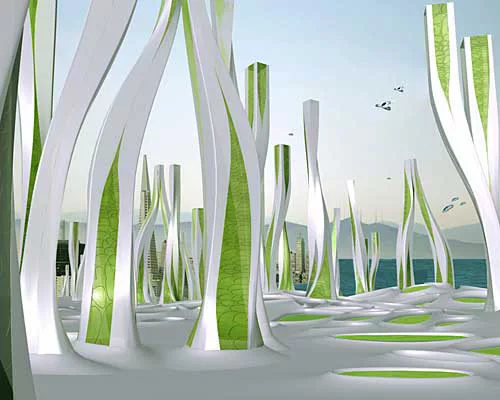
Above ground, the Hydro-net is linked to structures that resemble seaweed or mushrooms. They would contain hydrogen-producing algae farms, fog catchers, and water extractors.

Image courtesy Iwamoto Scott
Whose Vision of a Future City Prevail?

Whose Vision of a Future City Prevail?

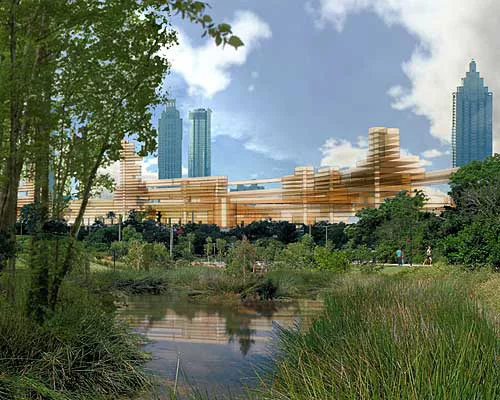
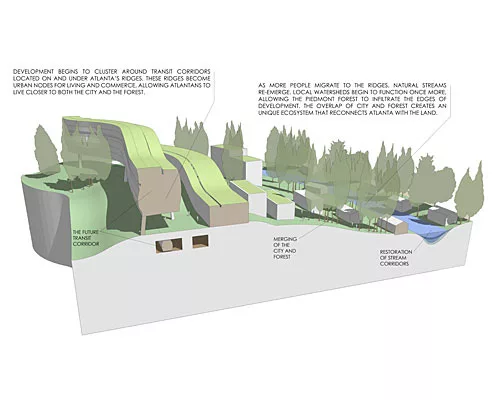
EDAW proposes restoring Atlanta's forest and stream network, in harmony with the city, by the year 2108. Buildings would be concentrated in forests at the tops of hills.

Image courtesy EDAW
Whose Vision of a Future City Prevail?

Whose Vision of a Future City Prevail?

Atlanta's old sewer system, which was built in the 1800s by re-channeling existing streams, would be uncovered and these waterways restored.

Image courtesy EDAW

Whose Vision of a Future City Prevail?
February 20, 2008
Whoever is elected president in the year 2108 might be taking up residence in a White House surrounded by fields of heirloom tomatoes—at least, that’s how Beyer Blinder Belle Architects & Planners (BBB) envisions the future appearance of Washington, D.C., in a scheme that calls for farmland to replace pavement along Pennsylvania Avenue and other thoroughfares.
 
BBB’s fanciful scheme is one of three futuristic urban visions generated through the second annual ideas competition City of the Future: A Design and Engineering Challenge. In a series of three contests this winter, sponsor The History Channel asked teams of architects in D.C., San Francisco, and Atlanta to envision their cities as they might appear a century from now. The winning firms were BBB, IwamotoScott Architecture, and EDAW, respectively. They are now vying against each other in an online competition to choose an overall winner.
 
The competition is a companion to the television series Cities of the Underworld, which profiles the underbellies of the world’s great metropolises, so teams were asked to examine their city’s substructures. They also considered aging infrastructures, natural topography, and historic buildings. “The proposals look into the future, but they generally mirror issues that are currently significant,” observes competition advisor Casey Jones.
 
Environmental crisis was the chief concern among the winning proposals, which grappled with issues including resource production and consumption, drought, and rising sea levels. In D.C., BBB predicts that flooding of the Potomac River will permanently inundate the National Mall. Communal farming will happen on greenways that replace the city’s historic avenues, planned by Pierre L’Enfant. Sinuous “ecotowers” will rise on 28 of 69 Civil War era military forts that ring the city, where they would harvest wind, solar energy, and rainwater, and produce food in hydroponic farms.
 
Does the positioning of these towers signify a post-apocalyptic world, in which the nation has declared war on eco-disaster? BBB partner Hany Hassan says that the scheme was “an optimistic approach,” but that the team “wanted to ground itself in certain realities.” Regarding the forts, he adds, “these structures once defended the city, but can now bring in new life.”
 
For San Francisco, IwamotoScott imagines an extensive underground “Hydro-net” that simultaneously circulates people, vehicles, water, and energy throughout the city. Connected to this network are resource collection systems whose forms resemble seaweed and chanterelle mushrooms. They include hydrogen-producing algae farms, fog catchers that harvest air moisture, and water extractors that pump fresh water from a currently unused aquifer beneath the city. The Hydro-net is so named after its ability to store hydrogen in walls made of carbon nanotubes. These infinitesimally small, carbon-based, tubular structures are an emerging technology that researchers hope can one day perform revolutionary tasks, like build microscopic computers, or efficiently store hydrogen. Many environmentalists consider the use of hydrogen over carbon-based fossil fuel a necessity in slowing climate change.
 
In a similar vein, EDAW sought to reintroduce water from Atlanta’s antiquated sewer system above ground to create natural waterways flowing through the city. Natural processes would treat the water rather than machines. Surrounding forests would also creep into the city, relaxing the urban grid and creating hybrid environments at the boundaries between city and nature. These changes would significantly reduce storm water runoff, lessening the effect of droughts like the one resulting from an 18.5-inch rainfall deficit last year. Team leader Eric Bishop believes these efforts would define a new age that he calls “the Restorative Era,” during which restored natural systems lift the burden from man-made infrastructure.
 
The three local winners each went home with a $10,000 prize. Public voting, via The History Channel’s Web site, began last week and will remain open until April 28; the winner of this final competition stage will receive another $5,000.
 
While this is strictly an ideas competition, elements from the schemes are likely to inspire real-world projects. Jones notes that Chicago is now constructing a few experimental “eco-boulevards,” a key feature in last year’s proposal by UrbanLab, winners of the Chicago competition. The firm proposed inserting green avenues throughout Chicago that would treat the city’s wastewater and storm water with microorganisms, fish, and plants. The water could then be harvested for use or returned to the Great Lakes Basin. Jones hopes that this year’s competition, like the previous one, will “create a spark for all cities to think proactively.”


Share This Story

Looking for a reprint of this article?
From high-res PDFs to custom plaques, order your copy today!

Post a comment to this article

Report Abusive Comment

Subscription Center
  • Create an Account
  • Start a Subscription
  • Manage My Account
  • Sign Up for Newsletters
  • Visit Customer Service
  • Update Preferences

More Videos

Sponsored Content

Sponsored Content is a special paid section where industry companies provide high quality, objective, non-commercial content around topics of interest to the Architectural Record audience. All Sponsored Content is supplied by the advertising company and any opinions expressed in this article are those of the author and not necessarily reflect the views of Architectural Record or its parent company, BNP Media. Interested in participating in our Sponsored Content section? Contact your local rep!

close
  • TAMLYN XtremeTrim Exterior Trim
    Sponsored byTamlyn

    Designing Cleaner Panel Facades: Why Exterior Trim Details Matter

  • Building with Vapor Barriers
    Sponsored byReef Industries, Inc.

    Vapor Barriers Help Control Moisture in Tighter Building Designs

  • Duct Interior with Prodeq System
    Sponsored byHenry, a Carlisle Company

    Designing Resilient Water Containment Systems

DESIGN:ED Podcast
Listen to Architectural Record’s DESIGN:ED Podcast

Events

June 11, 2026

Very Early Warning Fire Detection for Mission-Critical Facilities

Credits: 1 AIA LU/HSW; 1 AIBD P-CE; 0.1 ICC CEU

Examine advanced fire detection strategies that support uptime and enhance safety in data centers and other mission-critical facilities.

June 16, 2026

Focus on the Façade: Exploring Steel, Timber & Fire-Rated Curtain Walls and Channel Glass Systems

Credits: 1 AIA LU/HSW; 1 AIBD P-CE; 0.1 ICC CEU

Explore modern façade and glazing systems that enhance daylighting, fire safety, and thermal performance while expanding architectural design possibilities.

View All Submit An Event

Products

2026 Architect's Square Foot Costbook

2026 Architect's Square Foot Costbook

See More Products

Popular Stories

Coronado Bridge

The Architect’s Guide to San Diego

Practice Matters illustration

By the Numbers: Counting America's Architects

SanDiegoAirport

Top 300 Architecture Firms of 2026

House on a Hill

Design Vanguard 2026: Forma

Crane Cove, ONO

Design Vanguard 2026 Winners

Broader Sustainability of CMU - Free Webinar - May 21, 2026

Related Articles

  • 1-Venice-Architectural-Record.jpg

    The Venice Architecture Biennale’s Optimistic Vision of the Future

    See More
  • Maggie's Centre: A Patient's Vision of Cancer Care Inspires Architects' Designs

    See More
  • The Past and Future City

    The Past and Future City: How Historic Preservation is Reviving America’s Communities

    See More

Related Products

See More Products
  • 1118522532.gif

    Future Details of Architecture

  • WC_-SCA.png

    Building Great Schools for a Great City

  • 3dthinking.jpg

    3D Thinking in Design and Architecture: From Antiquity to the Future

See More Products
×

The latest news and information

#1 Source for Architectural Design, News and Products

SUBSCRIBE
  • RESOURCES
    • Advertise
    • Contact Us
    • Submit
    • Store
  • ACCOUNT CENTER
    • Create an Account
    • Start a Subscription
    • Manage My Account
    • Sign Up for Newsletters
    • Visit Customer Service
    • Update Preferences
  • PRIVACY
    • PRIVACY POLICY
    • TERMS & CONDITIONS
    • DO NOT SELL MY PERSONAL INFORMATION
    • PRIVACY REQUEST
    • ACCESSIBILITY
  • SERVICES
    • Marketing Services
    • Reprints
    • Market Research
    • List Rental
    • Survey/Respondent Access
  • STAY CONNECTED
    • Linkedin
    • Facebook
    • Instagram
    • YouTube
    • X (Twitter)

Copyright ©2026. All Rights Reserved BNP Media, Inc. and BNP Media II, LLC.

Design, CMS, Hosting & Web Development :: ePublishing