Architectural Record
search
cart
facebook twitter linkedin youtube
  • Sign In
  • Subscribe
  • Sign Out
  • My Account
Architectural Record
  • NEWS
    • Latest News
    • Awards
    • Interviews
    • Obituaries
    • Podcasts
      • Design:Ed Podcast
      • Sponsored Podcasts
  • OPINION
    • Book Reviews / Excerpts
    • Exhibition Reviews
    • Forum
  • EXCLUSIVES
    • Videos
    • Design Vanguard
    • Top 300 Firms
    • Sponsored Content
    • Sponsored eBooks
    • From the Archives
  • CONTINUING ED
    • Editorial Continuing Ed
    • CE Center
    • CE Academies
  • PROJECTS
    • Buildings By Type
    • Reuse & Renovation
    • Museums & Arts Centers
    • Colleges & Universities
    • Multifamily Housing
    • Interiors
    • Lighting
    • Kitchen & Bath
  • HOUSES
    • Record Houses
    • House of the Month
    • Featured Houses
  • PRODUCTS
    • Products by Category
    • Record Products of the Year
    • Latest Products
  • EVENTS
    • Dates & Events
    • Record on the Road
    • Innovation Conference
    • Sustainability in Practice
    • Women In Architecture
    • Webinars
    • Ad Excellence Awards
    • Submit an Event
  • CONNECT
    • Ask RECORD AI
    • Newsletters
    • Contact
    • Advertise
    • Editorial Calendar
    • Store
    • Customer Service
  • SUBMIT
    • Submission Guidelines
    • RECORD Competitions
  • MAGAZINE
    • Subscribe
    • My Account
    • Digital Edition
    • Current Issue
    • Firm Pass
    • Historic Archive

Gold Medal: Peter Bohlin

Unlike recent Gold Medalists, Peter Bohlin is not a lone prodigy; his contribution is inseparable from the firm he founded 45 years ago. His work lacks grandiosity, favoring instead a light touch, a Modernism mellowed by emotion. From the start, his designs have flowed from the circumstances of each project and his attempts to be environmentally responsible.

By Andrea Oppenheimer Dean
Gold Medal: Peter Bohlin

Gold Medal: Peter Bohlin

Photo © Brian Smale
Gold Medal: Peter Bohlin

Gold Medal: Peter Bohlin

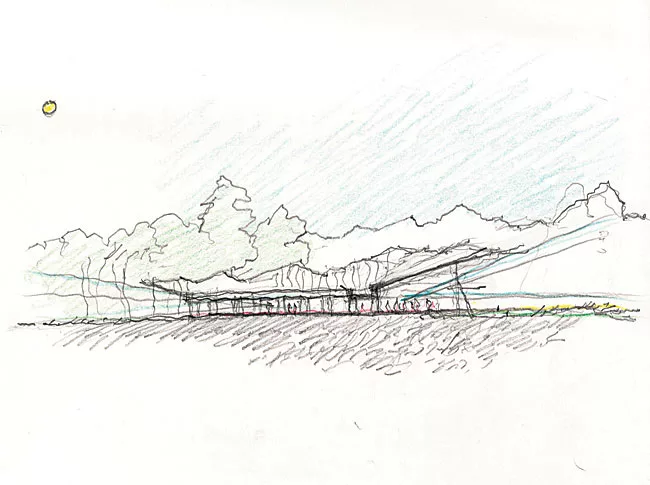
Bohlin’s sketch for the Grand Teton Discovery and Visitor Center shows circulation and the roof opening to mountain views.

Image courtesy Peter Bohlin
Gold Medal: Peter Bohlin

Gold Medal: Peter Bohlin

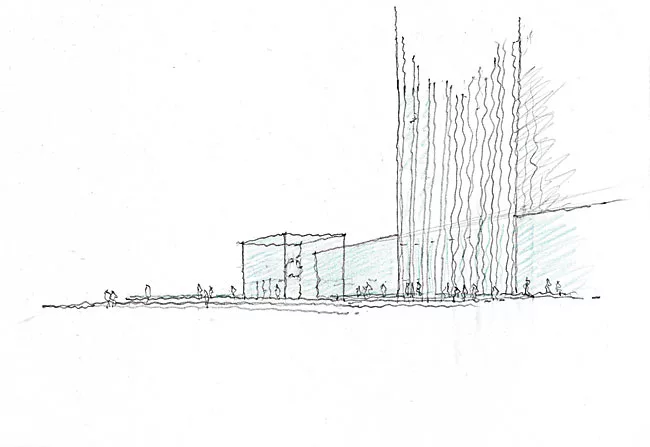
Bohlin’s early conceptual drawing for Apple Fifth Avenue envisions the 32-foot glass cube that acts both as entrance and symbol for the store.

Image courtesy Peter Bohlin
Gold Medal: Peter Bohlin

Gold Medal: Peter Bohlin

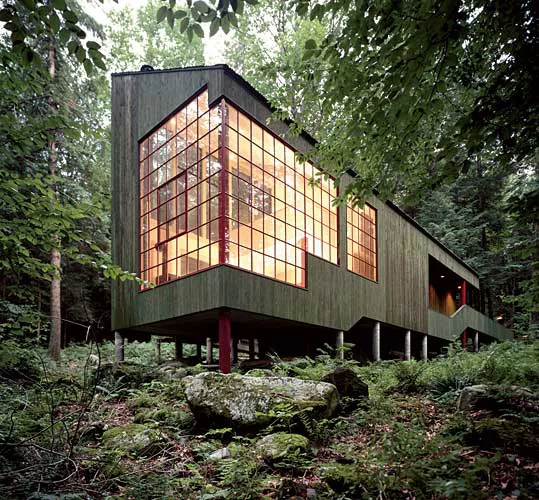
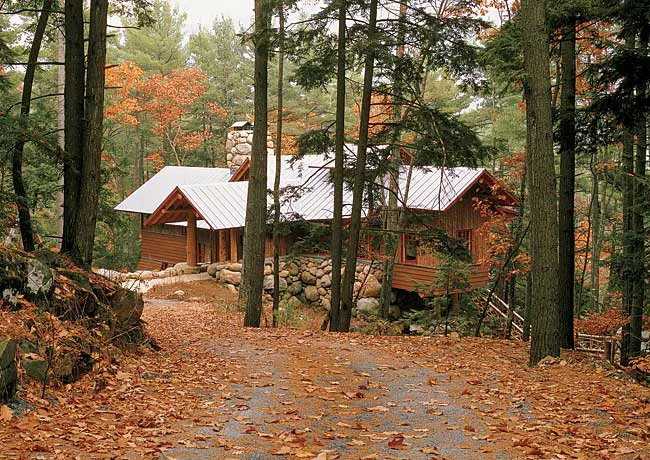
Bohlin designed this narrow, green-stained wood house as a retreat for his parents. At the junction of a dark evergreen forest and a deciduous woodland, the building springs from a log-loading platform and floats over the forest floor. Carving around an existing boulder, explains Bohlin, the house demonstrates the value of accommodation and of ""doing this and that rather than just one thing."" The architect says the house is ""all about moving from dark to light"" and points to its circulation, which originates on the shaded edge and ends in a tall, illuminated space. Bohlin’s light touch continues inside, where pale gray walls contrast with red-painted mullions that frame leafy views.

Photo © Michael Thomas
Gold Medal: Peter Bohlin

Gold Medal: Peter Bohlin

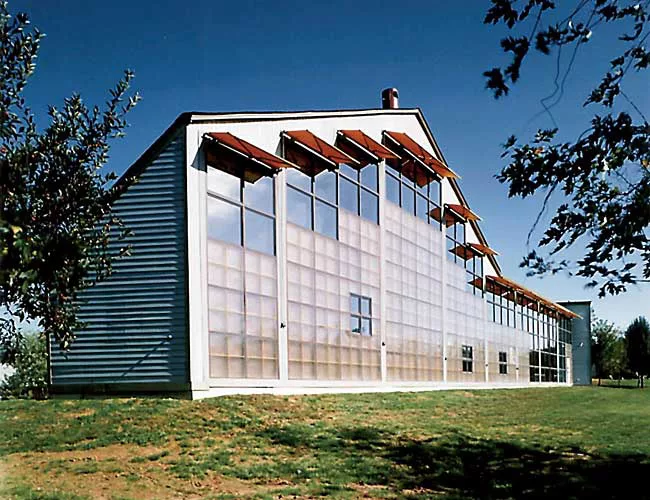
Designed and built under a federal nonresidential passive-solar demonstration program, the Girl Scout Center derives about half its heating, lighting, and hot water from solar energy. The deceptively simple design features a south-facing solar wall, an unusually thin Trombe wall supported by timber framing and brick infill. The Trombe wall facilitates quick warming on chilly mornings and distributes heat during afternoon and early evening hours when the building is in use. A concrete floor and semicircular brick wall also capture solar heat. Bohlin says that most passive-solar buildings of the time were visual one-liners. ""We wanted to make this a place children could learn from — and one that was fun.

Photo © Otto Baitz/Esto
Gold Medal: Peter Bohlin

Gold Medal: Peter Bohlin

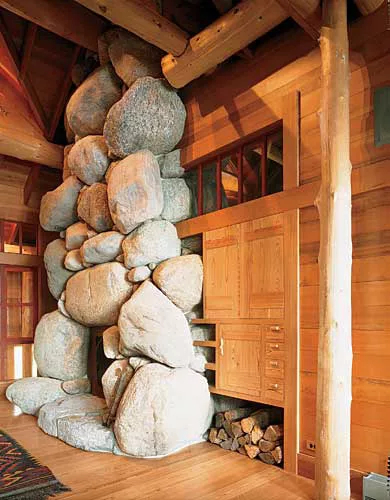
The client asked for a vacation home in the tradition of the great Adirondack camps, a request that Bohlin saw as an opportunity to enrich his Modern design vocabulary. The building steps down a steep slope at the edge of a mountain lake, adopting the design idiom of the Alpine tradition and melding man-made and natural elements. The slightly angled main entrance on the upper level inclines toward the visitor and is topped by a gable of stout logs. The entry leads through thick cedar columns to a massive granite fireplace, which rises through the structure and dominates the central living spaces, which are illuminated by high clerestories.

Photo © Karl A. Backus
Gold Medal: Peter Bohlin

Gold Medal: Peter Bohlin

The client asked for a vacation home in the tradition of the great Adirondack camps, a request that Bohlin saw as an opportunity to enrich his Modern design vocabulary. The building steps down a steep slope at the edge of a mountain lake, adopting the design idiom of the Alpine tradition and melding man-made and natural elements. The slightly angled main entrance on the upper level inclines toward the visitor and is topped by a gable of stout logs. The entry leads through thick cedar columns to a massive granite fireplace, which rises through the structure and dominates the central living spaces, which are illuminated by high clerestories.

Photo © Karl A. Backus
Gold Medal: Peter Bohlin

Gold Medal: Peter Bohlin

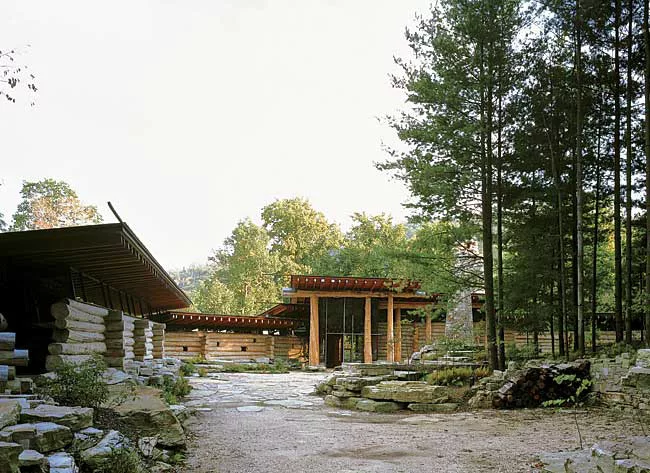
Sited on a mountainside clearing with stone ledges, Ledge House overlooks a valley. It employs the Adirondack Retreat’s material palette but represents a conceptual shift. The architects used boulders for the foundation and fireplace and logs for the entry vestibule and superstructure, and arranged timber-and-stone shed-roof pavilions in a horseshoe pattern wrapping a rock-lined entry court. The log entrance facade has a number of openings for viewing out, recalling the “gun-port” windows of the Civil War log forts that once dotted Maryland’s mountainsides. Inside, timber columns and beams, industrial metal strapping, and exposed wood joists reinforce the fortlike quality.

Photo © Karl A. Backus
Gold Medal: Peter Bohlin

Gold Medal: Peter Bohlin

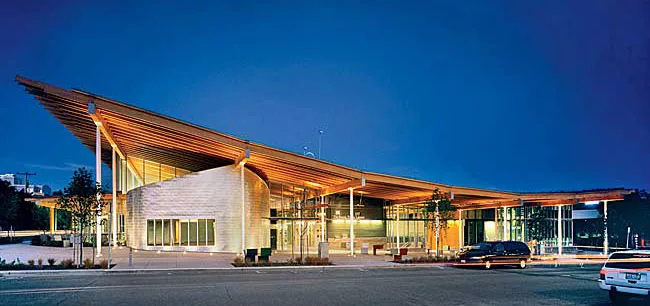
Local Residents pushed an aggressive environmental agenda and participated in selecting BCJ for this neighborhood center. In appearance, the library is at once Modern and respectful of the Ballard community’s maritime tradition. A dramatically sweeping roof supported by laminated wood beams extends beyond the exterior walls, defining the building. Both inside and out, white steel columns, tapered at each end, resemble ships’ masts.

Photo © Nic Lehoux
Gold Medal: Peter Bohlin

Gold Medal: Peter Bohlin

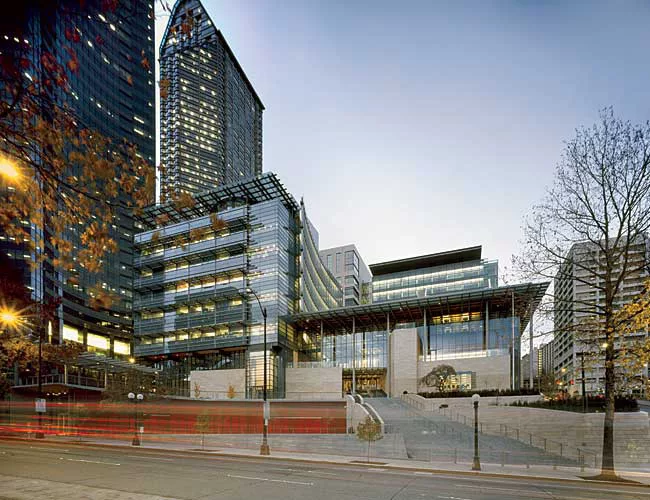
Aiming for LEED Silver, BCJ earned Gold for its Seattle City Hall. The firm’s strategies included a range of shading schemes, light shelves to distribute daylight inside, and a green roof. The city posited three requirements: City Hall had to be open and welcoming, environmentally respectful, and last 100 years. Outer walls of glass carry daylight into interiors and express the ideal of open government, while the lobby serves as a town square. The building, which glows at night, has become a civic focus for the downtown area.

Photo © Nic Lehoux
Gold Medal: Peter Bohlin

Gold Medal: Peter Bohlin

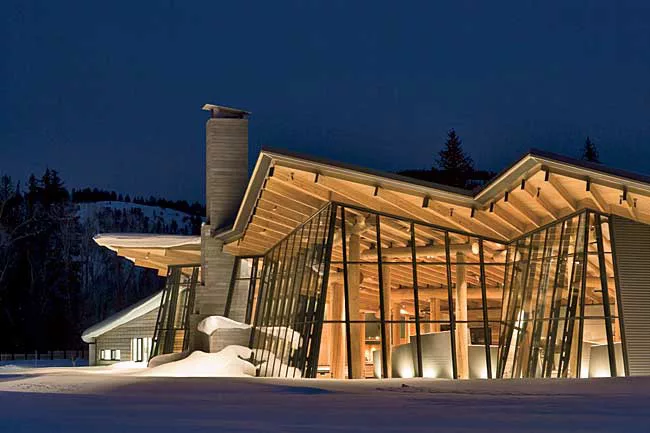
The architects successfully lobbied to separate the building and parking lot for this project, arguing that people need a short walk to decompress from the stresses of the road. BCJ designed the center to enhance, rather than compete with, the mountain views. As visitors follow a winding path from the lot, however, the Tetons temporarily disappear behind an undulating roofline that echoes the natural topography beyond. A courtyard formed by the building’s arms funnels visitors to a low entry that opens to the primary interior space with a soaring ceiling and a nearly 30-foot-high glass curtain wall facing the breathtaking views.

Photo © Nic Lehoux
Gold Medal: Peter Bohlin

Gold Medal: Peter Bohlin

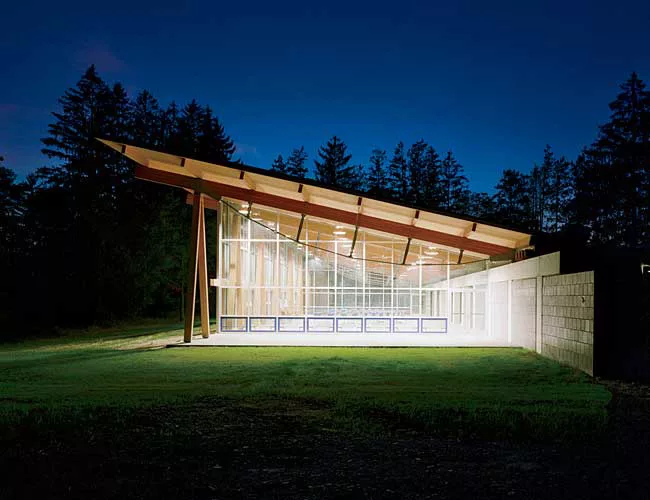
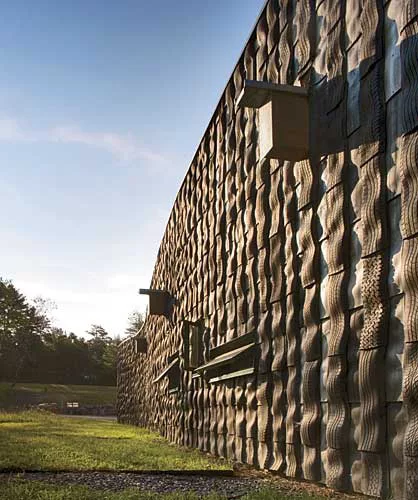
BCJ designed the Environmental Education center to reflect the commitment to environmental stewardship of its sponsors, the Pocono Environmental Education Center and the National Park Service. The building, which is used for meetings, lectures, and educational purposes, distills BCJ’s approach to nature-center design. It employs basic shed massing, a broad overhanging roof, a shingled facade made of recycled tires, natural materials, passive solar heating, natural ventilation, and daylighting strategies. The design is layered: Before entering an opening in the dark north wall, visitors traverse a forest, cross a wetland, and pass through service spaces. The entry leads into a bright, daylit central room, which is warmed by the sun, cooled by prevailing breezes, and open to views of the forest to the south.

Photo © Christopher Barone
Gold Medal: Peter Bohlin

Gold Medal: Peter Bohlin

BCJ designed the Environmental Education center to reflect the commitment to environmental stewardship of its sponsors, the Pocono Environmental Education Center and the National Park Service. The building, which is used for meetings, lectures, and educational purposes, distills BCJ’s approach to nature-center design. It employs basic shed massing, a broad overhanging roof, a shingled facade made of recycled tires, natural materials, passive solar heating, natural ventilation, and daylighting strategies. The design is layered: Before entering an opening in the dark north wall, visitors traverse a forest, cross a wetland, and pass through service spaces. The entry leads into a bright, daylit central room, which is warmed by the sun, cooled by prevailing breezes, and open to views of the forest to the south.

Photo © Nic Lehoux
Gold Medal: Peter Bohlin

Gold Medal: Peter Bohlin

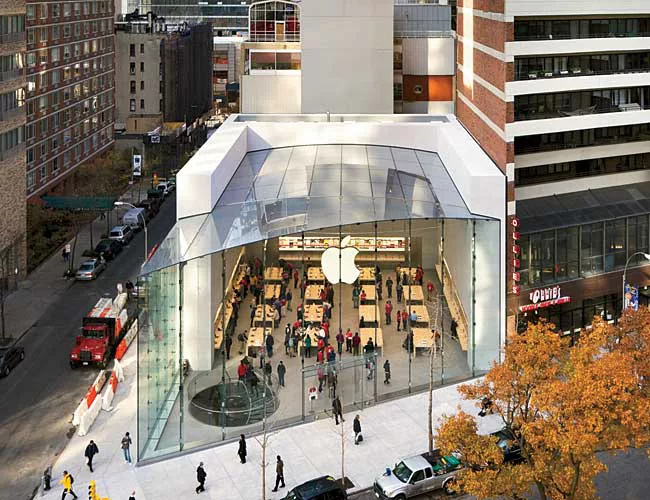
Apple has commissioned BCJ to design several stores, among them the flagship Apple Fifth Avenue (right) and Apple Upper West Side (below). Apple Fifth Avenue, the company’s busiest store, is a precision-engineered transparent cube. Mullion-free glass walls rise 32 feet to meet an all-glass roof with an almost invisible joint. The roof, of fritted insulating-glass panels on thin metal purlins, seamlessly incorporates lighting, sprinklers, and security systems. A spiral glass staircase effectively draws shoppers from the cube down to the store. Blonde maple floors, blocky wood display tables, and modular ceilings create a recognizable image for the brand. For their latest store on the Upper West Side, the architects carried over some of the same language, creating a grand, glassed-in main floor with a glass spiral staircase leading to more products below ground.

Photo © Peter Aaron/Esto
Gold Medal: Peter Bohlin

Gold Medal: Peter Bohlin

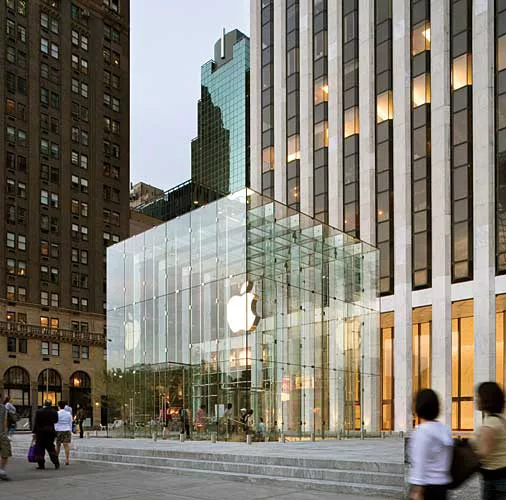
Apple has commissioned BCJ to design several stores, among them the flagship Apple Fifth Avenue (right) and Apple Upper West Side (below). Apple Fifth Avenue, the company’s busiest store, is a precision-engineered transparent cube. Mullion-free glass walls rise 32 feet to meet an all-glass roof with an almost invisible joint. The roof, of fritted insulating-glass panels on thin metal purlins, seamlessly incorporates lighting, sprinklers, and security systems. A spiral glass staircase effectively draws shoppers from the cube down to the store. Blonde maple floors, blocky wood display tables, and modular ceilings create a recognizable image for the brand. For their latest store on the Upper West Side, the architects carried over some of the same language, creating a grand, glassed-in main floor with a glass spiral staircase leading to more products below ground.

Photo © Peter Aaron/Esto
Gold Medal: Peter Bohlin

Gold Medal: Peter Bohlin

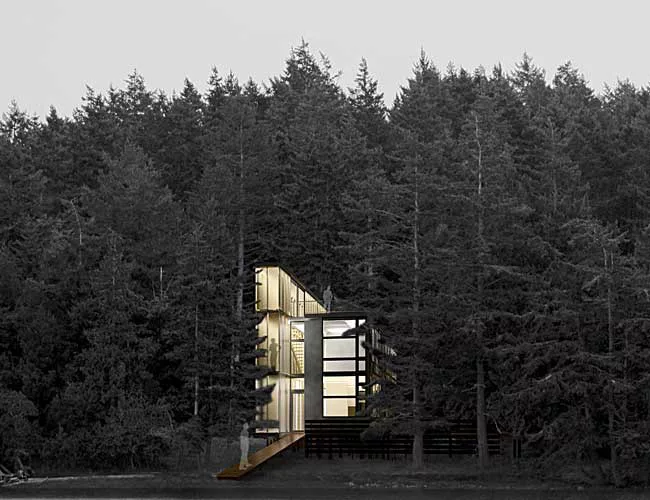
This house and studio for an architectural photographer sits on a densely forested spit of land extending south of the Canadian border and west of Washington’s coastline. To reduce the 1,200-foot structure’s footprint and its impact on the landscape, BCJ arranged it on three levels and raised it on piers. The architects are also using prefabricated building elements to prevent the damage caused by on-site construction. To build in the most economical fashion, they are spacing stock dimensional lumber 5 feet on center, accommodating 5-by-8-foot window modules. The cladding combines solid fiber cement, translucent polycarbonate, and clear glass in ways that maximize lighting schemes.

Image courtesy Bohlin Cywinski Jackson

Gold Medal: Peter Bohlin

Gold Medal: Peter Bohlin

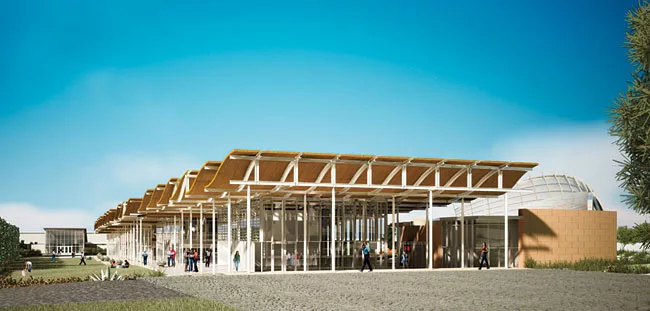
BCJ partnered with Arup and Peter Walker and Partners in this competition-winning design for a building and landscape symbolizing the community of Newport Beach. The project consists of a new City Hall and a parking structure screened by a plant-covered wall, an expanded library, and a public park. To create the new park, the team restructured the narrow 17-acre site, restoring wetlands. City Hall’s overhanging roof, patterned like ocean swells, screens north-facing clerestories that will bring diffused daylight into each two-level bay. The council chamber will ""fly"" a shimmering fabric ""sail,"" created by a scrim of Teflon-coated mesh over a steel frame. The designers situated the chamber and interior public space near City Hall’s main entry. Light-filled, flexible work areas will be built from a standard kit of parts, and cantilevered decks along the east facade, overlooking the community and its shoreline, will provide additional outdoor meeting space.

Image courtesy Bohlin Cywinski Jackson
Gold Medal: Peter Bohlin

Gold Medal: Peter Bohlin

BCJ partnered with Arup and Peter Walker and Partners in this competition-winning design for a building and landscape symbolizing the community of Newport Beach. The project consists of a new City Hall and a parking structure screened by a plant-covered wall, an expanded library, and a public park. To create the new park, the team restructured the narrow 17-acre site, restoring wetlands. City Hall’s overhanging roof, patterned like ocean swells, screens north-facing clerestories that will bring diffused daylight into each two-level bay. The council chamber will ""fly"" a shimmering fabric ""sail,"" created by a scrim of Teflon-coated mesh over a steel frame. The designers situated the chamber and interior public space near City Hall’s main entry. Light-filled, flexible work areas will be built from a standard kit of parts, and cantilevered decks along the east facade, overlooking the community and its shoreline, will provide additional outdoor meeting space.

Image courtesy Bohlin Cywinski Jackson
Gold Medal: Peter Bohlin

Gold Medal: Peter Bohlin

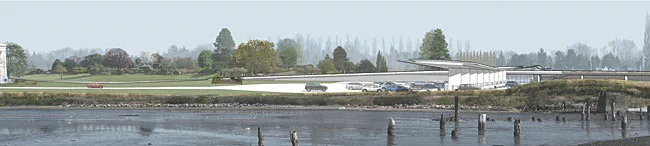
The redevelopment of this busy West Coast port features a long, narrow border-crossing structure paralleling the U.S.-Canadian boundary and an existing treeline. To create a design that represents democracy but is secure, BCJ has unobtrusively integrated security measures into the design. The 37-by-784-foot, two-story building floats on piers over the landscape, and slotted openings, admitting vehicular and pedestrian traffic, visually connect the two countries. Inside, a light-filled lobby leads to a court and to a park whose focus is the Peace Arch Monument. The compound, a GSA Design Excellence project, will qualify for LEED Gold.

Image courtesy Bohlin Cywinski Jackson

Gold Medal: Peter Bohlin
May 16, 2007
Peter Q. Bohlin, FAIA, describes himself as a “soft Modernist,” explaining, “I favor a more humane and emotionally nuanced Modernism, but without sacrificing intellectual rigor.” James Timberlake, FAIA, told the AIA board of directors in support of Bohlin’s Gold Medal candidacy, “His is not the work of grandiose egotism, or of vanity, but an ethically intelligent architecture of constructive logic that springs from the nature of circumstance.”
 
Unlike other recent Gold Medalists — Murcutt, Piano, Barnes, Predock, Calatrava, Mockbee, Ando, Graves — often regarded as lone prodigies, Bohlin’s contribution is inextricably linked with that of his practice, Bohlin Cywinski Jackson (BCJ), winner of the 1994 AIA Firm Award. With offices in Wilkes-Barre, Pennsylvania; Philadelphia; Pittsburgh; San Francisco; and Seattle, the 175-person practice has won more than 420 design awards for projects ranging from private houses to urban libraries, commercial buildings, and civic centers. Bohlin, 72, is identified as design principal on more than half of the firm’s projects and tends, more than his four partners or the firm’s seven principals, to “be a nomad,” as he puts it, traveling from office to office, as needed. “But it’s not a dictatorship,“ he insists. “We work in a collegial manner, by persuasion, enabling each other, driving each other, and getting better insights because of our interactions.”
 
With each project, Bohlin says, BCJ seeks to “broaden the means,” convinced that hybrids, satisfying two or more requirements, trump one-note solutions; that designs benefit from addressing perceived impediments; and that working at small and large scales at the same time is good for both types of buildings. For Bohlin, intuition is as important as intellect and, regardless of the commission, “the challenge is always the same,” he says, “to succeed in sensing what is unique and appropriate to each specific place, and understanding how people will live or work there. Then you have to realize those needs in a way that fascinates, inspires, and works.”
 
Bohlin’s search for a Modernism that “gets at the fundamentals,” as he says, began while he was a student at Rensselaer Polytechnic Institute, where he developed a Lou Kahn—like attitude toward materials. At Cranbrook, where he studied from 1959 to ‘61, Bohlin was deeply influenced by Eero Saarinen’s quest to amplify Modernism. In 1965, with a newly minted license and not yet 30, he launched his practice in Wilkes-Barre with Richard Powell, who served as managing partner. The firm would undergo several name changes before becoming BCJ in 1991.
 
From the start, Bohlin viewed sustainable design as not only the right thing to do but also as an opportunity to make richer, more persuasive architecture. His 1976 Forest House for his parents, in West Cornwall, Connecticut — a narrow, green-stained wood structure that hovers on piers above the forest floor — exemplifies this. “If the house were removed, the site would be left completely intact, an extremely sensitive approach to its intrusion upon nature,” Timberlake pointed out to the AIA directors.
 
The Forest House exhibits other characteristics that would make later appearances in BCJ’s mature work. There is the emphasis on “getting from here to there,” says Bohlin. Often meandering and marked by surprises, circulation is, for him and his team, as important as form in revealing the essence of a place. At Forest House, the approach twists toward a light-filled interior. There is an attempt to make an emotive place with simple means. And there is a convincing sense that the design is almost inevitable. “I was thinking of Joe DiMaggio and Ted Williams, who made it all look easy; that’s a goal of ours,” Bohlin explains.
 
Bohlin expanded his sustainable-design bona fides at the Shelly Ridge Girl Scout Center (1982) in eastern Pennsylvania, where he worked closely with colleague Frank Grauman — now a partner. At a time when energy-efficient buildings tended to look strictly utilitarian, Bohlin tried to make Shelly Ridge fun. It is a simple timber-framed structure with brick infill that incorporates daylighting schemes and employs an uncharacteristically thin south-facing Trombe wall to collect and distribute solar heat.
 
In the late 1980s, a client asked Bohlin to design a house in upstate New York in the manner of the 19th-century great Adirondack camps. Instead of deeming the commission as unworthy of a Modernist architect, Bohlin accepted the challenge and created the Adirondack Retreat using the great camps vocabulary of timbers and boulders to broaden his design lexicon. Later, in 1996, Bohlin completed the Ledge House in Maryland’s Catoctin Mountains, where he abandoned rustic forms but employed boulders for the foundation and timbers for the superstructure.
 
Bohlin applied some of the same language to his Environmental Education Center (2005) in Dingmans Ferry, Pennsylvania (a 2008 AIA Top Ten Green Project and a 2009 Green Good Design winner), and the Grand Teton Discovery and Visitor Center (2007) in Wyoming. Both projects are precisely sited wood-and-stone structures that “articulate the true nature of materials,” writes Tom Kundig, FAIA, in Bohlin Cywinski Jackson: The Nature of Circumstance (Rizzoli 2010). The centers are “of nature — not in it, above it, or instead of it,” Timberlake told the AIA trustees.
 
In the late 1990s, just as Bohlin and his partners were becoming concerned about being typecast as “very good wood-and-stone architects,” BCJ won two public commissions in Seattle. The firm had opened an office in the city in 1997 when working, in a joint venture with Cutler Anderson Architects, on Bill and Melinda Gates’s 65,000-square-foot compound in Bellevue, Washington. At Seattle’s City Hall (2003) and the Ballard Library and Neighborhood Service Center (2005), Bohlin and his team concerned themselves with “how people discover and move through a building, how places are revealed, how people interact and touch things, and with a Modernism that carries more emotion,” Bohlin says. Transparent walls at City Hall, a LEED Gold building, allude to the concept of government openness and transform the lobby into an indoor town square. “Seattle has never seen such a grand and elegant expression of civic life in a built form,” wrote Mark Hinshaw in Landscape Architecture magazine. With the Ballard Library (another 2009 Green Good Design winner), which expresses the nautical history of its neighborhood, the architects stepped the building back from the street and extended a broad roof over the sidewalk, creating a front porch where people can gather.
 
Bohlin and BCJ evaded typecasting yet again with their five retail outlets for Apple Inc. Manhattan’s Apple Fifth Avenue store (2006) is a mesmerizing precision-edged glass cube free of structural steel that marries technology and art, much as Apple Inc. does with its product lines. From the glazed entrance pavilion, which fronts the visually pedestrian General Motors building, a glass stair that spirals around a transparent elevator tube lures customers down to an open sales floor. The project poignantly demonstrates how Bohlin searches for the “inevitable solution that coordinates and magnifies all the conflicting voices of program, place, materials, and poetry,” in the words of James Cutler, FAIA.
 
Bohlin and his partners have been preparing for the future of their practice by, among other things, appointing three new principals over the past three years. “I don’t want to dominate or impose my will,” Bohlin says. “I don’t have a vision for the future. It’s up to [our successors]. Setting a good example and searching is a good idea, and I want to make sure we’re open-minded, brilliant, and see the nuance in things.”

Share This Story

Looking for a reprint of this article?
From high-res PDFs to custom plaques, order your copy today!

Post a comment to this article

Report Abusive Comment

Subscription Center
  • Create an Account
  • Start a Subscription
  • Manage My Account
  • Sign Up for Newsletters
  • Visit Customer Service
  • Update Preferences

More Videos

Sponsored Content

Sponsored Content is a special paid section where industry companies provide high quality, objective, non-commercial content around topics of interest to the Architectural Record audience. All Sponsored Content is supplied by the advertising company and any opinions expressed in this article are those of the author and not necessarily reflect the views of Architectural Record or its parent company, BNP Media. Interested in participating in our Sponsored Content section? Contact your local rep!

close
  • TAMLYN XtremeTrim Exterior Trim
    Sponsored byTamlyn

    Designing Cleaner Panel Facades: Why Exterior Trim Details Matter

  • Building with Vapor Barriers
    Sponsored byReef Industries, Inc.

    Vapor Barriers Help Control Moisture in Tighter Building Designs

  • Duct Interior with Prodeq System
    Sponsored byHenry, a Carlisle Company

    Designing Resilient Water Containment Systems

DESIGN:ED Podcast
Listen to Architectural Record’s DESIGN:ED Podcast

Events

June 16, 2026

Focus on the Façade: Exploring Steel, Timber & Fire-Rated Curtain Walls and Channel Glass Systems

Credits: 1 AIA LU/HSW; 1 AIBD P-CE; 0.1 ICC CEU

Explore modern façade and glazing systems that enhance daylighting, fire safety, and thermal performance while expanding architectural design possibilities.

June 18, 2026

Rebooting the Aging Office Building

Credits: 1 AIA LU/HSW; 1 AIBD P-CE; 0.1 ICC CEU; 1 PDH

Explore façade retrofit strategies and award-winning design concepts that can transform aging office buildings into healthier, higher-performing workplaces for today’s hybrid workforce.

View All Submit An Event

Products

2026 Architect's Square Foot Costbook

2026 Architect's Square Foot Costbook

See More Products

Popular Stories

SanDiegoAirport

Top 300 Architecture Firms of 2026

Coronado Bridge

The Architect’s Guide to San Diego

Crane Cove, ONO

Design Vanguard 2026 Winners

House on a Hill

Design Vanguard 2026: Forma

House A on a Hill

Design Vanguard 2026: Santiago Valdivieso

Focus on the Facade - Free Webinar - June 16, 2026

Related Articles

  • Gold Medal: Glenn Murcutt

    Interview with 2009 AIA Gold Medal Winner Glenn Murcutt

    See More
  • Gold Medal: Edward Larrabee Barnes

    See More
  • Zaha Hadid Awarded 2016 Royal Gold Medal

    See More

Related Products

See More Products
  • Architectural Record - September 2025

    Architectural Record September 2025 Issue

See More Products

Events

View AllSubmit An Event
  • October 16, 2025

    Liquid Gold: Harnessing Rainwater for a Sustainable Future

    NOW ON DEMANDCredits: 1 AIA LU/HSW; 1 AIBD P-CE; 0.1 ICC CEU; 0.1 IACET CEU; 0.1 ASPE CEUDiscover how to approach rainwater harvesting as a complete system that maximizes performance and sustainability.
View AllSubmit An Event
×

The latest news and information

#1 Source for Architectural Design, News and Products

SUBSCRIBE
  • RESOURCES
    • Advertise
    • Contact Us
    • Submit
    • Store
  • ACCOUNT CENTER
    • Create an Account
    • Start a Subscription
    • Manage My Account
    • Sign Up for Newsletters
    • Visit Customer Service
    • Update Preferences
  • PRIVACY
    • PRIVACY POLICY
    • TERMS & CONDITIONS
    • DO NOT SELL MY PERSONAL INFORMATION
    • PRIVACY REQUEST
    • ACCESSIBILITY
  • SERVICES
    • Marketing Services
    • Reprints
    • Market Research
    • List Rental
    • Survey/Respondent Access
  • STAY CONNECTED
    • Linkedin
    • Facebook
    • Instagram
    • YouTube
    • X (Twitter)

Copyright ©2026. All Rights Reserved BNP Media, Inc. and BNP Media II, LLC.

Design, CMS, Hosting & Web Development :: ePublishing