Architectural Record
search
cart
facebook twitter linkedin youtube
  • Sign In
  • Subscribe
  • Sign Out
  • My Account
Architectural Record
  • NEWS
    • Latest News
    • Awards
    • Interviews
    • Obituaries
    • Podcasts
      • Design:Ed Podcast
      • Sponsored Podcasts
  • OPINION
    • Book Reviews / Excerpts
    • Exhibition Reviews
    • Forum
  • EXCLUSIVES
    • Videos
    • Design Vanguard
    • Top 300 Firms
    • Sponsored Content
    • Sponsored eBooks
    • From the Archives
  • CONTINUING ED
    • Editorial Continuing Ed
    • CE Center
    • CE Academies
  • PROJECTS
    • Buildings By Type
    • Reuse & Renovation
    • Museums & Arts Centers
    • Colleges & Universities
    • Multifamily Housing
    • Interiors
    • Lighting
    • Kitchen & Bath
  • HOUSES
    • Record Houses
    • House of the Month
    • Featured Houses
  • PRODUCTS
    • Products by Category
    • Record Products of the Year
    • Latest Products
  • EVENTS
    • Dates & Events
    • Record on the Road
    • Innovation Conference
    • Sustainability in Practice
    • Women In Architecture
    • Webinars
    • Ad Excellence Awards
    • Submit an Event
  • CONNECT
    • Ask RECORD AI
    • Newsletters
    • Contact
    • Advertise
    • Editorial Calendar
    • Store
    • Customer Service
  • SUBMIT
    • Submission Guidelines
    • RECORD Competitions
  • MAGAZINE
    • Subscribe
    • My Account
    • Digital Edition
    • Current Issue
    • Firm Pass
    • Historic Archive
Projects

WMS Boathouse at Clark Park

Stroke of Genius: Part of a mayor's push to make the Chicago River a public asset, an energetic building turns structure and materials into a graceful expression of the activity it houses.
By Clifford A. Pearson
WMS Boathouse
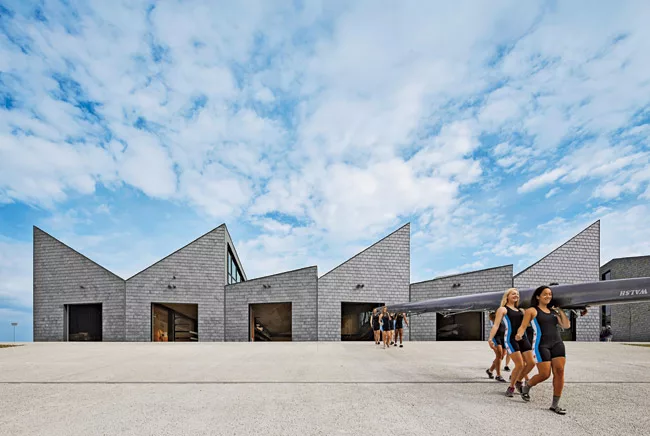
Rowers carry their shell to a floating dock on the river. The facility runs programs for students from public and private schools around the city, as well as for adults. It also offers kayaks and canoes for rent.
 
Photo © Steve Hall/Hedrich Blessing
WMS Boathouse
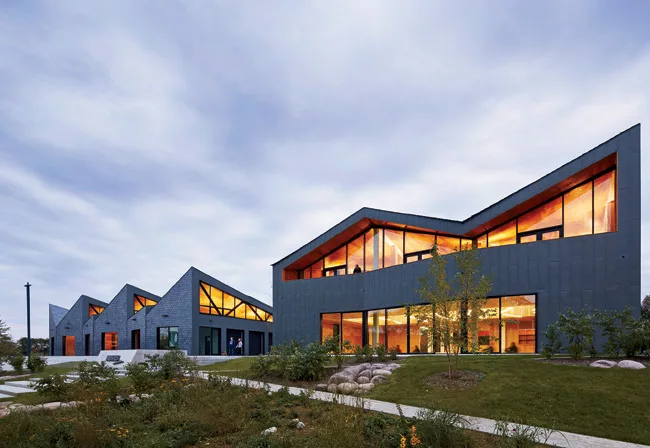
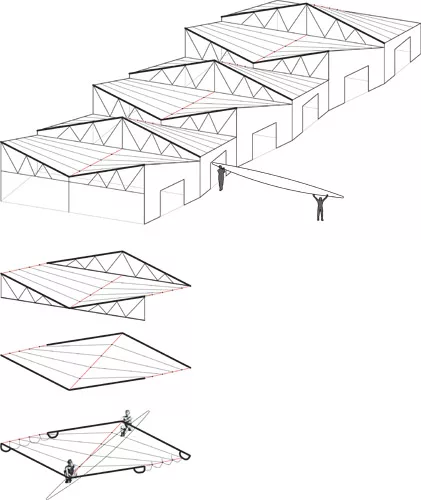
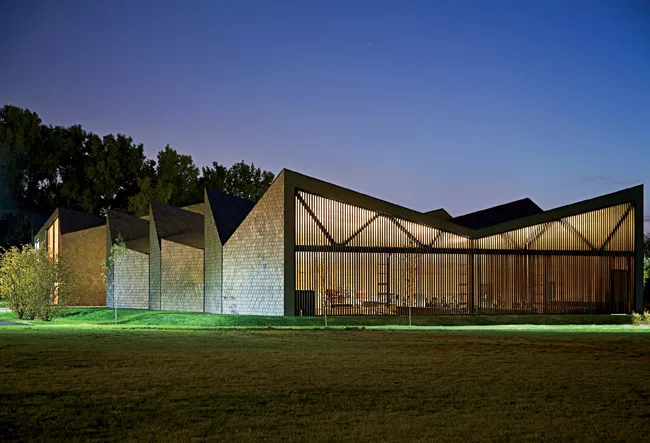
Architects at Studio Gang interpreted the motion of rowers and oars as V and M shapes for the buildings’ roof trusses.
 
Photo © Steve Hall/Hedrich Blessing
WMS Boathouse
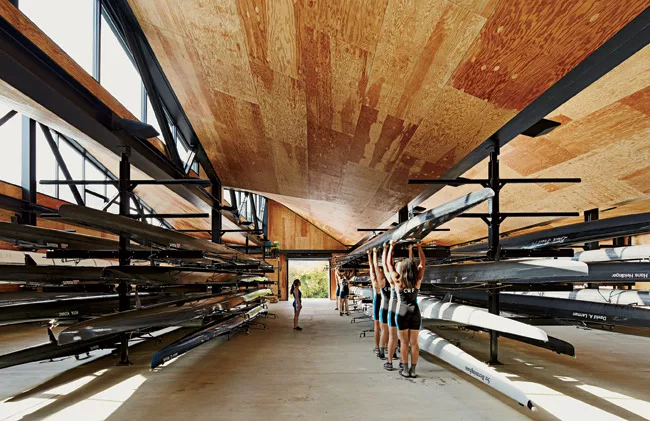
Plywood ceiling panels curve as they connect the two types of trusses in the boat shed. At the north end of the shed, a porchlike space holds motor boats for the rowing coaches.
 
Photo © Steve Hall/Hedrich Blessing
WMS Boathouse
A second-story balcony on the field house offers a place to watch races on the river.
 
Photo © Steve Hall/Hedrich Blessing
WMS Boathouse
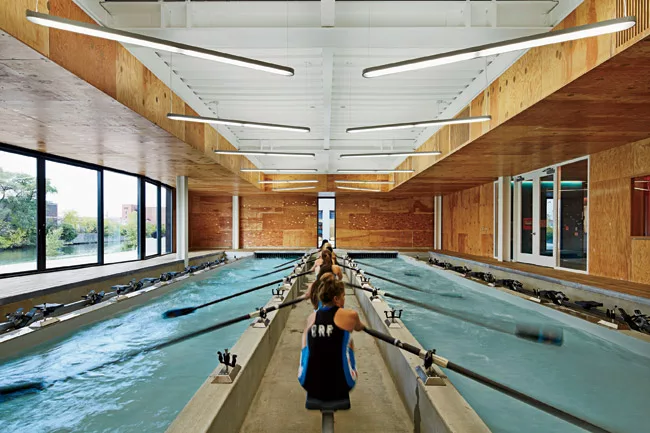
In the field house, rowers in the tank room can look out to the water. Pendant lights above them are angled like oars.
 
Photo © Steve Hall/Hedrich Blessing
WMS Boathouse
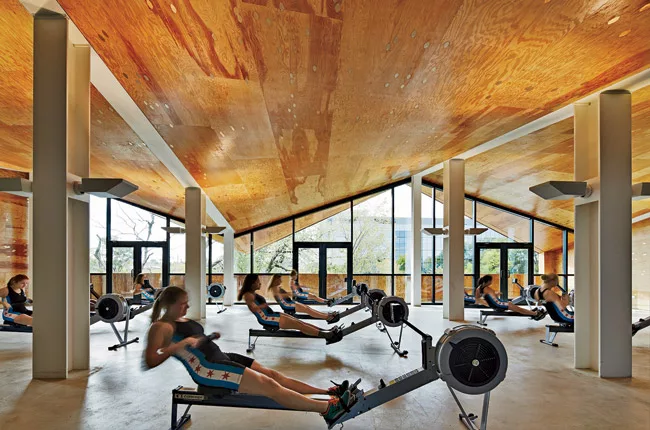
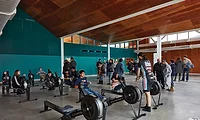
In the “erg” room on the second floor, athletes work out among the structural elements of the building’s roof trusses.
 
Photo © Steve Hall/Hedrich Blessing
WMS Boathouse
Architects at Studio Gang interpreted the motion of rowers and oars as V and M shapes for the buildings’ roof trusses.
 
Photo © Steve Hall/Hedrich Blessing
WMS Boathouse
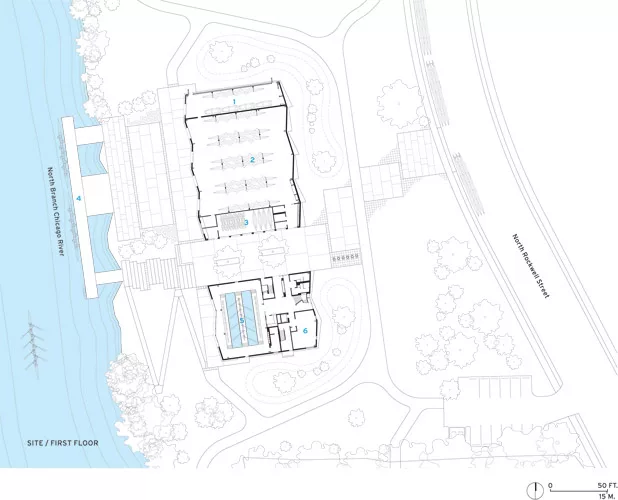
1 Exterior boat storage
2 Interior boat storage
3 Canoe & Kayak Storage
4 Floating dock
5 Rowing tank
6 Mechanical
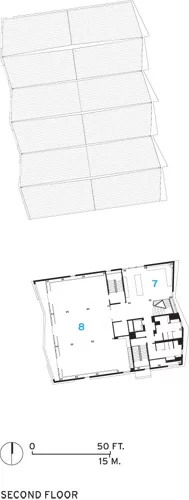
 
Photo © Steve Hall/Hedrich Blessing
WMS Boathouse
7 Community Room
8 Ergometer Room
 
Photo © Steve Hall/Hedrich Blessing
WMS Boathouse
WMS Boathouse
WMS Boathouse
WMS Boathouse
WMS Boathouse
WMS Boathouse
WMS Boathouse
WMS Boathouse
WMS Boathouse
January 16, 2014

Architects & Firms

Studio Gang Architects

Chicago

People/Products

A rower crouches with her knees tucked below her fists, then dips her oars in the water and pulls back. The lines of the oars sketch an elegant V in the air, which is repeated over and over as the slender boat cuts through the water. Jeanne Gang thought about such movement when she started designing the WMS Boathouse at Clark Park in Chicago. She looked at Eadweard Muybridge's famous stop-motion photographs of rowers, eventually translating the dynamic lines of the oars into her building's distinctive sawtooth roofs and the exposed trusses that support them. The 22,600-square-foot boathouse, which cost $8.8 million to construct, continues to demonstrate Gang's interest in the Chicago River and her commitment to turning the much-abused waterway into a public amenity.

In 2011, Gang published Reverse Effect, a book that compiles research she did with the Natural Resources Defense Council and students from a studio at Harvard and that offers proposals for renewing Chicago's waterways. That same year, Rahm Emanuel took office as mayor and called the Chicago River “the city's next recreational frontier.” Within months, he announced plans to build four boathouses as “anchors of the river's future development” and picked Studio Gang to design two of them and Johnson & Lee to do the other two, asking both firms to work with students at the Illinois Institute of Technology. Johnson & Lee's first boathouse opened last June at the edge of the Chinatown and South Loop neighborhoods, and its next one is scheduled for later this year, while Gang's building at Clark Park, on the north branch of the Chicago River, debuted in October. Her second boathouse, which will have a slightly different program and design, is scheduled to be completed in 2015.

With the Muybridge photographs in mind, Gang designed a structural system for the Clark Park buildings' roofs that alternates between trusses shaped like inverted V's and ones shaped like M's. The steel trusses trace a rhythmic up-and-down pattern, which creates a jagged roof profile while framing clerestory glazing that brings southern light into the spaces below, warming the concrete floors. From the outside, the roofs are all sharp angles poking at the sky and grabbing attention. Inside, though, a softer geometry insinuates itself as the connective tissue between the bones. Look up at the ceiling and you notice that the large, 4-by-8-foot plywood panels overhead curve gently as they negotiate the distance between the V and M trusses. The subtle arc of these transitional planes calms the visual composition and at the same time sets off a wonderful rippling motion on the ceiling.

The boathouse is actually a pair of buildings: a one-story shed for storing rowing shells (as well as rental kayaks and canoes) and a two-story field house with a rowing tank, small offices for the Chicago Park District and the Chicago Rowing Foundation (CRF), a community room, and a space filled with ergometer exercise machines. Separating the functions in two buildings made sense because the boat storage area doesn't need to be heated or cooled, and a pair of structures could bracket a central plaza framing the view from the street to the river. The Park District was the client for the project, while CRF—a nonprofit that runs public programs for students and adults—is one of the main users.

Gang says that when she and her team started on the project, they tried applying oar-motion lines to the facades of the buildings. “It didn't work, so we used them for the roofs.” But the ghost of that initial idea can be seen in the faceted exterior walls of the two structures, which not only animate the elevations but offer views up and down the river to the people inside. A palette of rugged materials—slate shingles and zinc panels on the outside, plywood surfaces and concrete floors on the inside—emphasize the simple massing of the paired blocks. In the boat shed, teams of wet-suited rowers bring the space alive, lifting shells off black-steel racks in movements echoing those of the trusses.

Inside the field house, the architects cut loose in a couple of places: they specified colored tiles in the rest rooms that pick up the hues of the river (from brown to green) and painted a two-story wall in the lobby with a pattern of bright-orange life preservers on white drywall. Thoughtful touches include built-in seating on the stair landing and in the community room on the second floor, and a spacious balcony off the “erg” room that serves as an excellent place to watch races on the river.

Sustainable-design strategies were woven in throughout the project—from planting a pair of small “rain gardens” and using permeable concrete on the plaza (so no rainwater runs off the site) to providing enough daylighting to reduce dependence on electric fixtures.

Water is a theme that runs through many of Gang's projects. For an 82-story apartment tower in Chicago, she created rippling balconies that inspired its name: Aqua. And even a marble wall she designed for an exhibition at the National Building Museum cascaded out like a stream of stone. Her first boathouse on the Chicago River contributes to this record, converting athleticism into architecture.


People

Formal name of building:
WMS Boathouse at Clark Park

Location:
3400 North Rockwell Ave, Chicago, IL

Completion Date:
October 2013

Gross square footage:
22,620 gsf

Total construction cost:
$8.8 million

Client:
Chicago Park District

Owner:
Chicago Park District

Architect:
Studio Gang Architects
1212 N. Ashland
Suite 212
Chicago, IL 60622
773.384.1212

Personnel in architect's firm who should receive special credit:
Jeanne Gang, FAIA, LEED AP, Founder and Design Principal; Mark Schendel, AIA, LEED AP, Managing Principal; William Emmick, AIA, LEED AP, Project Architect; with John Castro, Juan de la Mora, Jay Hoffman; Wei-Ju Lai, Angela Peckham; Christopher Vant Hoff; Michan Walker; Todd Zima

Architect of record:
Studio Gang Architects

Engineers:
Structural ' Matrix Engineering Corporation
Civil ' Spaceco, Inc.
MEP ' dbHMS: Design Build Engineering
River civil ' AECOM

Consultant(s):
Landscape: Terry Guen Design Associates, Inc.
Lighting: dbHMS: Design Build Engineering

Other:
General contractor: Schaefges Brothers, Inc.
Roofing contractor: M Cannon Roofing
Slate and Zinc contractor: Mortensen Roofing Co., Inc.
Plywood contractor: Wendell Builders

Photographer(s):
Steve Hall, Hedrich Blessing
Image credit Steve Hall © Hedrich Blessing

Size:

22,620 feet

Cost:

$8.8 million (construction)

Completion date:

October 2013


Products

Exterior cladding
Metal Panels: Zinc panels, Rheinzink
Metal/glass curtain wall: Tubelite
Wood: Marine Grade Doug Fir Fire treated Plywood
Moisture barrier: VaproShield WrapShield
Curtain wall: Tubelite
Other cladding unique to this project: Heathermoor Slate, Vermont Structural Slate, Co.

Roofing
Tile/shingles: Heathermoor Slate, Vermont Structural Slate, Co.

Windows
Metal frame: Tubelite

Glazing
Glass: Guardian SunGuard SNX 62/67, Saint Gobain Glass Cool-Lite SKN 174

Doors
Entrances: Tubelite
Sliding doors: Kawneer
Upswinging doors, other: Wayne Dalton, Thermotite Overhead Door

Hardware
Locksets: Corbin Russwin
Closers: LCN
Exit devices: Corbin Russwin
Pulls: Corbin Russwin

Interior finishes
Cabinetwork and custom woodwork: Custom fabricated by Accurate Custom Cabinets
Paints and stains: Sherwin Williams
Paneling: Doug Fir Fire Treated Plywood
Solid surfacing: Corian Solid Surfaces
Floor and wall tile: Grayson Slate, Vermont Structural Slate Company (at trophy case millwork) Daltile Natural Hues (at bathroom walls)
Special interior finishes unique to this project: Graphic Art Installation, Juan de la Mora, Studio Gang Architects

Furnishings
Upholstery: Maharam

Lighting
Interior ambient lighting: Ligman Lighting
Downlights: Pinnacle Architectural Lighting, Bega, Lightolier, Axis Lighting, Luminii, XAL
Exterior: Bega
Dimming System or other lighting controls: Acuity Brands

Conveyance
Elevators/Escalators: Schindler Elevator

Plumbing
Haws, Chicago Faucets, E.L. Mustee and Sons, Kohler

Energy
Energy management or building automation system: Honeywell

Other unique products that contribute to sustainability:
Indoor Rowing Tank: Studio Gang collaboration with Inriver
Permeable site concrete: Ozinga Filtercrete

 
KEYWORDS: Chicago

Share This Story

Looking for a reprint of this article?
From high-res PDFs to custom plaques, order your copy today!


Cliff portrait 2 0t5a1761 0031

Contributing editor Clifford Pearson is the co-author, with A. Eugene Kohn, of The World By Design, and writes about architecture and urbanism.

Post a comment to this article

Report Abusive Comment

Subscription Center
  • Create an Account
  • Start a Subscription
  • Manage My Account
  • Sign Up for Newsletters
  • Visit Customer Service
  • Update Preferences

More Videos

Sponsored Content

Sponsored Content is a special paid section where industry companies provide high quality, objective, non-commercial content around topics of interest to the Architectural Record audience. All Sponsored Content is supplied by the advertising company and any opinions expressed in this article are those of the author and not necessarily reflect the views of Architectural Record or its parent company, BNP Media. Interested in participating in our Sponsored Content section? Contact your local rep!

close
  • cold storage facility
    Sponsored byCarlisle SynTec Systems

    How Architects Can Design More Continuous Cold Storage Envelopes

  • TAMLYN XtremeTrim Exterior Trim
    Sponsored byTamlyn

    Designing Cleaner Panel Facades: Why Exterior Trim Details Matter

  • Building with Vapor Barriers
    Sponsored byReef Industries, Inc.

    Vapor Barriers Help Control Moisture in Tighter Building Designs

DESIGN:ED Podcast
Listen to Architectural Record’s DESIGN:ED Podcast

Events

June 23, 2026

Enhancing Fire Resistance with Advanced PVC Solutions

Credits: 1 AIA LU/HSW; 1 AIBD P-CE; 0.1 ICC CEU; 1 IIBEC CEH

Evaluate advanced PVC solutions that improve fire resistance, support WUI compliance, and enhance resilience in residential and commercial building design.

June 25, 2026

Designing Glass Railing Systems that Enhance Aesthetics and Meet Code

Credits: 1 AIA LU/HSW; 1 AIBD P-CE; 0.1 ICC CEU

Upon course completion, participants will possess a deeper understanding of glass railings to help ensure that safety, aesthetic, and performance objectives are achieved.

View All Submit An Event

Products

2026 Architect's Square Foot Costbook

2026 Architect's Square Foot Costbook

See More Products

Popular Stories

Lorcan O' Herilhy

California Architect Lorcan O’Herlihy Has Died, Age 66

Obama Presidential Center, Chicago

The Obama Presidential Center Opens on Chicago’s South Side

Spoonbill Ranch

Johnsen Schmaling Architects Integrates Spoonbill Ranch into a Pristine Landscape

West Village Penthouse

Design Vanguard 2026: Brent Buck Architects

Image of Bruce Springsteen Center for American Music

The CookFox-designed Bruce Springsteen Center for American Music Opens in New Jersey

Enhancing Fire Resistance with Advanced PVC Solutions - Free Webinar - June 23, 2026

Related Articles

  • La femme et la marechal ferran

    Currents: ‘Wall Power!’ at the Clark Institute Explores the Art of Tapestry

    See More
  • Where Go the Boats?

    Studio Gang Connects Locals to the River at Park 571's Eleanor Boathouse

    See More
  • Brooklyn Bridge Boathouse by Architecture Research Office

    Brooklyn Bridge Park Boathouse by Architecture Research Office

    See More

Related Products

See More Products
  • bim design firms.jpg

    BIM for Design Firms: Data Rich Architecture at Small and Medium Scales

See More Products
×

The latest news and information

#1 Source for Architectural Design, News and Products

SUBSCRIBE
  • RESOURCES
    • Advertise
    • Contact Us
    • Submit
    • Store
  • ACCOUNT CENTER
    • Create an Account
    • Start a Subscription
    • Manage My Account
    • Sign Up for Newsletters
    • Visit Customer Service
    • Update Preferences
  • PRIVACY
    • PRIVACY POLICY
    • TERMS & CONDITIONS
    • DO NOT SELL MY PERSONAL INFORMATION
    • PRIVACY REQUEST
    • ACCESSIBILITY
  • SERVICES
    • Marketing Services
    • Reprints
    • Market Research
    • List Rental
    • Survey/Respondent Access
  • STAY CONNECTED
    • Linkedin
    • Facebook
    • Instagram
    • YouTube
    • X (Twitter)

Copyright ©2026. All Rights Reserved BNP Media, Inc. and BNP Media II, LLC.

Design, CMS, Hosting & Web Development :: ePublishing