RECORD's Top 10 Boston Buildings
If you come to Boston expecting to see a city full of buildings that date back to Colonial America, you will probably be disappointed. While there are a few surviving examples of traditional New England architecture, Boston has undergone several face lifts over the years. And now, with the completion of the Big Dig and the removal of its old elevated highway, it’s in the midst of yet another. Here we present ten architectural gems that embody different periods of Boston’s history.
Harrison Gray Otis House
Photo courtesy Historic New England
Massachusetts State House
Photo courtesy Greater Boston CVB/ FayFoto
Trinity Church
Photo courtesy Greater Boston CVB/ FayFoto
Boston Public Library
Photo courtesy Boston Public Library
Baker House
Photo courtesy MIT Department of Facilities
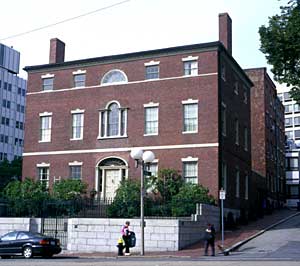
1 – Harrison Gray Otis House
The history of Boston’s built environment is marked by a series of planners and developers who, in ways both seen and unseen, shaped the city in broad strokes. Among the first was Harrison Gray Otis, 1765-1848, whose long career included both politics—he served in both chambers of the U.S. Congress and was mayor of Boston—law and business. When it came to real estate, Otis was more of a behind-the-scenes mover and shaker. He helped insure that Boston was made Massachusetts’ capital by securing land for the State House and, in the process, purchased nearby land that he developed into the stylish Beacon Hill district. Otis was also a friend of Charles Bulfinch, the architect responsible for Boston’s signature Federalism style, who designed three separate houses for Otis. The first one, a three-story brick-clad manse completed in 1796 at 141 Cambridge Street, is the simplest in appearance but considered to be the finest. Its exterior, brick-clad facade is a simple composition of five window bays. Inside, the house is furnished in high Federalist style. “There’s an incredible riot and bravado of color inside,” says Ann Beha, FAIA, founder & president of Ann Beha Architects. “The lavish fabrics and very robust wall colors make its interior design very different from the exterior. I would recommend visiting Otis House because there are very few period houses like it in Boston.” The building is now home to Historic New England.
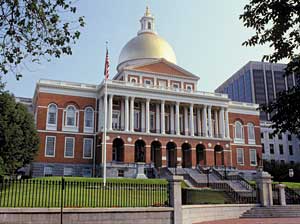
2 – Massachusetts State House
When it was completed in 1798, at a time when only 16 stars graced the United States’ flag, the Massachusetts State House was considered one of the nation’s finest public buildings—and its elegantly proportioned, centralized dome is credited with defining the basic look for capitol buildings in the 34 states to come. Designed by the celebrated architect Charles Bulfinch, who later helped design the U.S. Capitol in Washington, D.C., the Massachusetts State House sports a neoclassical, Georgian facade inspired by Somerset House in London, the most famous building of the day. The dome was originally copper, rolled by none other than patriot Paul Revere, but it was gilded within a few years of construction. Given the statehouse’s location at the crest of a hill overlooking Boston Common—on farmland once owned by Declaration of Independence signatory John Hancock—this dome was the most recognizable landmark on Boston’s skyline until well into the 20th century.
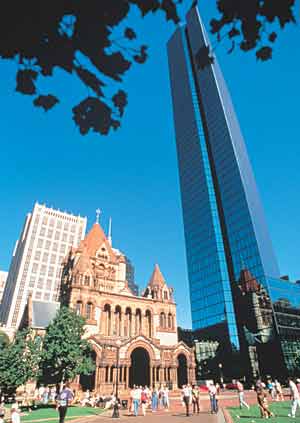
3 – Trinity Church
Trinity Church, on its completion in 1877, heralded an entire style of architecture called Richardsonian Romanesque, named after its architect, H.H. Richardson. Like this church, Richardsonian Romanesque buildings are made of heavy masonry that gives them an almost fortress-like appearance. Trinity’s sumptuous interior, though, is illuminated by brilliant stained glass windows designed by Edward Burne-Jones; its walls are graced with murals by John La Farge. It was immediately branded a masterpiece and, even today, is considered one of the finest buildings in the United States.
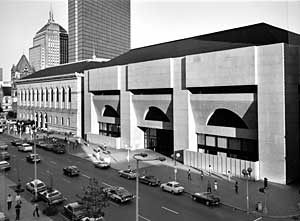
4 – Boston Public Library
During the late 19th century and early years of the 20th century, the principals of McKim, Mead, and White were household names: the starchitects of their day. The Boston Public Library, designed by the threesome and completed in 1895, set a new standard for great civic architecture. Its Renaissance Revival exterior—featuring a frieze engraved with the names of famous authors—looks as though it dates to 16th century Italy. Like a Florentine palazzo, the library’s interior exquisitely pairs art and interior design: murals by John Singer Sargent and Edwin Austin Abbey, paintings, and sculptures spread amid arcaded courtyards and halls capped by coffered, vaulted ceilings. An addition to the building, designed by Philip Johnson, was completed in 1972.
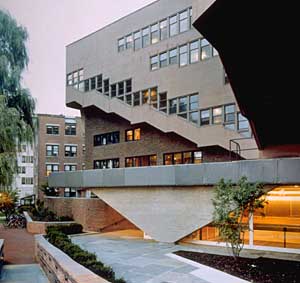
5 – Baker House
Finnish architect Alvar Aalto’s Baker House dormitory at the Massachusetts Institute of Technology, completed in 1949, is considered a seminal Modernist building that helped define the look of things to come in the United States. Facing south, its undecorated brick facade curves in and out along a stretch of busy Memorial Drive: the curves, while graceful and visually pleasing, are intended to lessen the impact of road noise. Aalto also designed curvy furniture for the dorm’s rooms. The building’s northern facade, which faces the heart of campus, is dominated by cantilevered forms that step up the side of the building.
Looking for a reprint of this article?
From high-res PDFs to custom plaques, order your copy today!