Making (too) big plans for Manhattan's West Side
New York’s powerful deputy mayor for economic development, Dan Doctoroff, recently resigned, something that had been rumored for a time. Doctoroff, who came to the city from a master-of-the-universe career as a private equity dealer, has left—with scarcely a murmur of disapproval—to become head of Bloomberg L.P., the Mayor’s very own multibillion-dollar financial reporting company. While there is apparently nothing illegal about this, it does affirm once again the degree of control of the city by an interlocking directorate of government, finance, and real estate–development interests, and the tendency of players to move seamlessly from one sector to another. This cozy relationship finds its parallel at the national level in the kind of reciprocal arrangement that has Cheney going from government to Halliburton and back to government, with the resulting engorgement of Halliburton on no-bid contracts in Bush’s war in Iraq.

While in office, Doctoroff accomplished a great deal, much of it constructive. He became the city’s de-facto head of planning and was frequently compared to Robert Moses for the scope of his activities and energy. This favorable comparison resulted from a long-growing national feeling that government has been incompetent (what politician nowadays doesn’t run against the government?), incapable of delivering the goods, too mired in the ethos of welfare, too estranged from the can-do mentality of big business. The electorate has bought into this to a remarkable degree. Our bluest of blue-state towns has now been run for 15 years by Republican mayors—Giuliani and Bloomberg—who have pursued the sort of tough-on-crime, big-business-friendly policies of the national party. The results have been very successful by certain measures: Crime is down dramatically and real estate prices have never been higher, with the city still seemingly immune to the current national meltdown. And Bloomberg, in particular, has used the city’s rising revenues for substantial improvements in many areas of public service.
Of course, there are down sides. Many people seem to have forgotten Giuliani’s vicious authoritarianism. And the obscene income gap that has grown so dramatically in both the nation and the city means that New York in general—with Manhattan as an extreme case—is becoming increasingly inhospitable to any but the wealthiest, a culture too skewed to remorseless getting and spending. While by many measures the “quality of life” in the city has improved—the subway is better, the streets are cleaner and safer, the fizz of construction is everywhere—the question must be asked: Better for whom? Certainly not for kids in public school, where improvements proceed at a glacial pace and a two-tier system has most parents who can afford it sending their children to private schools. Nor for those squeezed from their homes by the cruelties of the market.
Doctoroff made his first big appearance on the city scene as a promoter of New York’s unsuccessful bid for the 2012 Olympic Games. The centerpiece of that effort was a proposal to build a giant stadium on the last truly vast tract of developable land on Manhattan, the commuter rail yards on the West Side. After the Olympics, the stadium was to have served as the home for the Jets football team. The massive structure would have joined the even more massive Javits Center nearby in hulking isolation and conspired to further isolate the area from the riverfront. In a district very poorly served by public transportation, the stadium would have created massive traffic problems and a vast social vacuum. Widely opposed, it proved a nonstarter with the public and both it and the bid for the games went down in flames.
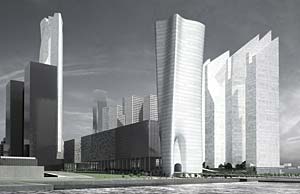
After the Olympics debacle, the city has moved to a more comprehensive approach and produced a zoning and public infrastructure plan for the area to encourage a more “mixed” strategy. The plan includes the extension of a subway line and a clear, if not exactly inspired, formal armature for development. The linchpin for the plan is the rail yards—28 acres of opportunity for big bucks, with the sky as the limit. (In comparison, Ground Zero offers a mere 16 acres.) The owner of the yards, the Metropolitan Transportation Authority, has put the site out for bids and five proposals were recently submitted by a roster of the usual development and architectural suspects. In making its selection, the MTA, in what might be interpreted as no more than the exercise of its fiduciary responsibility, is likely to focus entirely on the bottom line, this being the Republican definition of civic virtue. As at Ground Zero, this choice is protected by the ability of the agency to make its decision with too much independence from public review and by a program—12 million square feet of buildings, a cultural bauble, and a park in the middle—that fixes the project’s scale at a level of sublime unreason.
One of the keys to the magician’s art is misdirection: We are fooled, tricked into looking at the wrong thing. Recent presentations of the five schemes have all focused on the architecture, which plays its usual supine role in distracting our gaze from necessity to invention. (The five teams are Steven Holl for Extell Development; SOM, Diller Scofidio + Renfro, Thomas Phifer, SHoP, SANAA, Field Operations, and Handel Architects for Brookfield Properties; Murphy/Jahn, Cooper Robertson, and Peter Walker for Tishman Speyer and Morgan Stanley; Pelli Clarke Pelli, FXFOWLE, and WRT for the Durst Organization and Vornado Realty; and KPF, Arquitectonica, and Robert A.M. Stern for The Related Companies.) As many have remarked in the media, none of the schemes will have any necessary bearing on what is finally built, and all will be subjected to the usual closed-door deal-making between the MTA and the developers, as each seeks to max out its profits and minimize any investment that detracts from the mellifluous ka-ching, ka-ching playing in their collective cortex. They will, nonetheless, surely claim, as they stand behind their lovely renderings and models, that the best “design” has won.
Looking for a reprint of this article?
From high-res PDFs to custom plaques, order your copy today!