“I do like the grandiose.”
I had been to China frequently, but somehow, until a few months ago, never to Beijing. Like many cities in China, it’s intimidatingly vast and growing like Topsy. Unlike other cities, though, it is laid out with an orthogonal monumentality, with vast boulevards, widely spaced buildings, and a thick aura of imperium.
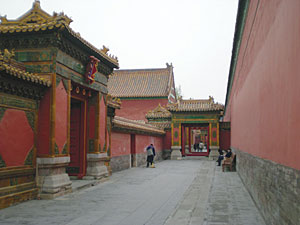
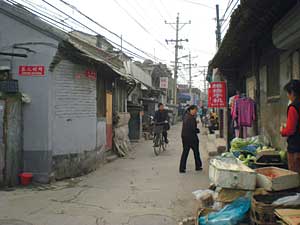
The prototype for the city as a whole is the famous Forbidden City, described by Marco Polo as the finest, most complete palace complex on the planet (“… no man on earth could design anything superior to it”)—an astonishing monument to dynastic power. Centralized authority loves recursion, seeing its favored forms deployed at every site and scale; official Beijing is an exemplar of this merger of symbol and control. As Versailles is to Haussman’s Paris, the Forbidden City is to both historic and contemporary Beijing. And the Forbidden City was itself conceived recursively, as the terrestrial expression of celestial geometry.
The astonishing building program the city has undertaken in preparation for the coming-out party of the Olympics is an obvious extension of this attitude. The insistent grandiosity, the incredible extent, the mobilization of labor, the fixation on symbolism, and the centralization of planning, all announce a representational project as well as an urban and architectural one. The city proclaims its importance at every turn, from its humongous airport to its endless ring roads and millions of saplings planted to proclaim its greenness, mitigate the toxic air, and obscure in Potemkin fashion the remnant disorder beyond the highways.
That so many of the striking buildings of this effort are designed by foreign architects is also powerfully symbolic. For millennia, China has been known for its resistance to outside influences from non-Han barbarism. The country’s modern history, in particular, has been defined by the struggle against colonization, invasion, and influence by imperial powers and ideas, including the now disappearing resistance to capitalist ideology. Indeed, as China heads in breakneck fashion down that particular path, it is laying an infrastructure that reflects the architectures and attitudes from our own high-water of capitalist consumption in the 1950s and ’60s. The car and its implications are embraced enthusiastically, creating prodigious traffic jams, freeways galore, pollution, and sprawl with all its components, from gated suburbs to numbing commutes.
The wanton hybridity of this urbanism is very much of a piece with global developments and, as elsewhere, the splicing produces forms that are alternately freakish, fascinating, forbidding, and familiar. For a culture that is immersed in an internal argument about “opening” to the outside, the conflicts between tradition and globalism are of striking importance. A revelatory incident in this debate was surely the closing last year of the Starbucks that had been operating within the Forbidden City since 2000. Closing the store was the result of a petition drive that collected half a million signatures in protest of this “affront to China’s dignity.” But where to draw the line?
China has been struggling with issues of indigenousness and influence for many years. If the current model for development is strongly shaped by the multinational metropolis—the format for cities from Los Angeles to Dubai—the Maoist period was in thrall of Soviet models of mass housing, heavy infrastructure, and Stalinoid monumentality, as well as the desire (most radically expressed during the Cultural Revolution) to expunge remnants of the decadent, classist, imperial past. But the confrontation between native and imported formulations also led to the creation in the 19th century of a building type that proliferated by the millions and continues to offer a valuable solution to questions of life in the city while engaging both the happinesses and the anxieties of influence. It also suggests an important strategy for mediating the compatibility of large and small, surely one of the most vexing issues for the postmodern environment.
Visiting the Forbidden City, I was struck both by its fabulous refinement and enormity and by the way it defines its differences between public and domestic spaces. The emperor’s sleeping quarters within the Inner Court, in particular, seemed surprisingly miniscule, scaled to the intimacy of village life, small rooms around a little courtyard in dramatic contrast to the gigantic spaces of official encounter nearby. Here, the intrigues were also personal and it was easy to imagine the habitual weirdness of the eunuch standing outside the royal bedroom timing the emperor’s congress with his concubines with a burning stick of incense. Talk about performance pressure!


Post a comment to this article
Report Abusive Comment