Handmade Architecture
With a series of projects in Bangladesh, Anna Heringer has turned modest resources and traditional materials into architecture that is both vigorously contemporary and attuned to local social forces.
.
Years before she became an architect, Anna Heringer traveled to Bangladesh as a young volunteer with Dipshikha, a nongovernment organization dedicated to rural development. “I got to know Bangladesh by spending a year studying its agricultural ways, its schools, and the health issues facing its people,” recalls the German-born architect, who has since built a series of small projects in the village of Rudrapur.
Instead of immediately focusing on the built environment, Heringer looked first at the country’s social structure and tried to understand it from the ground up. “I looked at it from a sustainability perspective,” she explains. “What are the problems and what are the opportunities here?”
Before her first trip to Bangladesh in 1997, she was afraid she was going to “a place that would be ugly,” she admits. “When I got there, I saw the colors of the saris, the bracelets that everyone wears, the way people take pride in their appearance. I realized that beauty isn’t a luxury; it’s part of everyone’s identity.”
Returning to Europe, Heringer enrolled at the University of Art and Design in Linz, Austria, and graduated from there in 2004—she now teaches in Linz and Stuttgart, Germany. She wrote her thesis on the design and construction of a “handmade” school in Rudrapur. Her goal was to fuse local materials and building technologies with a modern sensibility to create a two-story school that would fit into its context and make local residents proud.
Although [traditional materials] [link to October Tech story] such as mud and bamboo work well in the hot, wet climate and don’t require the expense and energy associated with imported materials, Heringer understood that villagers looked down on them because they represent the old way of doing things. “One of our challenges was to change the image of these traditional materials and show they can be beautiful,” states Heringer.
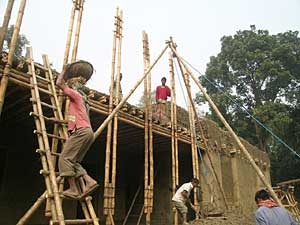
Working with architect Eike Roswag, Heringer designed a 3,500-square-foot school with three classrooms and six small “cavelike” spaces on the ground floor and two large classrooms on the upper floor. Built in five months in the second half of 2005 by local workers and trainees, along with student and faculty volunteers from Europe, the Modern Education and Training Institute (METI) showed how sustainable building technologies, derived from the region’s traditional building methods, could pack new punch.
For example, Heringer and Roswag used thick mud walls to enclose the ground floor but added colorful doors on one of the long façades and a jazzy, irregular pattern for placing small wood windows on the short sides. On the upper level, the architects used bamboo for cladding and angled struts supporting a corrugated iron roof—creating a more open, daylit interior than is typically found in this part of the world.
Commonly called the Handmade School, the project grabbed international attention, earning an award from the Aga Khan Foundation for Architecture in 2007. Heringer was particularly pleased that the building also generated strong local reviews. “I was surprised that Bangladeshi architects accepted it so quickly,” she says.
This spring, she completed two new projects in the same village—a trio of single-family houses and a vocational school to train electricians. While Bangladesh struggles with a huge population (147 million people in a country the size of Iowa), most houses in its rural areas are just one-story high. By making the houses in her new project (called HOMEmade) two stories, Heringer set an example for a higher-density, more sustainable pattern of development.
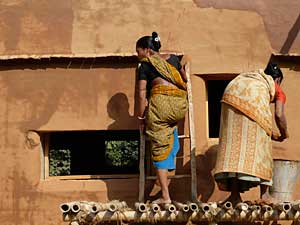
Once again using earth and bamboo as her main materials, she improved on the area’s traditional houses by adding coconut-fiber insulation and glass windows to create well-lit interiors that keep out the cold during the winter. Daylit rooms aren’t just an aesthetic issue in Rudrapur; they allow children to study and prepare themselves for better futures. “Architecture is more than just shelter,” states Heringer. “It is a sign of identity, pride, and self-confidence.”
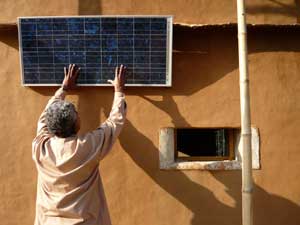
The vocational school called DESI (Dipshikha Electrical Skill Improvement) combines low-tech construction with high-tech features, such as solar panels to generate heat and power lights and a water pump. The two-story, 3,250-square-foot building requires no other source of energy. Thick walls, cross ventilation, and verandas on each floor carry on traditional building patterns, while a covered stair hall in the center of the plan and a lively window pattern give the facility a modern flair.
“We want to show that people can attain a middle-class lifestyle while staying in the village,” says Heringer. Good schools and attractive houses are important parts of that strategy. Next, she hopes to attract an industrial company and develop an eco-tourism resort to create jobs.
Heringer, who is working on her doctorate degree and splitting her time between Europe and the developing world, is starting to consult on projects in Mozambique and South Africa. She says lots of students and young architects approach her wanting to do socially conscious work. She advises them to “trust their instincts and don’t be afraid of not having a job.” She also tells them they need “to be on the ground with the people.”
Looking for a reprint of this article?
From high-res PDFs to custom plaques, order your copy today!