Architectural Record
search
cart
facebook twitter linkedin youtube
  • Sign In
  • Subscribe
  • Sign Out
  • My Account
Architectural Record
  • NEWS
    • Latest News
    • Awards
    • Interviews
    • Obituaries
    • Podcasts
      • Design:Ed Podcast
      • Sponsored Podcasts
  • OPINION
    • Book Reviews / Excerpts
    • Exhibition Reviews
    • Forum
  • EXCLUSIVES
    • Videos
    • Design Vanguard
    • Top 300 Firms
    • Sponsored Content
    • Sponsored eBooks
    • From the Archives
  • CONTINUING ED
    • Editorial Continuing Ed
    • CE Center
    • CE Academies
  • PROJECTS
    • Buildings By Type
    • Reuse & Renovation
    • Museums & Arts Centers
    • Colleges & Universities
    • Multifamily Housing
    • Interiors
    • Lighting
    • Kitchen & Bath
  • HOUSES
    • Record Houses
    • House of the Month
    • Featured Houses
  • PRODUCTS
    • Products by Category
    • Record Products of the Year
    • Latest Products
  • EVENTS
    • Dates & Events
    • Record on the Road
    • Innovation Conference
    • Sustainability in Practice
    • Women In Architecture
    • Webinars
    • Ad Excellence Awards
    • Submit an Event
  • CONNECT
    • Ask RECORD AI
    • Newsletters
    • Contact
    • Advertise
    • Editorial Calendar
    • Store
    • Customer Service
  • SUBMIT
    • Submission Guidelines
    • RECORD Competitions
  • MAGAZINE
    • Subscribe
    • My Account
    • Digital Edition
    • Current Issue
    • Firm Pass
    • Historic Archive
Commentary & Criticism

American Architecture Today

By Clifford A. Pearson
February 15, 2008

Paul Goldberger is the architecture critic of The New Yorker.

  Paul Goldberger
Paul Goldberger
   

“I DON’T SEE THE REGIONAL differences in design that were apparent in the past,” states Paul Goldberger when asked what American architecture looks like from his perspective at The New Yorker. “Trends today are national or even global. Sustainability is certainly one. We should be doing more on this, but we’re doing more than we did in the past.”

He also talks about “the democratization of architecture,” a process that in recent years has brought Modernism to the masses, or at least, to a larger audience. “What you can get at Ikea and Crate & Barrell is a lot better than what most people used to buy for their homes. At the same time, major architects are finally getting to design large commercial developments in New York,” he says, mentioning Norman Foster’s Hearst Tower, Frank Gehry’s Atlantic Yards complex, and Renzo Piano’s New York Times Building. “The results are mixed. When things move into the mainstream, they inevitably get compromised. I think, though, where the center of the dial has moved is more important than where the cutting edge is.” He is also encouraged by a growing audience for architecture within the general public, noting the popularity, for example, of the Web site Curbed (curbed.com). “It’s gossipy and sometimes it’s silly, but it shows a growing level of engagement with the built environment.”
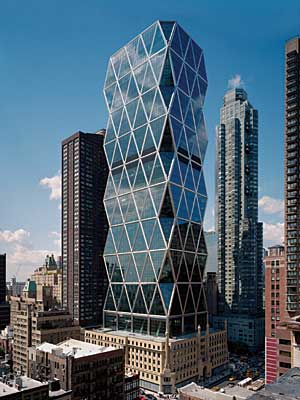
Hearst Tower
Photo © Chuck Choi

Hearst Tower

Related Links:
Project Portfolio: American Architecture

Modernist architects have even penetrated that bastion of middle-brow design: the New York City apartment house. “Glass has become the new white brick,” says Goldberger. Transparent residential towers by Richard Meier, Jean Nouvel, Herzog & de Meuron, and others are rising in Manhattan and Brooklyn. He notes, though, that there is still room for buildings such as Robert A.M. Stern’s 15 Central Park West, which captures the spirit of the great apartment houses built in New York between the two World Wars.

While New York is finally getting major buildings by star architects, Goldberger notes, “I’m fascinated by the extent to which provincial places in the country are willing to take more risks than cities like New York and L.A. I’m thinking of Zaha in Cincinnati, Steven Holl in Kansas City, and SANAA in Toledo. I’m also intrigued by the time lag between when major architects first build in the provinces and when they finally get to do so in New York. For example, Gehry built in Toledo long before he did anything in New York. How many years was it between Meier’s project in New Harmony, Indiana, and his apartment towers on the Hudson?”

Reviewing New York’s recent crop of high-profile buildings, Goldberger cites SANAA’s New Museum as a “significant” addition to the city’s architecture. “It manages to straddle an industrial aesthetic and an intellectual approach to design. And it brings a distinctive young firm to New York.” He also approves of Foster’s Hearst Tower. “I like the way it challenges our intuitive perception. It seems at first like the wrong way to add onto the Joseph Urban base. But it makes us realize that the Urban building isn’t really about Classicism; it’s about an almost bombastic expressionism. Foster’s design captures that spirit.” As for Renzo Piano’s New York Times tower, Goldberger says, “It’s not the transcendent building some people had hoped for, but it’s still one of the best buildings of the past few years.”

Reviewing what is happening at Ground Zero, Goldberger calls it “a sad story. In many ways, it merely reflects where we are today. It’s a commercial development, not a civic place. And it isn’t effective urban design.” Warming to the topic, he talks about “the relative withdrawal, even abandonment, of large-scale planning by the public sector. It’s giving way to private developers, letting them take charge of what gets built where. At the end of the day, it’s not real planning.” A reason for this withdrawal is the government’s inability to build urban infrastructure on the scale that is needed. “What we’re seeing is the development of parallel infrastructures—one built by the private sector and one by the public. I can imagine a time in the future when some people might have little interaction with the public infrastructure.”

Share This Story

Looking for a reprint of this article?
From high-res PDFs to custom plaques, order your copy today!

Cliff portrait 2 0t5a1761 0031

Contributing editor Clifford Pearson is the co-author, with A. Eugene Kohn, of The World By Design, and writes about architecture and urbanism.

Post a comment to this article

Report Abusive Comment

Subscription Center
  • Create an Account
  • Start a Subscription
  • Manage My Account
  • Sign Up for Newsletters
  • Visit Customer Service
  • Update Preferences

More Videos

Sponsored Content

Sponsored Content is a special paid section where industry companies provide high quality, objective, non-commercial content around topics of interest to the Architectural Record audience. All Sponsored Content is supplied by the advertising company and any opinions expressed in this article are those of the author and not necessarily reflect the views of Architectural Record or its parent company, BNP Media. Interested in participating in our Sponsored Content section? Contact your local rep!

close
  • 3D configurator
    Sponsored byDoorBird

    How DoorBird’s 3D Configurator Is Redefining Customization Across Residential and Commercial Design

  • interior of modern office
    Sponsored byCurrent

    The Downlight's Second Life: Why Below-Ceiling Serviceability Is the Specification Detail That Matters Most

  • cold storage facility
    Sponsored byCarlisle SynTec Systems

    How Architects Can Design More Continuous Cold Storage Envelopes

DESIGN:ED Podcast
Listen to Architectural Record’s DESIGN:ED Podcast

Events

July 1, 2026

Hospitality in Higher Education

Credits: 1 AIA LU/HSW; 1 AIBD P-CE; 0.1 ICC CEU

Explore how hospitality-driven campus design can strengthen belonging, wellbeing, and community connection in higher education environments.

July 8, 2026

Co-Intelligence: The Architect's AI Advantage

Credits: 1 AIA LU/Elective; 1 AIBD P-CE; 0.1 ICC CEU

Examine how AI is reshaping architectural practice and how architects can elevate their role from task execution to directing design intent.

View All Submit An Event

Products

2026 Architect's Square Foot Costbook

2026 Architect's Square Foot Costbook

See More Products

Popular Stories

Kìwekì Point, Ottawa, Canada

Perched High Above the Ottawa River, Kìwekì Point Showcases Sweeping Views of the Canadian Capital Region

Baileywick Park

An Elegant Pavilion by In Situ Studio Adds Sheltered Courts and a Gateway to a Public Park in Raleigh

T Bar M Racquet Club

Lake Flato Architects Serves Up a Classic Tennis Clubhouse in Dallas

Under Armour Global  Headquarters

In a Former Industrial Area in Baltimore, Gensler Builds an Office Building that Broadcasts its Client’s Ambitions

Reservoir Park and Recreation Center

A Historic Sand Filtration Plant in Washington, D.C., is Transformed into a Multipurpose Green Space

Hospitality in Higher Education - Free Webinar - July 1, 2026

Related Articles

  • American Architecture Today

    See More
  • American Architecture Today

    See More
  • American Architecture Today

    See More

Related Products

See More Products
  • american arch.jpg

    American Architecture: An Illustrated Encyclopedia

  • ribbonarch.jpg

    Ribbon Architecture: Light, Shadow, and Reflection in Architecture

See More Products
×

The latest news and information

#1 Source for Architectural Design, News and Products

SUBSCRIBE
  • RESOURCES
    • Advertise
    • Contact Us
    • Submit
    • Store
  • ACCOUNT CENTER
    • Create an Account
    • Start a Subscription
    • Manage My Account
    • Sign Up for Newsletters
    • Visit Customer Service
    • Update Preferences
  • PRIVACY
    • PRIVACY POLICY
    • TERMS & CONDITIONS
    • DO NOT SELL MY PERSONAL INFORMATION
    • PRIVACY REQUEST
    • ACCESSIBILITY
  • SERVICES
    • Marketing Services
    • Reprints
    • Market Research
    • List Rental
    • Survey/Respondent Access
  • STAY CONNECTED
    • Linkedin
    • Facebook
    • Instagram
    • YouTube
    • X (Twitter)

Copyright ©2026. All Rights Reserved BNP Media, Inc. and BNP Media II, LLC.

Design, CMS, Hosting & Web Development :: ePublishing