Architectural Record
search
cart
facebook twitter linkedin youtube
  • Sign In
  • Subscribe
  • Sign Out
  • My Account
Architectural Record
  • NEWS
    • Latest News
    • Awards
    • Interviews
    • Obituaries
    • Podcasts
      • Design:Ed Podcast
      • Sponsored Podcasts
  • OPINION
    • Book Reviews / Excerpts
    • Exhibition Reviews
    • Forum
  • EXCLUSIVES
    • Videos
    • Design Vanguard
    • Top 300 Firms
    • Sponsored Content
    • Sponsored eBooks
    • From the Archives
  • CONTINUING ED
    • Editorial Continuing Ed
    • CE Center
    • CE Academies
  • PROJECTS
    • Buildings By Type
    • Reuse & Renovation
    • Museums & Arts Centers
    • Colleges & Universities
    • Multifamily Housing
    • Interiors
    • Lighting
    • Kitchen & Bath
  • HOUSES
    • Record Houses
    • House of the Month
    • Featured Houses
  • PRODUCTS
    • Products by Category
    • Record Products of the Year
    • Latest Products
  • EVENTS
    • Dates & Events
    • Record on the Road
    • Innovation Conference
    • Sustainability in Practice
    • Women In Architecture
    • Webinars
    • Ad Excellence Awards
    • Submit an Event
  • CONNECT
    • Ask RECORD AI
    • Newsletters
    • Contact
    • Advertise
    • Editorial Calendar
    • Store
    • Customer Service
  • SUBMIT
    • Submission Guidelines
    • RECORD Competitions
  • MAGAZINE
    • Subscribe
    • My Account
    • Digital Edition
    • Current Issue
    • Firm Pass
    • Historic Archive
Architecture News

NY Times Building Altered Due to Climbing Trend
By Alanna Malone
July 17, 2008
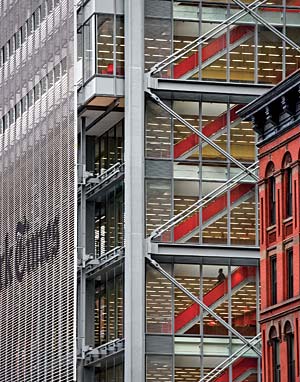
When the New York Times Building opened in late 2007, critics marveled at the 3-inch-diameter ceramic rods covering the façade of the 52-story skyscraper—the first glass tower with a sunscreen to be built in the United States. But last Wednesday, dozens of the trademark, and evidently climber-friendly, rods were removed just hours after the third person in five weeks attempted to scale the building. The decision was made as a safety measure to prevent future daredevils from mounting the high-rise that cost more than $1 billion to construct. Increased security in the area after the first stunt clearly was not enough to deter thrill seekers.
 
New York Times Building
Last week, dozens of the New York Times Building’s ceramic rods were removed after the third person in five weeks attempted to scale the 52-story skyscraper.
Photo © David Sundberg/Esto
 
The 1.5-million-square-foot project was designed by Renzo Piano Building Workshop (RPBW), based in Italy, with FXFOWLE in New York. The firms are working with The New York Times Company and its development partner, Forest City Ratner, to create measures that “will reduce and hopefully limit access to the ceramic screen of the building,” says Bernard Plattner, a partner at RPBW who oversaw the project. The New York Times Company has declined to comment on any changes to the building, although The New York Times newspaper reports that permanent glass panels will be installed to hinder access to glass canopies, which climbers have used as stepping stools to the rods.

Renzo Piano devised the brise-soleil as a “lace curtain” that envelops the tower’s glass-and-steel frame. More than 186,000 ceramic tubes comprise the screen, which projects eighteen inches from the curtain wall. Their purpose goes far beyond aesthetics. According to The Times, the rods block half of the sun’s energy, but still allow a significant amount of light to pass through the building’s floor-to-ceiling, ultra-clear windows.

Piano certainly didn’t intend for the ceramic screen to serve as a ladder that would entice so-called urban climbers. In the early hours of Wednesday morning, David Malone, 29, from Hartford, Connecticut, ascended 11 stories and hung a banner from the building’s Eighth Avenue façade. On June 5, two other climbers scaled the building in separate incidences: Alain Robert, a French stuntman, and Renaldo Clarke, a Brooklyn resident, both reached the top.

“We decided to remove a limited number of rods in the lower part. This is the only immediate possible way to reduce accessibility,” Plattner explains. “The permanent solution is about to be worked out and will not affect the building’s aesthetic.” He adds that the building’s interior temperature shouldn’t increase, as the alterations only concern a small section of rods on the north and south façades, which face narrow streets. 

Share This Story

Looking for a reprint of this article?
From high-res PDFs to custom plaques, order your copy today!

Post a comment to this article

Report Abusive Comment

Subscription Center
  • Create an Account
  • Start a Subscription
  • Manage My Account
  • Sign Up for Newsletters
  • Visit Customer Service
  • Update Preferences

More Videos

Sponsored Content

Sponsored Content is a special paid section where industry companies provide high quality, objective, non-commercial content around topics of interest to the Architectural Record audience. All Sponsored Content is supplied by the advertising company and any opinions expressed in this article are those of the author and not necessarily reflect the views of Architectural Record or its parent company, BNP Media. Interested in participating in our Sponsored Content section? Contact your local rep!

close
  • TAMLYN XtremeTrim Exterior Trim
    Sponsored byTamlyn

    Designing Cleaner Panel Facades: Why Exterior Trim Details Matter

  • Building with Vapor Barriers
    Sponsored byReef Industries, Inc.

    Vapor Barriers Help Control Moisture in Tighter Building Designs

  • Duct Interior with Prodeq System
    Sponsored byHenry, a Carlisle Company

    Designing Resilient Water Containment Systems

DESIGN:ED Podcast
Listen to Architectural Record’s DESIGN:ED Podcast

Events

June 10, 2026

Rethinking Stormwater – The Power of Porous Paving

Credits: 1 AIA LU/HSW; 1 AIBD P-CE; 0.1 ICC CEU

Learn how porous paving systems support stormwater management, reduce heat island effects, and enhance sustainable site design performance.

June 11, 2026

Very Early Warning Fire Detection for Mission-Critical Facilities

Credits: 1 AIA LU/HSW; 1 AIBD P-CE; 0.1 ICC CEU

Examine advanced fire detection strategies that support uptime and enhance safety in data centers and other mission-critical facilities.

View All Submit An Event

Products

2026 Architect's Square Foot Costbook

2026 Architect's Square Foot Costbook

See More Products

Popular Stories

Practice Matters illustration

What’s in a (Firm’s) Name? Thinking About Succession and Legacy

Coronado Bridge

The Architect’s Guide to San Diego

Practice Matters illustration

By the Numbers: Counting America's Architects

House on a Hill

Design Vanguard 2026: Forma

Crane Cove, ONO

Design Vanguard 2026 Winners

Broader Sustainability of CMU - Free Webinar - May 21, 2026

Related Articles

  • It’s Official: Kimmelman Will Be the New NY Times Architecture Critic...But With a More General Job Title

    See More
  • Haiti Design Expo Postponed Due to Upcoming Election

    See More

Related Products

See More Products
  • corp arch.jpg

    Corporate Architecture Building a Brand

  • facade.jpg

    Sustainable Facades: Design Methods for High-Performance Building Envelopes

See More Products
×

The latest news and information

#1 Source for Architectural Design, News and Products

SUBSCRIBE
  • RESOURCES
    • Advertise
    • Contact Us
    • Submit
    • Store
  • ACCOUNT CENTER
    • Create an Account
    • Start a Subscription
    • Manage My Account
    • Sign Up for Newsletters
    • Visit Customer Service
    • Update Preferences
  • PRIVACY
    • PRIVACY POLICY
    • TERMS & CONDITIONS
    • DO NOT SELL MY PERSONAL INFORMATION
    • PRIVACY REQUEST
    • ACCESSIBILITY
  • SERVICES
    • Marketing Services
    • Reprints
    • Market Research
    • List Rental
    • Survey/Respondent Access
  • STAY CONNECTED
    • Linkedin
    • Facebook
    • Instagram
    • YouTube
    • X (Twitter)

Copyright ©2026. All Rights Reserved BNP Media, Inc. and BNP Media II, LLC.

Design, CMS, Hosting & Web Development :: ePublishing