Architectural Record
search
cart
facebook twitter linkedin youtube
  • Sign In
  • Subscribe
  • Sign Out
  • My Account
Architectural Record
  • NEWS
    • Latest News
    • Awards
    • Interviews
    • Obituaries
    • Podcasts
      • Design:Ed Podcast
      • Sponsored Podcasts
  • OPINION
    • Book Reviews / Excerpts
    • Exhibition Reviews
    • Forum
  • EXCLUSIVES
    • Videos
    • Design Vanguard
    • Top 300 Firms
    • Sponsored Content
    • Sponsored eBooks
    • From the Archives
  • CONTINUING ED
    • Editorial Continuing Ed
    • CE Center
    • CE Academies
  • PROJECTS
    • Buildings By Type
    • Reuse & Renovation
    • Museums & Arts Centers
    • Colleges & Universities
    • Multifamily Housing
    • Interiors
    • Lighting
    • Kitchen & Bath
  • HOUSES
    • Record Houses
    • House of the Month
    • Featured Houses
  • PRODUCTS
    • Products by Category
    • Record Products of the Year
    • Latest Products
  • EVENTS
    • Dates & Events
    • Record on the Road
    • Innovation Conference
    • Sustainability in Practice
    • Women In Architecture
    • Webinars
    • Ad Excellence Awards
    • Submit an Event
  • CONNECT
    • Ask RECORD AI
    • Newsletters
    • Contact
    • Advertise
    • Editorial Calendar
    • Store
    • Customer Service
  • SUBMIT
    • Submission Guidelines
    • RECORD Competitions
  • MAGAZINE
    • Subscribe
    • My Account
    • Digital Edition
    • Current Issue
    • Firm Pass
    • Historic Archive
Projects

New York University Department of Philosophy

Steven Holl provides a new home for the NYU Department of Philosophy with porosity in mind.

By David Sokol
June 19, 2008

Architects & Firms

Steven Holl Architects

New York, New York

Crowded into one floor of an old classroom building until 2007, New York University’s philosophy department had quarters far less grand than its top-notch reputation. Its new home, fashioned by Steven Holl Architects (SHA) inside a nearby 30,000-square-foot landmark building, finally matches the faculty’s accommodations with its renown.

Like its counterparts at other universities, NYU’s philosophy department has experienced a surge in popularity during the past decade and now counts 140 undergraduate majors. SHA’s task was to convert a 118-year-old corner building, originally designed by Alfred Zucker as a warehouse and later used by the university as offices and music studios, into thought-provoking spaces for a growing department. To do this, Steven Holl, FAIA, applied notions of “porosity”—a signature concept of his that features multiple incisions and openings—to the interior of the stone building. “Rather than being preoccupied by solid, independent, objectlike forms, porosity addresses the experiential phenomena of spatial sequences that trigger emotions and joy in architecture,” he explains.

While Holl has explored porosity in projects ranging from a very large mixed-use development under construction in Beijing to furniture pieces for the manufacturer Horm, the architect thought it was particularly well suited to the philosophy project because the client had expressed fear that professors and graduate students would lose their sense of community once they spread out on a series of floors.

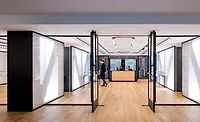
The concept can be seen in pivoting doors, such as the giant one at the entry to the top-floor faculty lounge, as well as windows in seminar rooms, which enhance connections between people and show that philosophy is neither a mute nor self-absorbed pursuit. But porosity is realized most spectacularly in the main stairwell that runs up the southeastern corner of the six-story building. The stair, which hugs a vertical shaft lined with windows on the south elevation, features a 16-gauge-steel banister laser-cut with a seemingly random series of holes and amoeboid shapes. Where the perimeter wall is not original to the building, Holl has installed a faceted wall that has been water-jet-cut with porthole-size incisions. A similar surface, made of ash-veneer ply and more densely punctuated with an array of small dots, backs up to the first wall; it faces interior offices and classroom spaces, which are double-loaded into the remaining L-shaped plan.

The designers say this centerpiece element fosters interaction in the already tightly knit community, with students and faculty skipping the elevator for the stairs and engaging in conversations on its generous landings. Project architect Edward Lalonde also notes that the client “especially appreciates that this feature has found a way to modestly capture a sense of identity.” Indeed, besides serving as the community generator for the department, the stairwell is a kind of billboard for it: SHA sandwiched T5 fluorescent lamps with acrylic, milky-white diffusers between the stair’s main walls, and at night this tall, multifaceted volume can be seen from the street, its openings shining like so many display windows or good ideas.

In many ways, the design of the philosophy-department interior seems to portray, sometimes with a wink, minds at work. On stairwell windows, the architects applied spectral film, a cheap off-the-shelf material, in vertical and horizontal strips; at midday, sunlight streams through the film and casts rainbows (a diversity of opinions?) on the old brick walls and the other windows. Ash benches designed by Holl that sit in the wide hallways of the double-loaded upper floors might evoke miniature landscapes and, by association, the Socratic method of philosophizing outdoors. Holl sees in cast-aluminum coat hooks the dot, dot, dot of ellipses, often signifying the process of getting lost in thought.

That the design’s features permit multiple readings is appropriate for a philosophy department. In fact, Holl explains that the design was originally inspired by the Austrian philosopher and sometime architect Ludwig Wittgenstein and his Remarks on Color. In that book, Wittgenstein extensively explores the multiple properties and experiences of colors, as well as the relationships between them. Holl’s predominant use of white (prismatically containing all colors, and which Wittgenstein found particularly slippery) loads the interior with meaning and encourages flexibility in interpretation. At the same time, all of the project’s apertures and moving elements initiate a social and architectural dynamism that seems just right for a place of mental gymnastics.

KEYWORDS: New York City

Share This Story

Looking for a reprint of this article?
From high-res PDFs to custom plaques, order your copy today!
David Sokol is a contributing editor to Architectural Record. 

Post a comment to this article

Report Abusive Comment

Subscription Center
  • Create an Account
  • Start a Subscription
  • Manage My Account
  • Sign Up for Newsletters
  • Visit Customer Service
  • Update Preferences

More Videos

Sponsored Content

Sponsored Content is a special paid section where industry companies provide high quality, objective, non-commercial content around topics of interest to the Architectural Record audience. All Sponsored Content is supplied by the advertising company and any opinions expressed in this article are those of the author and not necessarily reflect the views of Architectural Record or its parent company, BNP Media. Interested in participating in our Sponsored Content section? Contact your local rep!

close
  • TAMLYN XtremeTrim Exterior Trim
    Sponsored byTamlyn

    Designing Cleaner Panel Facades: Why Exterior Trim Details Matter

  • Building with Vapor Barriers
    Sponsored byReef Industries, Inc.

    Vapor Barriers Help Control Moisture in Tighter Building Designs

  • Duct Interior with Prodeq System
    Sponsored byHenry, a Carlisle Company

    Designing Resilient Water Containment Systems

DESIGN:ED Podcast
Listen to Architectural Record’s DESIGN:ED Podcast

Events

June 10, 2026

Rethinking Stormwater – The Power of Porous Paving

Credits: 1 AIA LU/HSW; 1 AIBD P-CE; 0.1 ICC CEU

Learn how porous paving systems support stormwater management, reduce heat island effects, and enhance sustainable site design performance.

June 11, 2026

Very Early Warning Fire Detection for Mission-Critical Facilities

Credits: 1 AIA LU/HSW; 1 AIBD P-CE; 0.1 ICC CEU

Examine advanced fire detection strategies that support uptime and enhance safety in data centers and other mission-critical facilities.

View All Submit An Event

Products

2026 Architect's Square Foot Costbook

2026 Architect's Square Foot Costbook

See More Products

Popular Stories

Practice Matters illustration

What’s in a (Firm’s) Name? Thinking About Succession and Legacy

Coronado Bridge

The Architect’s Guide to San Diego

Practice Matters illustration

By the Numbers: Counting America's Architects

House on a Hill

Design Vanguard 2026: Forma

Crane Cove, ONO

Design Vanguard 2026 Winners

Broader Sustainability of CMU - Free Webinar - May 21, 2026

Related Articles

  • New York University Department of Philosophy Interiors

    See More
  • The crisply Miesian reception and exhibition area of NYU’s Special Collections Library.

    New York University Special Collections Library by CannonDesign

    See More
  • archival spread of architectural record issue 12/56

    From the RECORD Archives: ‘Out of a Philosophy of Architecture’

    See More

Related Products

See More Products
  • Architectural Record - May 2026

    Architectural Record May 2026 Issue

See More Products
×

The latest news and information

#1 Source for Architectural Design, News and Products

SUBSCRIBE
  • RESOURCES
    • Advertise
    • Contact Us
    • Submit
    • Store
  • ACCOUNT CENTER
    • Create an Account
    • Start a Subscription
    • Manage My Account
    • Sign Up for Newsletters
    • Visit Customer Service
    • Update Preferences
  • PRIVACY
    • PRIVACY POLICY
    • TERMS & CONDITIONS
    • DO NOT SELL MY PERSONAL INFORMATION
    • PRIVACY REQUEST
    • ACCESSIBILITY
  • SERVICES
    • Marketing Services
    • Reprints
    • Market Research
    • List Rental
    • Survey/Respondent Access
  • STAY CONNECTED
    • Linkedin
    • Facebook
    • Instagram
    • YouTube
    • X (Twitter)

Copyright ©2026. All Rights Reserved BNP Media, Inc. and BNP Media II, LLC.

Design, CMS, Hosting & Web Development :: ePublishing