Cond' Nast's 750 Third Avenue Cafeteria
SOM's Ed Lab morphs Cond' Nast's 750 Third Avenue cafeteria into its own luminaire.
Cond' Nast's 750 Third Avenue Cafeteria
Photo © Robert Polidori
Cond' Nast's 750 Third Avenue Cafeteria
Photo © Robert Polidori
Cond' Nast's 750 Third Avenue Cafeteria
Photo © Robert Polidori
Cond' Nast's 750 Third Avenue Cafeteria
Photo © Robert Polidori
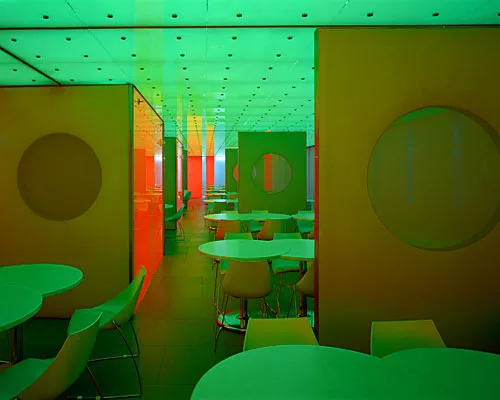
Cond' Nast's 750 Third Avenue Cafeteria
Photo © Robert Polidori
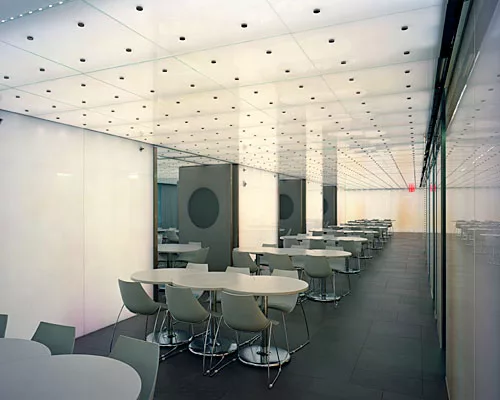
Cond' Nast's 750 Third Avenue Cafeteria
Photo © Robert Polidori
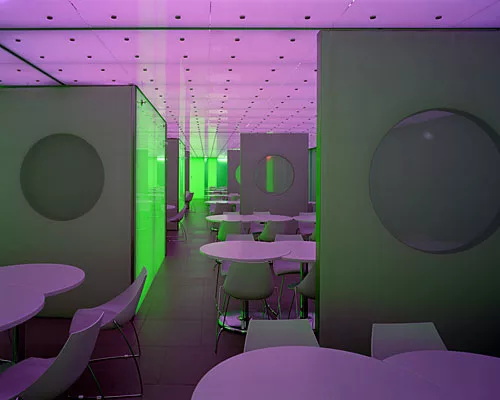
Cond' Nast's 750 Third Avenue Cafeteria
Photo © Robert Polidori
Architects & Firms
New York, New York
Skidmore, Owings & Merrill design partner Roger Duffy, FAIA, describes his SOM Education Lab as “a studio that is both independent and dependent on the bigger whole.” Although it capitalizes on the resources of a firm large enough to have its own annual compendium of best work (SOM Journal, a publication that Duffy also devised), the Ed Lab purposefully maintains a boutique perspective, employing only a handful of core associates and focusing mostly on smaller-scale building projects. And although the soft-spoken Duffy seems more likely to step away from the mic than to hog the spotlight, his work leaps ahead of the mainstream—raising the ambitions of his SOM colleagues, and changing popular perception of the giant firm.
Ed Lab’s hallmark is its intense collaborations with artists. “I came to New York in ’85 and I became really taken by the Dia and American conceptual art from the ’60s and ’70s,” he explains. “As I got the opportunity to develop my own voice, I took the risk of doing smaller works in a collaborative fashion. I thought these artists could contribute in a way that could challenge the boundaries of formal architecture.” “Roger involves artists like Bob Irwin, James Turrell, Leo Villareal, and Lawrence Wiener in the process from the very beginning,” says associate Darrell Puffer, one of Duffy’s senior teammates. “And the results are integral. They don’t look like a One Percent project in which art is tacked on.”
One collaborative effort with Turrell, a dream-like indoor pool in Greenwich, Connecticut, for Lisa and Richard Baker, caught the attention of Dennis Freedman, creative director of W magazine. The fashion and style bible published the project in its August 2005 issue, and, when parent company Fairchild (which later merged with Condé Nast) asked Freedman to choose an architect to redesign the cafeteria at its 750 Third Avenue building in New York, the mag man tapped Duffy for the job. The new cafeteria has been open to the staffers of W and sibling publications like Women’s Wear Daily, Daily News Record, and Details since 2006.
The actual spatial allotment and configuration of the two projects were similar in that both were confining, dark, and uninspired. The Baker pool occupies the windowless, low-ceilinged basement of the couple’s barn. The ceilings at 750 Third Avenue’s existing cafeteria measured eight and a half feet tall, with one strip of windows framing an unexceptional second-story view. The design program—a combination of light, art, and architecture—imparts a sense of infinity that, to the untrained, would have seemed completely hampered by limitations.
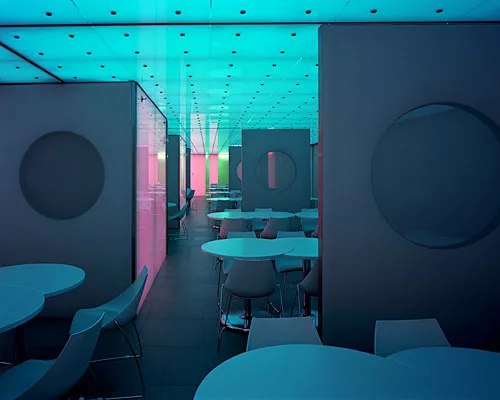
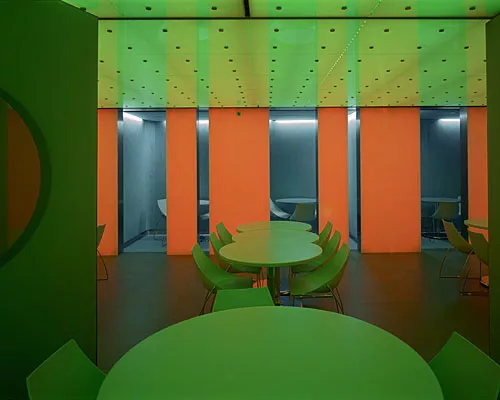
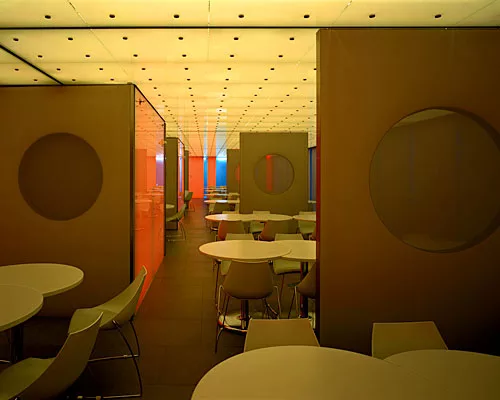
The end products of each, however, are clearly unique. Whereas at the Baker pool Turrell’s shards of colored light pierce expanses of darkness, the Condé Nast cafeteria represents the opposite tack. The dining room, which takes up the majority of the 12,000-square-foot space, is a veritable carnival of light. Ninety thousand iColor Flex SL nodes—each nub-like node comprises five LEDs—inhabit walls and ceiling, mounted behind panes of glass with translucent inter-layers. “It’s like walking into a light fixture,” Duffy says, “and we’re able to tune it to provoke different human responses.”
The room is a rectilinear open plan save for two center columns also wrapped in LED-studded glass. Removable panels that have sound-absorbing qualities can be mounted between the two center volumes to divide the room for special events. Moreover, a pair of rooms with porcelain-tile floors and Ultrasuede walls peel off two sides of the main hall to offer a modicum of privacy.
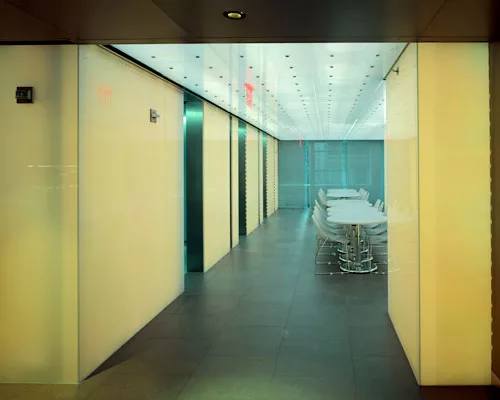
Although the configuration of the dining room is not particularly complex, so as not to compete with the lighting, the lighting technology itself is another matter. The planes operate by video signal rather than more-common DMX, which allows the architecture to function as a low-resolution television screen. The illuminated wall separating the cafeteria from the elevator lobby exemplifies the use of video: It can be switched into surveillance mode, in which light and color synchronizes with people’s movement toward the cafeteria entrance.
Inside the dining room, “Seven unique light sequences were programmed as a base number of looks for the space,” Puffer says. Here Duffy collaborated with Villereal as well as Robert Whitman, who offered their help without compensation. The artists choreographed this dynamic surface using Max/Jitter software for a variety of scenarios, ranging from soft-light loops for eating to dramatic cycles of saturated color more likely to be deployed for social events. Speaking of one of the latter settings, which flashes with intense blue-green, Duffy says “It’s unlike anything I’ve ever seen. Sometimes you’re surprised—even though we’ve envisioned this whole thing and knew it had a lot of potential, it’s still a revelation.”
On a recent visit, the cafeteria showed its passive side. The dining room ceiling glowed white with hues of red, casting occupants in an appealing, just-back-from-the-Hamptons glow. The walls slowly cycled from that base color to margarine yellow and back again. Yet Duffy points out that this and the six other settings are not set in software stone. “The flexibility is there for it to be used in different ways. You can do a party, or stage a fashion show. It can be tuned, and on a laptop. If you know what you’re doing it’s quite instant and remarkable.”
Looking for a reprint of this article?
From high-res PDFs to custom plaques, order your copy today!