Burj Khalifa
The completion of the world’s tallest skyscraper raises intriguing questions about the significance of this gleaming, spiraling form.


Architects & Firms
Dubai
Iconic skyscrapers, especially those that strive for the fleeting title of “world’s tallest building,” are rarely the progeny of cold logic. Their backers invariably are motivated by ambition and ego. The architect does not control whether or where such behemoths are built. He or she can only ensure that they are proud and soaring things, not Frankenstein-esque, XXL-size monstrosities. Such is the considerable achievement of Adrian Smith, FAIA, and his former colleagues at the Chicago office of Skidmore, Owings & Merrill (SOM) in the gargantuan yet persuasive Burj Khalifa, which rises half a mile above the desert in the once-unstoppable, now-humbled Persian Gulf playground of Dubai.
At the staggering height of 2,717 feet (easily more than two Empire State Buildings), this shimmering, spiraling mixed-use tower inevitably raises the question: When is big too big? To some, this giant of giants — its spire alone is more than 700 feet tall — clearly overshoots the mark. Shortly after its spectacular January 4 opening ceremonies, critics pegged it the Hummer of skyscrapers. “Purely a vanity project,” said the German urban planner Albert Speer, Jr., in Spiegel. “Completely unsustainable,” jibed Britain’s Guardian. Pundits also ridiculed the tower’s abrupt name change — from Burj Dubai (Arabic for “Dubai Tower”) to Burj Khalifa in honor of Sheik Khalifa-bin-Zayed al-Nahyan of Abu Dhabi, who bailed Dubai out of its 2009 debt crisis. In the Great Recession, when sustainability supposedly has supplanted spectacle as architecture’s guiding principle, the bling of the Burj Khalifa offers a convenient target for those eager to consign the pre-Crash Age of Excess to the ash heap of history.
But it would be shortsighted to conflate the messy circumstances surrounding the Burj Khalifa’s completion with the tower’s exhilarating and surprisingly refined architecture. And such a dismissal would ignore previous supertall sagas. When the now-beloved Empire State Building opened in 1931, so few of its floors were rented out that it was labeled “the Empty State Building.” Building booms and busts come and go, as do the temporary wearers of the world’s-tallest-building crown. What matters, in the long haul, is the artistry that separates skyscrapers that are merely yardstick-tall from those that make of their tallness a smashing aesthetic virtue. And the Burj Khalifa easily meets — and exceeds — and exceeds — that standard, soaring in both height and design quality above Dubai’s often-ludicrous collection of architectural cartoons.
The $1.5 billion skyscraper marks the first time since Egypt’s Great Pyramid of Giza that the world’s tallest building has been found in the Middle East. It also represents a great leap forward in height, rising higher than the previous record-holder, Taipei 101 in Taiwan, by more than 1,000 feet. Yet the tower is more than a mere feat of engineering, the product of mad scientists striving to achieve a listing at guinessworldrecords.com. The secret to its success is its integration of architecture and engineering, long a staple of the SOM Chicago office, responsible for five of the world’s current 10 tallest buildings.
To be sure, the tower is no paragon of sustainability. But a little perspective is in order. When the tower’s developer, the state-backed Emaar Properties, rounded up the usual supertall suspects — including SOM, Kohn Pedersen Fox, and Pelli Clarke Pelli — for an invited competition in 2002, green was not on its agenda; “Big” was. At that time, architects and the culture at large had yet to embrace sustainability as they have today. It is perhaps unfair to judge a building birthed in one era by the standards of another, just as it is unrealistic to insist on passive solar cooling in a climate where summer temperatures hit 120 degrees Fahrenheit and even the bus shelters are air-conditioned. The Burj beats the heat with double-paned glass walls that combine a low-E outer layer with a reflective inner layer. Besides, by promoting urban density, the skyscraper has attributes of conceptual green rather than literal green.
Located a few miles inland from the azure waters of the Persian Gulf, the tower is the undisputed centerpiece of a 500-acre, master-planned city-within-a-city that has improbably risen on what was desert just six years ago. Its nearly occupied 160 floors house a chic Armani hotel, floor upon floor of sold-out but mostly unoccupied condominiums, an already-popular observatory, and still-under-construction boutique offices. Huddled around the tower, like Lilliputians to its Gulliver, are various residential and hotel towers, the sprawling Dubai Mall, and a new “old town” of traditional, Islamic-themed town houses and hotels. While the juxtaposition of heights may seem bizarre, Emaar shrewdly calculated that the presence of the world’s tallest building would give the area cachet and allow the company to charge higher prices for units with prized “Burj views.” Such a strategy paid off — at least until Dubai’s real estate market collapsed in 2009.
Taking note of the Burj’s superskinny, supertall silhouette, many critics have wrongly averred that the tower was inspired by Frank Lloyd Wright’s unbuilt Mile-High Illinois scheme of 1956. In fact, as Smith and SOM have made clear, the actual forerunners were the suavely curved, three-pronged Lake Point Tower in Chicago of 1968, designed by Schipporeit & Heinrich, which has shallow floor plates to keep residents close to prized views; and another three-lobed, residential high-rise, SOM’s Tower Palace III in Seoul, South Korea, completed in 2004. Such was the formal genesis of the Y-shaped Burj, whose organic forms subtly echo in plan the onion domes and pointed arches prevalent in Islamic architecture. In tandem, SOM’s chief structural engineer, William Baker, designed a wind-resistant “buttressed core” of concrete that, at the 156th floor, gives way to an internal steel structure that carries the mostly unoccupied spire to the summit (see page 89).
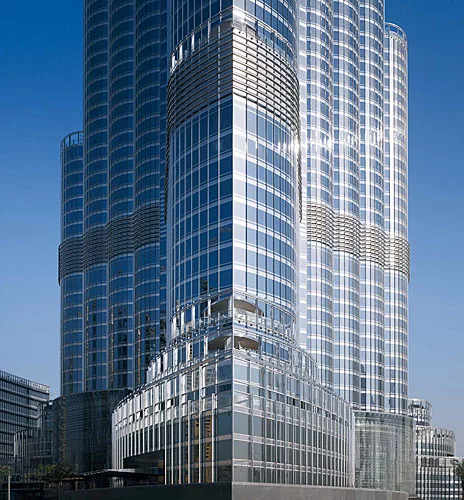
This innovative structural solution allows the Burj to be remarkably tall and remarkably thin, with one-third less square footage than the steel-framed Willis (originally Sears) Tower even though it almost doubles Willis’s height. As at Willis, floor plates simply drop off as the tower sets back, letting columns run continuously and avoiding costly structural transfers. Yet in lieu of Willis’s boxy Miesian geometry, the setbacks whir upward in a dynamic, counterclockwise spiral. By sheathing the faceted, sculptural mass in a luminous, light-catching skin, accentuated with fin-shaped stainless-steel mullions, Smith creates a dazzling skyline object that mounts rhythmically to a thrilling climax. This skyscraper looks like a skyscraper, its elegant, exultant verticality providing Dubai’s random clumps of high-rises with an unmistakable center of the tent.
The tower’s extraordinary height, Smith insists, was not his — or his client’s — aim, but an outgrowth of his desire to prevent the tower from appearing stubby, as it did in earlier, shorter schemes. “I just wanted the proportions to be right,” said Smith, who left SOM in 2006 to start his own firm, Adrian Smith + Gordon Gill Architecture. “That was the singular motivation for reaching to that height — not a number.”
The tower is equally persuasive at ground level, achieving Smith’s aim that it approximate the effect of a vertical stalagmite that grows naturally out of the earth. Footlike extensions of its Y-shaped floors step down nimbly to the surrounding plaza. Lacking an immediate context, Smith built one in the form of wedge-shaped low-rise annexes (an office building and a health club) that belly up to the Burj and shape relatively intimate spaces around it. Pedestrians approaching the tower encounter lozenge-shaped entrance pavilions outfitted with precisely detailed, cable-supported double walls. The pavilions have the added benefit of deflecting downdrafts that could knock visitors off their feet.
Upstairs, the benefits of the tower’s structural parti are readily apparent. By dispensing with closely spaced perimeter columns and deep floor plates, the buttressed core opens the interior to million-dollar views of the Gulf, Dubai’s skyline, and the surrounding desert. While the “At the Top” observatory on the 124th floor is not truly at the tower’s top, as its name implies, it is still a splendid lookout point. From bottom to top, SOM’s interiors team wisely employed soothing, understated finishes, creating oases of calm that sharply contrast with Dubai’s visual cacophony.
For all the design skill, the question looms: Is the skyscraper nothing more than beautiful folly? Undeterred by the Burj’s empty spaces, Emaar reports that the tower’s Armani Hotel is recording “strong occupancy levels,” that the observatory is on target to attract 1.2 million visitors in its first 12 months of operation, that owners are starting to occupy the condos, and that the transfer of offices to owners will begin this summer. Nonetheless, due to Dubai’s sharp decline in real estate prices, some Burj condo owners are renting out apartments rather than flipping them.
For his part, Smith argues that the Burj is not the last blast of the age of spectacle, but a harbinger of the future, as developing countries follow its prototype of the mega-scale, master-planned community anchored by an iconic tower. With Saudi Arabia contemplating a kilometer-high skyscraper, and other developing countries getting set to join the supertall race, time may well prove him right — just as it did the backers of the Depression-era giant that eventually became synonymous with the exuberance of New York City and the resilience of America.
PeopleDesign Architect: SOM – George Efstathiou, FAIA, Partner-in-Charge; Bill Baker, Structural Engineer; Adrian Smith, FAIA, Consulting Design Partner; Ray J. Clark; Eric Tomich; Stan Korista; Edward Thompson AIA; Peter Weismantle, AIA; Gregory L. Smith AIA; Heather K. Poell AIA; Lawrence Novak; James Pawlikowski; Luke Leung; Gil Di Lorio; Joseph Jamal; Nancy Abshire, AIA; Kenneth Turner, AIA; Peter Freiberg, AIA; Gabriel Wong, AIA B. Eunjung Cho; Bradley Young; Miguel Gonzalez; Michael Filar; Scott Kadlec; Bridgett Baker Thomas; Ishac Koussa; Katey Knott; Mohamed Sheriff; Scott Cherney; Dennis Milam; Kenneth Maruyama; David Scott; Nada Andric, Associate Director for Interiors; Daniel Bell, Associate, Site Team Architect of record: Hyder Consulting Engineers: SOM, Hyder Consultants: Jaume Plensa, Plensa Studio (residential lobby artwork); SWA Group (landscape); Ominum International (quantity surveyor); Fisher Marantz Stone (lighting); Pelton Marsh Kinsella Consulting (acoustical); Lerch Bates Consulting (vertical transportation); Lerch Bates Façade (façade access); The RJA Group (fire & life safety); Square Peg Design (signage & graphics); Opening Solutions (ironmongery); GHD (independent verification and testing); RWDI (wind engineering); Boundary Layer Wind Tunnel Laboratory at the University of Western Ontario (wind tunnel peer review); Hyder Consulting (geotechnical); AECOM/STS (geotechnical peer review); CTL Group (concrete testing); CBM Engineers (structural peer review); Crystal Fountains / PA EMS (interior water features); WET Design (exterior water features); Emirll Services (security systems); Speirs and Major Associates (external feature lighting); STS Consultants (geotechnical peer review); Trend Foodservice Design (food service/laundry); Walker Parking (parking) General Contractor: Samsung Coporation / BESIX Group / Arabtec Construction Sub-contractors: Middle East Foundations (Piling); NASA Multiplex (foundation); Samsung / BESIX / Arabtech (superstructure); Doka (formwork); Unimix (concrete supplier); Eversendai (steel); DEPA, Heeho, Ashtaar, Fino (interior fit-out) |
ProductsExterior cladding: Far East Group, Al Abbar Aluminum & Glass (metal/glass curtainwall); Waagner Biro AG (cable wall pavilions); UNIMIX Concrete Supplies (concrete) Glazing: Guardian Industries (glass); Dow Corning (silicone) Doors: Al Abbar (entrances); Task Industrial, UAE (metal doors); Fino International FTZ, Depa Dubai, Hee Hoon Design Group (wood doors); Marshfield Door, USA; Eggers Doors, USA (fire-control doors) Hardware: Dorma (locksets, hinges); Dorma, Samuel Heath (closers); Dorma (exit devices); CHMI (pulls); Ogro, Olivari, Manital (levers) Interior finishes: Hunter Douglas, Decoustics, Armstrong, Armani Hotel (acoustical ceilings); STO (suspension grid); Dorma (demountable partitions); Imperial Woodworking, Fino International, Depa Dubai, Hee Hon Design Group (cabinetwork and custom woodwork); Jotun Paint, Sherwin-Williams, Benjamin Moore, Dupont (paints and stains); Wolf Gordon, Knoll Textiles, Carnegie, Maharam, Valley Forge (wallcoverings); TABU Spa / Berti Pavimentui Legno (paneling); Abet Laminati (plastic laminate); Formica (solid surfacing); Italian Automotive Texture Paints (special surfacing) Floor and wall tile: Royal Mosa, Dal Tile, Sicis, Glacier, Fino International, London Grey, Kerman Grey, ERAMOSA; Mannington Commercial (resilient flooring); Hokanson, Tai Ping, Interface, Shaw Floors (carpet); Campolonghi Group, Tre Emme (natural stone); Lopark, Margaritelli (wood flooring); Fritz Kohl, Tabu (veneer); Figla (glass floors); Excelsior, Eden Design (metal flooring) Furnishings: Halcon, Knoll, Haworth, Interna Contract, Moroso, Cassina, Poltrona Frau, Zographos, Interior Crafts, Arper, Cherner Chair, Holly Hunt, Armani Casa; Calvin Fabrics, J Robert Scott, Larsen, Gretchen, Bellinger (fabrics); Edelman Leather, Cortina, Pollaro Custom Furniture, Richard Schultz, Mechoshade Lighting: Zonca; Lucent Lighting, Erco, DAL, Oldham Lighting, B-K Lighting, Dynalite, Tectronics, Philips, Holly Hunt, Armani Casa Conveyance: Otis Plumbing: Dornbracht, Durvait, Hansgrohe
Armani Hotel: |
Looking for a reprint of this article?
From high-res PDFs to custom plaques, order your copy today!