Architectural Record
search
cart
facebook twitter linkedin youtube
  • Sign In
  • Subscribe
  • Sign Out
  • My Account
Architectural Record
  • NEWS
    • Latest News
    • Awards
    • Interviews
    • Obituaries
    • Podcasts
      • Design:Ed Podcast
      • Sponsored Podcasts
  • OPINION
    • Book Reviews / Excerpts
    • Exhibition Reviews
    • Forum
  • EXCLUSIVES
    • Videos
    • Design Vanguard
    • Top 300 Firms
    • Sponsored Content
    • Sponsored eBooks
    • From the Archives
  • CONTINUING ED
    • Editorial Continuing Ed
    • CE Center
    • CE Academies
  • PROJECTS
    • Buildings By Type
    • Reuse & Renovation
    • Museums & Arts Centers
    • Colleges & Universities
    • Multifamily Housing
    • Interiors
    • Lighting
    • Kitchen & Bath
  • HOUSES
    • Record Houses
    • House of the Month
    • Featured Houses
  • PRODUCTS
    • Products by Category
    • Record Products of the Year
    • Latest Products
  • EVENTS
    • Dates & Events
    • Record on the Road
    • Innovation Conference
    • Sustainability in Practice
    • Women In Architecture
    • Webinars
    • Ad Excellence Awards
    • Submit an Event
  • CONNECT
    • Ask RECORD AI
    • Newsletters
    • Contact
    • Advertise
    • Editorial Calendar
    • Store
    • Customer Service
  • SUBMIT
    • Submission Guidelines
    • RECORD Competitions
  • MAGAZINE
    • Subscribe
    • My Account
    • Digital Edition
    • Current Issue
    • Firm Pass
    • Historic Archive
Residential Architecture

Lake Tahoe House

Lake/Flato Architects’ Lake Tahoe House performs the duties of a camp compound for its owners.

By Stephen Sharpe
October 19, 2007

Architects & Firms

Lake|Flato

Lake Tahoe, Nevada

The notion of a camp compound appealed to the project’s client, an active family wanting to be outdoors as much as possible at their vacation home near the north shore of Lake Tahoe, Nevada. This underlying design concept allowed the architect, David Lake, FAIA, of Lake/Flato Architects in San Antonio, to spread out the program and divide its components among three buildings sited along the edge of the 3⁄4-acre tract. The strategy also protected the site’s most distinctive features, particularly its towering Ponderosa pines. “It was a way of preserving the character of the site and leaving as much open space as possible,” says Lake.
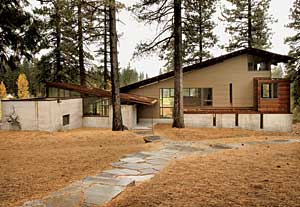
Photo: © Jeff Dow Photography

The multibuilding plan loosely forms a courtyard that slopes downward and culminates in a 2,950-square-foot, three-story main house, referred to as the lodge, which consists of a kitchen; a large, open living/dining room; smaller reading rooms; and two bedrooms with separate bathrooms. The profile of the second building, a long and narrow garage/shop/playroom, mimics the incline of the hill and helps block views of the neighbors. An open arbor connects the garage building to the lodge, while a detached guest house, the third building in the set, sits on the other side of the lodge. Simple shed forms inspired by the old mining structures and small barns common to the region characterize all three buildings. Low-maintenance materials, including board-formed concrete, weathered cedar siding, and rusted Cor-Ten steel, make up the rugged exterior palette. Metal roofs, the typical snow-country “cold” variety that retains a blanket of snowfall as insulation, top the three buildings and ward off potential damage from wildfires.

By breaking up the program, the architects also reduced the scale of the project, which encompasses 5,845 square feet of indoor space. The client didn’t want a big house that might overwhelm the neighbors’ modest-size residences, says Lake. The neighborhood, developed in the 1950s, represents a throwback in time compared to newer developments in the area. For example, homes built more recently tend to range from 12,000 to 15,000 square feet—significantly larger than his clients’ buildings, says Lake. Standing about 5,500 feet above sea level and 800 feet below a ridgetop, the site is protected from north and northwest winds while also benefitting from ample direct sunlight. Lake describes the buildings as energy-efficient, designed with passive solar strategies that include south-facing glass and stained-concrete floors to capture the abundant daytime sunshine that keeps the interiors warm during winter nights.


KEYWORDS: Nevada

Share This Story

Looking for a reprint of this article?
From high-res PDFs to custom plaques, order your copy today!

Post a comment to this article

Report Abusive Comment

Subscription Center
  • Create an Account
  • Start a Subscription
  • Manage My Account
  • Sign Up for Newsletters
  • Visit Customer Service
  • Update Preferences

More Videos

Sponsored Content

Sponsored Content is a special paid section where industry companies provide high quality, objective, non-commercial content around topics of interest to the Architectural Record audience. All Sponsored Content is supplied by the advertising company and any opinions expressed in this article are those of the author and not necessarily reflect the views of Architectural Record or its parent company, BNP Media. Interested in participating in our Sponsored Content section? Contact your local rep!

close
  • TAMLYN XtremeTrim Exterior Trim
    Sponsored byTamlyn

    Designing Cleaner Panel Facades: Why Exterior Trim Details Matter

  • Building with Vapor Barriers
    Sponsored byReef Industries, Inc.

    Vapor Barriers Help Control Moisture in Tighter Building Designs

  • Duct Interior with Prodeq System
    Sponsored byHenry, a Carlisle Company

    Designing Resilient Water Containment Systems

DESIGN:ED Podcast
Listen to Architectural Record’s DESIGN:ED Podcast

Events

June 11, 2026

Very Early Warning Fire Detection for Mission-Critical Facilities

Credits: 1 AIA LU/HSW; 1 AIBD P-CE; 0.1 ICC CEU

Examine advanced fire detection strategies that support uptime and enhance safety in data centers and other mission-critical facilities.

June 16, 2026

Focus on the Façade: Exploring Steel, Timber & Fire-Rated Curtain Walls and Channel Glass Systems

Credits: 1 AIA LU/HSW; 1 AIBD P-CE; 0.1 ICC CEU

Explore modern façade and glazing systems that enhance daylighting, fire safety, and thermal performance while expanding architectural design possibilities.

View All Submit An Event

Products

2026 Architect's Square Foot Costbook

2026 Architect's Square Foot Costbook

See More Products

Popular Stories

Practice Matters illustration

What’s in a (Firm’s) Name? Thinking About Succession and Legacy

Coronado Bridge

The Architect’s Guide to San Diego

Practice Matters illustration

By the Numbers: Counting America's Architects

SanDiegoAirport

Top 300 Architecture Firms of 2026

Crane Cove, ONO

Design Vanguard 2026 Winners

Broader Sustainability of CMU - Free Webinar - May 21, 2026

Related Articles

  • Lake Tahoe House Residential Quarterly

    See More
  • The Analog House.

    Analog House by Olson Kundig & Faulkner Architects

    See More

Related Products

See More Products
  • biogenic.jpg

    Manual of Biogenic House Sections

  • iconic house.jpg

    The Iconic House

See More Products
×

The latest news and information

#1 Source for Architectural Design, News and Products

SUBSCRIBE
  • RESOURCES
    • Advertise
    • Contact Us
    • Submit
    • Store
  • ACCOUNT CENTER
    • Create an Account
    • Start a Subscription
    • Manage My Account
    • Sign Up for Newsletters
    • Visit Customer Service
    • Update Preferences
  • PRIVACY
    • PRIVACY POLICY
    • TERMS & CONDITIONS
    • DO NOT SELL MY PERSONAL INFORMATION
    • PRIVACY REQUEST
    • ACCESSIBILITY
  • SERVICES
    • Marketing Services
    • Reprints
    • Market Research
    • List Rental
    • Survey/Respondent Access
  • STAY CONNECTED
    • Linkedin
    • Facebook
    • Instagram
    • YouTube
    • X (Twitter)

Copyright ©2026. All Rights Reserved BNP Media, Inc. and BNP Media II, LLC.

Design, CMS, Hosting & Web Development :: ePublishing