Architectural Record
search
cart
facebook twitter linkedin youtube
  • Sign In
  • Subscribe
  • Sign Out
  • My Account
Architectural Record
  • NEWS
    • Latest News
    • Awards
    • Interviews
    • Obituaries
    • Podcasts
      • Design:Ed Podcast
      • Sponsored Podcasts
  • OPINION
    • Book Reviews / Excerpts
    • Exhibition Reviews
    • Forum
  • EXCLUSIVES
    • Videos
    • Design Vanguard
    • Top 300 Firms
    • Sponsored Content
    • Sponsored eBooks
    • From the Archives
  • CONTINUING ED
    • Editorial Continuing Ed
    • CE Center
    • CE Academies
  • PROJECTS
    • Buildings By Type
    • Reuse & Renovation
    • Museums & Arts Centers
    • Colleges & Universities
    • Multifamily Housing
    • Interiors
    • Lighting
    • Kitchen & Bath
  • HOUSES
    • Record Houses
    • House of the Month
    • Featured Houses
  • PRODUCTS
    • Products by Category
    • Record Products of the Year
    • Latest Products
  • EVENTS
    • Dates & Events
    • Record on the Road
    • Innovation Conference
    • Sustainability in Practice
    • Women In Architecture
    • Webinars
    • Ad Excellence Awards
    • Submit an Event
  • CONNECT
    • Ask RECORD AI
    • Newsletters
    • Contact
    • Advertise
    • Editorial Calendar
    • Store
    • Customer Service
  • SUBMIT
    • Submission Guidelines
    • RECORD Competitions
  • MAGAZINE
    • Subscribe
    • My Account
    • Digital Edition
    • Current Issue
    • Firm Pass
    • Historic Archive
Residential Architecture

Keel Cabin

Salmela Architect's animal-like Keel Cabin rests in the woods of the North Country.

By Jane Kolleeny
January 19, 2008

Architects & Firms

Salmela Architect

Whiteface Reservoir, Makinen, Minnesota

Duluth, Minnesota, sits on the edge of Lake Superior, the largest freshwater lake in the world. Although connected via the lake and the St. Lawrence Seaway to seafaring vessels from around the globe, this city of 80,000 remains far outside the centers of fashion. It is a place where nature dominates and people seldom make news, with a few exceptions. Duluth native Bob Dylan, for example, captured the toughness of the North Country in his songs for years. But poetry comes in many forms, and Duluth-based David Salmela, FAIA, exemplifies the body and soul of these same wooded lands in his skillfully crafted designs.
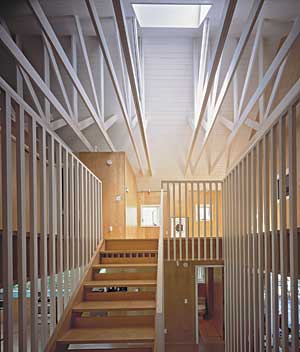
Keel Cabin

During his 38-year career, Salmela has designed mostly residential projects ranging in size from the 468-square-foot Emerson Sauna, for clients in Duluth, to the 306-acre Jackson Meadow, a community in Minnesota (both AIA Honor Award winners in 2005). Born and raised on a dairy farm in the state, Salmela, of Finnish origin, blends Modern with traditional design, resulting in an aesthetic that is distinctively Scandinavian, peppered with his signature North Country agricultural vernacular. While no two of his projects are alike, they all reveal a Salmela imprint, with his characteristic accents of bright color, use of local wood and organic shapes, and a desire to be in concert with nature. The 1,656-square-foot Keel Cabin, on the Whiteface Reservoir, in Makinen, Minnesota, demonstrates this well.

The Keels, who live and work 3 hours away in the Twin Cities, needed a summer retreat, and decided to build a rustic, three-bedroom house and guesthouse on their lake property. Though professionally an engineer, the husband studied architecture in school; his interest in design, tempered by a tight budget, led him and his wife to do much of the site and foundation work themselves. The couple also salvaged the windows and pilings from a manufacturer’s boneyard, and Salmela incorporated these into his design. Remarkably, total construction cost only about $120,000, or $72 per square foot. “If you buy discarded windows before design, you can’t expect the Farnsworth House,” jokes Salmela. Still, the cabin is remarkably exuberant.

As you approach the cabin, it emerges as a rectilinear form with painted plywood siding and standing-metal-seam roofing, sitting on poured-in-place concrete footings. Within this conventional envelope, an unexpected, animal-like shape emerges—a cantilevered form that sags then swells into the rounded back of what appears to be an “aged creature in a boreal forest,” as Salmela describes it. The architect used a similar abstracted form on the Loken Horse Barn (Duluth, 1993) and is considering something similar with the Yingst Screen House (still in design), in Traverse City, Michigan.


KEYWORDS: Minnesota

Share This Story

Looking for a reprint of this article?
From high-res PDFs to custom plaques, order your copy today!
Post a comment to this article

Report Abusive Comment

Subscription Center
  • Create an Account
  • Start a Subscription
  • Manage My Account
  • Sign Up for Newsletters
  • Visit Customer Service
  • Update Preferences

More Videos

Sponsored Content

Sponsored Content is a special paid section where industry companies provide high quality, objective, non-commercial content around topics of interest to the Architectural Record audience. All Sponsored Content is supplied by the advertising company and any opinions expressed in this article are those of the author and not necessarily reflect the views of Architectural Record or its parent company, BNP Media. Interested in participating in our Sponsored Content section? Contact your local rep!

close
  • TAMLYN XtremeTrim Exterior Trim
    Sponsored byTamlyn

    Designing Cleaner Panel Facades: Why Exterior Trim Details Matter

  • Building with Vapor Barriers
    Sponsored byReef Industries, Inc.

    Vapor Barriers Help Control Moisture in Tighter Building Designs

  • Duct Interior with Prodeq System
    Sponsored byHenry, a Carlisle Company

    Designing Resilient Water Containment Systems

DESIGN:ED Podcast
Listen to Architectural Record’s DESIGN:ED Podcast

Events

June 10, 2026

Rethinking Stormwater – The Power of Porous Paving

Credits: 1 AIA LU/HSW; 1 AIBD P-CE; 0.1 ICC CEU

Learn how porous paving systems support stormwater management, reduce heat island effects, and enhance sustainable site design performance.

June 11, 2026

Very Early Warning Fire Detection for Mission-Critical Facilities

Credits: 1 AIA LU/HSW; 1 AIBD P-CE; 0.1 ICC CEU

Examine advanced fire detection strategies that support uptime and enhance safety in data centers and other mission-critical facilities.

View All Submit An Event

Products

2026 Architect's Square Foot Costbook

2026 Architect's Square Foot Costbook

See More Products

Popular Stories

Practice Matters illustration

What’s in a (Firm’s) Name? Thinking About Succession and Legacy

Coronado Bridge

The Architect’s Guide to San Diego

Practice Matters illustration

By the Numbers: Counting America's Architects

House on a Hill

Design Vanguard 2026: Forma

Crane Cove, ONO

Design Vanguard 2026 Winners

Broader Sustainability of CMU - Free Webinar - May 21, 2026

Related Articles

  • Keel Cabin Residential

    See More
  • Stacked Cabin

    See More
  • Mountain Cabin

    See More

Related Products

See More Products
  • 0470126736.gif

    Modern Sustainable Residential Design: A Guide for Design Professionals

See More Products
×

The latest news and information

#1 Source for Architectural Design, News and Products

SUBSCRIBE
  • RESOURCES
    • Advertise
    • Contact Us
    • Submit
    • Store
  • ACCOUNT CENTER
    • Create an Account
    • Start a Subscription
    • Manage My Account
    • Sign Up for Newsletters
    • Visit Customer Service
    • Update Preferences
  • PRIVACY
    • PRIVACY POLICY
    • TERMS & CONDITIONS
    • DO NOT SELL MY PERSONAL INFORMATION
    • PRIVACY REQUEST
    • ACCESSIBILITY
  • SERVICES
    • Marketing Services
    • Reprints
    • Market Research
    • List Rental
    • Survey/Respondent Access
  • STAY CONNECTED
    • Linkedin
    • Facebook
    • Instagram
    • YouTube
    • X (Twitter)

Copyright ©2026. All Rights Reserved BNP Media, Inc. and BNP Media II, LLC.

Design, CMS, Hosting & Web Development :: ePublishing