Architectural Record
search
cart
facebook twitter linkedin youtube
  • Sign In
  • Subscribe
  • Sign Out
  • My Account
Architectural Record
  • NEWS
    • Latest News
    • Awards
    • Interviews
    • Obituaries
    • Podcasts
      • Design:Ed Podcast
      • Sponsored Podcasts
  • OPINION
    • Book Reviews / Excerpts
    • Exhibition Reviews
    • Forum
  • EXCLUSIVES
    • Videos
    • Design Vanguard
    • Top 300 Firms
    • Sponsored Content
    • Sponsored eBooks
    • From the Archives
  • CONTINUING ED
    • Editorial Continuing Ed
    • CE Center
    • CE Academies
  • PROJECTS
    • Buildings By Type
    • Reuse & Renovation
    • Museums & Arts Centers
    • Colleges & Universities
    • Multifamily Housing
    • Interiors
    • Lighting
    • Kitchen & Bath
  • HOUSES
    • Record Houses
    • House of the Month
    • Featured Houses
  • PRODUCTS
    • Products by Category
    • Record Products of the Year
    • Latest Products
  • EVENTS
    • Dates & Events
    • Record on the Road
    • Innovation Conference
    • Sustainability in Practice
    • Women In Architecture
    • Webinars
    • Ad Excellence Awards
    • Submit an Event
  • CONNECT
    • Ask RECORD AI
    • Newsletters
    • Contact
    • Advertise
    • Editorial Calendar
    • Store
    • Customer Service
  • SUBMIT
    • Submission Guidelines
    • RECORD Competitions
  • MAGAZINE
    • Subscribe
    • My Account
    • Digital Edition
    • Current Issue
    • Firm Pass
    • Historic Archive
Residential Architecture

House at the Shawangunks

Bohlin Cywinski Jackson's leafy House at the Shawangunks deftly scales a hillside.

By Russell Fortmeyer
January 19, 2008

Architects & Firms

Bohlin Cywinski Jackson

New Paltz, New York

It would be easy to think of Bohlin Cywinski Jackson’s House at the Shawangunks—located a few miles west of the Hudson River in the hills near the upstate New York town of New Paltz—as a house designed for rock climbers. Granted, the clients—a husband and wife who left New York City—enjoy rock climbing and moved there in part to be within walking distance of cliffs. And the primary organizing strategy of the house is a light-filled central stair that connects three floors, capped by a ladder to an attic loft. But aside from these details, this analogy oversimplifies the house’s relationship to its sloped site.
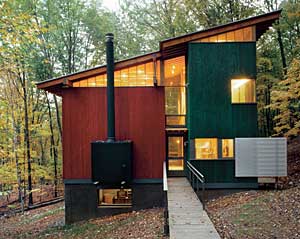
House at the Shawangunks
Photo ' Nic Lehoux

As the architect Peter Bohlin, FAIA, puts it, up was the only way to go. Since the foundation needed to be close to 4 feet deep, on a substantial slope for a house with a basement, curtailing the foundation’s cost meant minimizing the overall footprint. As a result, even on its heavily wooded 6-acre site, the 2,100-square-foot house appears somewhat diminutive. Its vertically arranged program includes living and dining rooms, a kitchen, and a bathroom on the first floor; a master bedroom and bath, as well as a balcony office, on the second; the attic loft for an office and storage; and a basement with a media room, guest bedroom, bath, and utility room.

All of this is arranged in a series of cubes—the basement with a gray-stained concrete base, the living room with red-stained Western red cedar shiplap siding, and the kitchen and second floor with a green-stained version of the cedar. A dining room, entirely clad in glass, stands in for a porch. The wood-framed cubes support the single-pitch metal roof, which follows the slope of the site and is secured to the cubes with framing clad in translucent polygal panels that reinforce the relatively simple geometries of the house’s volumes.

While the tight plan of the house relies on a fairly conventional arrangement of spaces, in section the architects designed each room with view windows and clerestories that rather elegantly correspond to the specific conditions of the site. Walking from the raised wood sidewalk of the entrance and into the double-height living room, it’s not only the large window opening to the southeast, down the site, that attracts you, but also the view opposite, overhead and up to the underside of the top edge of the roof. With sunlight pouring through in various ways all day, these clerestories help to embed the house further into the rhythms of the forest.


KEYWORDS: New York

Share This Story

Looking for a reprint of this article?
From high-res PDFs to custom plaques, order your copy today!

Russell fortmeyer
Russell Fortmeyer, a contributing editor to RECORD, is a Los Angeles-based sustainability principal at Arup and adjunct professor at the University of Southern California School of Architecture.

Post a comment to this article

Report Abusive Comment

Subscription Center
  • Create an Account
  • Start a Subscription
  • Manage My Account
  • Sign Up for Newsletters
  • Visit Customer Service
  • Update Preferences

More Videos

Sponsored Content

Sponsored Content is a special paid section where industry companies provide high quality, objective, non-commercial content around topics of interest to the Architectural Record audience. All Sponsored Content is supplied by the advertising company and any opinions expressed in this article are those of the author and not necessarily reflect the views of Architectural Record or its parent company, BNP Media. Interested in participating in our Sponsored Content section? Contact your local rep!

close
  • TAMLYN XtremeTrim Exterior Trim
    Sponsored byTamlyn

    Designing Cleaner Panel Facades: Why Exterior Trim Details Matter

  • Building with Vapor Barriers
    Sponsored byReef Industries, Inc.

    Vapor Barriers Help Control Moisture in Tighter Building Designs

  • Duct Interior with Prodeq System
    Sponsored byHenry, a Carlisle Company

    Designing Resilient Water Containment Systems

DESIGN:ED Podcast
Listen to Architectural Record’s DESIGN:ED Podcast

Events

June 10, 2026

Rethinking Stormwater – The Power of Porous Paving

Credits: 1 AIA LU/HSW; 1 AIBD P-CE; 0.1 ICC CEU

Learn how porous paving systems support stormwater management, reduce heat island effects, and enhance sustainable site design performance.

June 11, 2026

Very Early Warning Fire Detection for Mission-Critical Facilities

Credits: 1 AIA LU/HSW; 1 AIBD P-CE; 0.1 ICC CEU

Examine advanced fire detection strategies that support uptime and enhance safety in data centers and other mission-critical facilities.

View All Submit An Event

Products

2026 Architect's Square Foot Costbook

2026 Architect's Square Foot Costbook

See More Products

Popular Stories

Practice Matters illustration

What’s in a (Firm’s) Name? Thinking About Succession and Legacy

Practice Matters illustration

By the Numbers: Counting America's Architects

House on a Hill

Design Vanguard 2026: Forma

Crane Cove, ONO

Design Vanguard 2026 Winners

House A on a Hill

Design Vanguard 2026: Santiago Valdivieso

Broader Sustainability of CMU - Free Webinar - May 21, 2026

Related Articles

  • House at the Shawangunks Residential

    See More
  • House at Further Lane - House of the Month -

    See More
  • House At Wind Point - House of the Month -

    See More

Related Products

See More Products
  • iconic house.jpg

    The Iconic House

  • bim design firms.jpg

    BIM for Design Firms: Data Rich Architecture at Small and Medium Scales

See More Products
×

The latest news and information

#1 Source for Architectural Design, News and Products

SUBSCRIBE
  • RESOURCES
    • Advertise
    • Contact Us
    • Submit
    • Store
  • ACCOUNT CENTER
    • Create an Account
    • Start a Subscription
    • Manage My Account
    • Sign Up for Newsletters
    • Visit Customer Service
    • Update Preferences
  • PRIVACY
    • PRIVACY POLICY
    • TERMS & CONDITIONS
    • DO NOT SELL MY PERSONAL INFORMATION
    • PRIVACY REQUEST
    • ACCESSIBILITY
  • SERVICES
    • Marketing Services
    • Reprints
    • Market Research
    • List Rental
    • Survey/Respondent Access
  • STAY CONNECTED
    • Linkedin
    • Facebook
    • Instagram
    • YouTube
    • X (Twitter)

Copyright ©2026. All Rights Reserved BNP Media, Inc. and BNP Media II, LLC.

Design, CMS, Hosting & Web Development :: ePublishing