Continuing Education: Adapting to New Environs
As Passive House certification gains ground in the United States, the standards are modified for North America's diverse climate conditions.
The original standards made sense in the relatively consistent maritime climate of north-central Europe, says Katrin Klingenberg, executive director of PHIUS. “But in the context of the extreme climates of the U.S., designers were sometimes forced to choose strategies that had unintended consequences,” such as overheating from too much glazing, she explains. The new standards also represent PHIUS's further divergence from the criteria set by its parent organization, the Passivhaus Institute (PHI) in Darmstadt, Germany. The two broke contractual ties in 2011.
The original Passive House standards, devised to minimize energy loads, were balanced on just three pillars: a space-conditioning limit of 4.75 Btu's per square foot per year; a source energy cap (usually the total electrical demand) of 38,000 Btu's per square foot per year; and an airtight envelope criterion of no more than 0.6 air changes per hour at 50 Pascals of pressure. The revamped standards maintain these three pillars, but expand them.
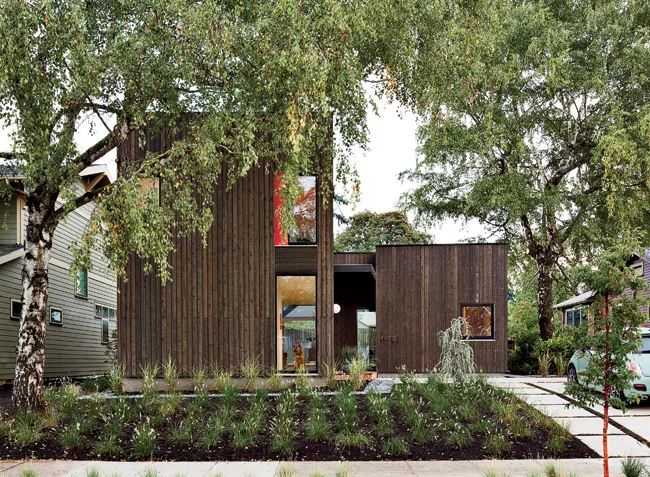
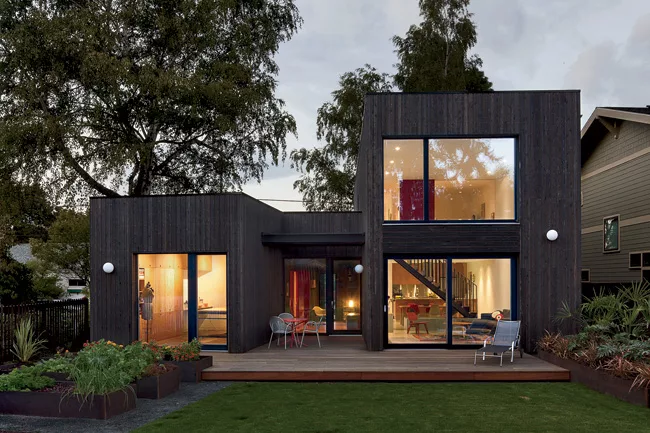
While it is too early to say what the impact of the new North American requirements will be, the German standards have made their mark on a variety of projects in the U.S., including houses, apartment buildings, and even a laboratory. One example is In Situ Architecture's Skidmore Passivhaus in Portland, Oregon. Completed in 2013, the single-family house, made up of two shed-roofed cedar-clad volumes, met the original benchmarks by creating a super-insulated shell. It consists of a hefty frame of 2-by-8 wood studs that is filled with cellulose insulation and wrapped with 3 inches of rigid insulation. And since the Pacific Northwest receives a relatively small amount of annual solar radiation—much like Germany—the architect was able to open the house's living areas to the sun with copious south-facing glazing. Motorized external shades help prevent overheating.
The succinct set of requirements in the German standards were extremely appealing to In Situ's principal, Jeff Stern, who is concerned that the new standards will add complexity and make certification more cumbersome. “One of the things that was attractive about Passive House was the clarity and simplicity of the criteria,” he says.
One illustration of the intricacies of the overhauled standards is an expanded set of targets for heating and cooling. Instead of setting just an annual space-conditioning limit, the new Passive House system also takes into account peak loads (often referred to as design temperatures), to help optimize the envelope and the building systems. In place of one uniform cap for both heating and cooling, the new standards establish four thresholds: annual heating loads, annual cooling loads, peak heating loads, and peak cooling loads—each specific to the building's location.
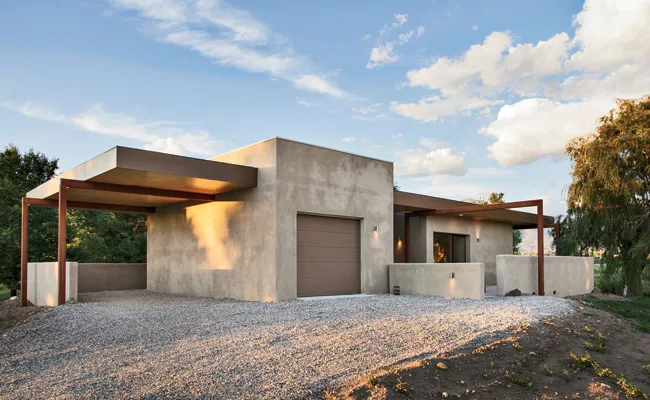
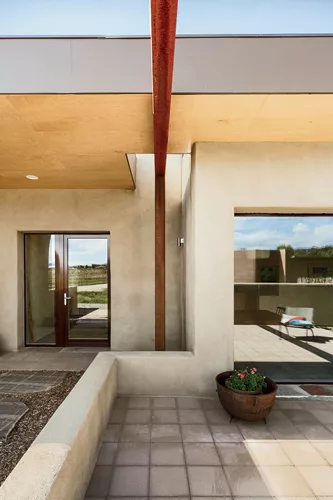
Some architects working with the Passive House system have already been considering such factors. Peak loads were extremely important for the Santa Fe, New Mexico, firm NEEDBASED when it designed a recently completed house in a senior cohousing community in Taos, where design temperatures are almost the same as Chicago's.
To cope with these extremes, and create a house that exceeded Passive House requirements by 30 percent, Jonah Stanford, the firm's principal designer, shaped the three-bedroom, 1,750-square-foot house to take advantage of the plentiful desert sun during the winter but be protected from potential overheating during the summer. The Southwest Modern'style dwelling has flat roofs and deep overhangs to shield its south-facing triple-glazed windows.
It also has a high-efficiency air-to-air heat exchanger—standard equipment on Passive House projects—which adds fresh air to the tightly sealed building and recovers thermal energy. There are two types of such heat exchangers. One is a heat recovery ventilator (HRV), which, in winter, passes heat from the exiting interior air to the incoming fresh air. In summer, it recovers coolness from the exiting air. Another type is an energy recovery ventilator (ERV). It performs the same function as an HRV but also exchanges humidity. ERVs are commonly used in humid climates, where moisture needs to be removed for comfort. But the Taos house has an ERV because the winter air can be uncomfortably dry. It recovers indoor moisture and adds it to the incoming air.
The Taos project was designed to surpass Passive House standards because it also targeted Net Zero Energy (NZE) status, which was achieved by generating an equivalent of the home's annual electrical needs on-site with grid-connected photovoltaics (PVs). PHIUS recently instituted an add-on certification for NZE, and one goal of the DOE-funded study was to adjust the Passive House criteria to create a path to NZE. “It makes sense to use Passive House to take efficiency as far as possible while considering economic payback, then generate the remaining demand with renewables,” Stanford says. The Taos house required only nine PV panels—a 1.7 kilowatt system.
The report leading to the new standards also emphasized the need for making Passive House more cost-effective—too often, projects invested in elements that had limited payback, according to the study. Toward that end, the study's authors, including consulting and research group Building Science Corporation, and PHIUS, used software developed by the National Renewable Energy Laboratory (NREL) to evaluate the cost-effectiveness for an array of variables, from window types to building orientation. The researchers also used the NREL tool to generate the four heating and cooling targets (for peak demands and annual loads) for 100 locations in North America. This function is being incorporated into the new design and verification tool WUFI Passive. It will help designers balance heating and cooling strategies for the most cost-effective design. The software is free.
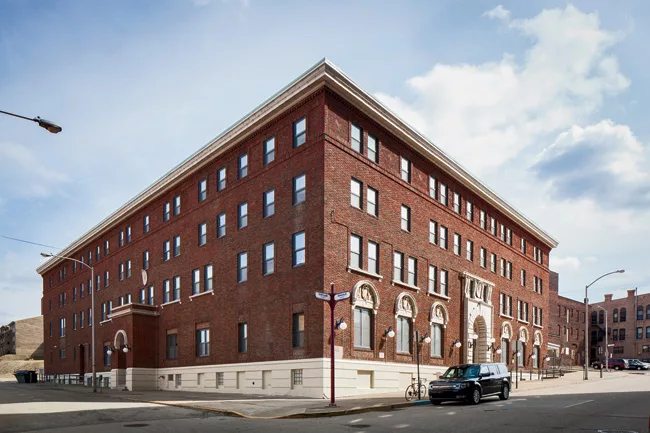
This new analytical tool could have been useful for the architects from Pittsburgh-based Thoughtful Balance when they began working on the conversion of a 1922 YMCA building into 84 units of affordable housing in McKeesport, Pennsylvania, for those at risk of homelessness. Their client was stunned by the projected cost of HVAC upgrades and utility bills. So, in the absence of the new cost-analysis software, the designers commissioned an engineer's report that showed that Passive House strategies could reduce energy bills by as much as two thirds.
The renovation, completed last year, included adding 7 inches of closed-cell foam insulation on the inside of the brick walls. The approach produced high R-values (about 6.5 per inch) and preserved the classical facade. It was also cost-neutral when factoring in the savings of avoiding elaborate mechanical systems, according to project architect Laura Nettleton. However, the renovation demonstrates the challenges of certifying a historic structure without substantial invasive modification to seal its envelope. The building missed its blower-door-test benchmark for airtightness and therefore didn't achieve certification.
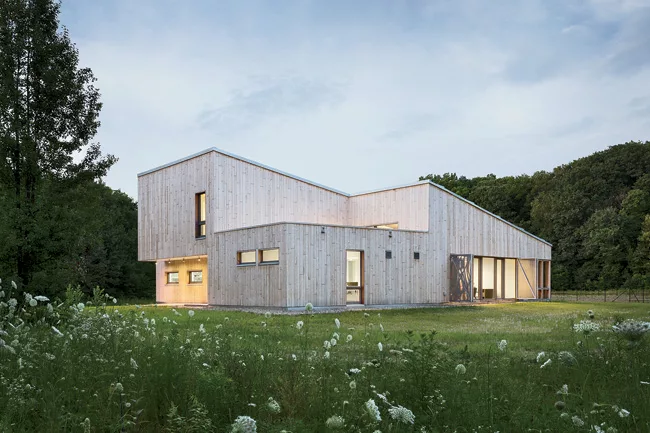
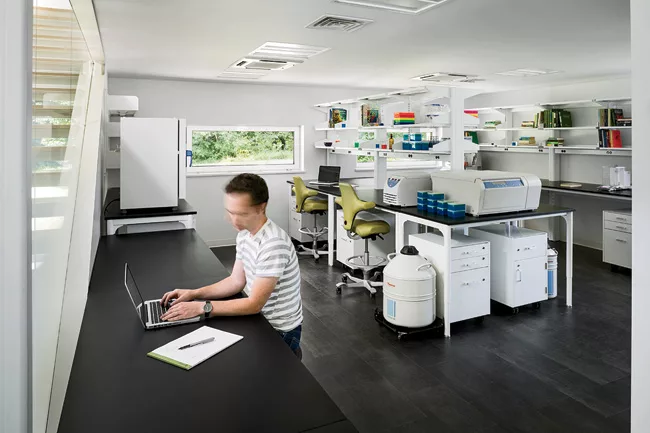
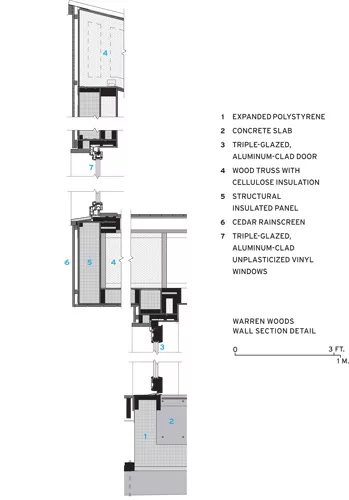
New construction projects may not have to deal with existing-envelope problems, but they often present substantial programmatic challenges. This is especially true for certain building types such as laboratories, which typically consume huge amounts of energy. Last year, the University of Chicago's Warren Woods Ecological Field Station—located east of Chicago in Berrien County, Michigan—became the first Passive House'certified laboratory in the U.S. Because there were already several Passive House labs in Europe, the designers, Belfast, Maine'based G•O Logic, elected to certify the building through PHI in Germany.
G•O Logic configured the building to take advantage of the heat generated by the equipment-heavy lab, which is located in the shaded northwest corner of the 2,100-square-foot building. They then designed the ductwork to move excess heat to the rest of the facility in winter. Night-flush ventilation and an air-to-air heat pump cool the building in the summer.
Notably, PHI adjusts the requirements for source-energy loads to compensate for special building types like labs. But it still requires that the envelope perform up to the standard criteria should the use of the building change in the future.
To meet these requirements, G•O Logic developed a patented frost-protected slab-on-grade system that utilizes an L-shaped rigid-insulation perimeter component. The element is made from 8-inch-thick expanded polystyrene (EPS) with a high level of compressive strength. The continuous L-shape makes an airtight joint at the slab edge. A layer of EPS under the slab creates a container and permanent formwork that is filled with 14 inches of gravel and then topped with a slab. The insulated slab-and-gravel-fill assembly makes a deep thermal mass that is especially beneficial in keeping the building cool, according to project architect Timothy Lock. The wall assembly includes both structural insulated panels (SIPs) and interior 2-by-6 framing filled with cellulose insulation; the roof structure consists of 30-inch-deep trusses filled with cellulose insulation.
The firm advocates designing beyond the standard. For example, there was no Passive House requirement for distributing the excess heat from the lab to the rest of the facility. But with the help of the project's mechanical engineer, the architects developed a system for doing so, knowing it would improve the building's performance.
So, with savvy designers producing good buildings using the old standards, why make a change? PHIUS's Klingenberg believes that the new standards will ensure the optimization of both costs and efficiency. “There's only so much capital available,” she says. “But if we're going to deal with climate change, we'll need to make new projects more efficient and bring existing buildings to a similarly ambitious standard.”
|
Continuing Education

To earn one AIA learning unit (LU), including one hour of health, safety, and welfare (HSW) credit, read “Adapting to New Environs,” review the supplemental material listed below, and complete the online test. Upon passing the test, you will receive a certificate of completion, and your credit will be automatically reported to the AIA. Additional information regarding credit-reporting and continuing-education requirements can be found online at continuingeducation.bnpmedia.com.
Learning Objectives 1 Describe the goals of the Passive House certification system. 2 Outline the arguments for adapting the certification system for North America. 3 Outline the original certification criteria and explain how the new criteria are different. 4 Discuss the challenges faced by several design teams using the original Passive House system in extreme climates and explain how these challenges were overcome.
For CEU credit, read "Adapting to New Environs" and take the quiz at continuingeducation.bnpmedia.com, or use our architectural record continuing-education app, available in the itunes store. structure, finishes, and other original fabric when
a building is moved.
significant buildings.
|
Looking for a reprint of this article?
From high-res PDFs to custom plaques, order your copy today!