Water and Resilience
Continuing Education: Ten Years After Katrina
New Orleans Goes with the Flow: Ten years after Katrina, the city learns to live with water.
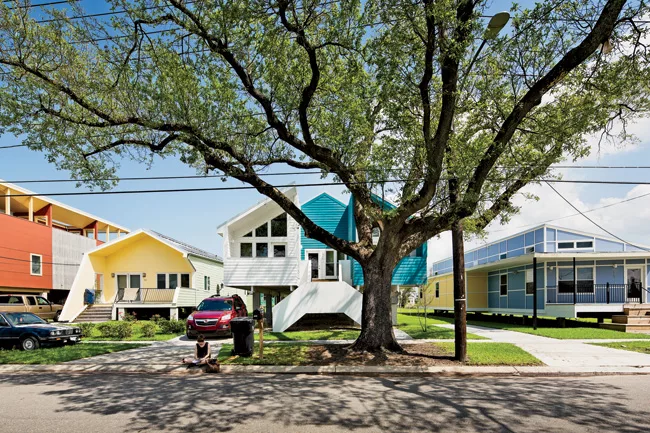


The rebuilding of New Orleans 10 years after Hurricane Katrina is as patchwork and kaleidoscopic as the city itself. A line of slab buildings approaching completion along Canal Street near the downtown looks impressive—an image bound for the cover of economic-development brochures. The buildings are part of a 70-acre, $2.7 billion two-hospital replacement plan designed by two teams led by NBBJ. Like so much else about the reconstruction of the city that sat for weeks in a soup of fetid water after disastrous levee failures, the hospital project has been both controversial (displacing residents in a city awash in vacant land) and seen as a good thing for the jobs it will create.
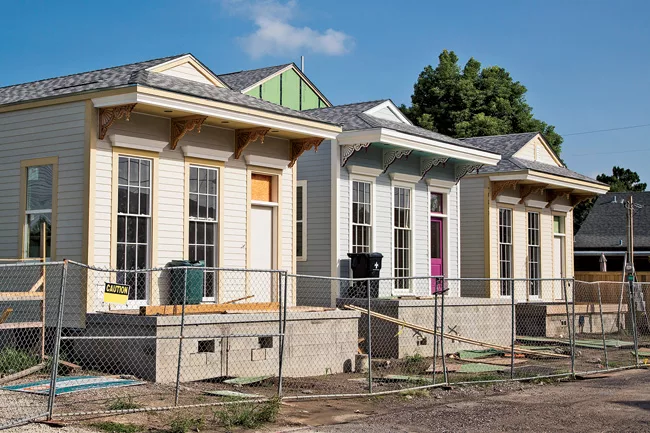
An unpredicted wave of investment and renovation has come to the charming shotgun houses and cottages of high-ground neighborhoods like the Marigny, Bywater, and Holy Cross that line the river. Before the storm, they had languished. Many schools known for their dysfunction and dilapidation have been handsomely restored or replaced, if with ungainly but functional boxes. Population has steadily grown but remains 100,000 lower than it was pre-Katrina.
For all the destruction and lives lost or permanently altered, there's a broad consensus that the city works better and offers greater opportunity than it did before the storm. Local governance is more responsive and seems to be less corrupt.
Yet many opportunities have been squandered. “We're proclaimed a 'new' New Orleans,” says Karen Gadbois, of the investigative-reporting website The Lens. Yet, she adds, “40 percent of children here live in poverty,” and high crime rates persist.
The necessary reform of institutions and governance “attracted entrepreneurs, capital, and brains,” says Tim Williamson, who cofounded the nonprofit organization Idea Village in 2000 to nurture just that. Jean Nathan, executive director of the Creative Alliance of New Orleans (also a nonprofit), says the city's low costs and welcoming attitude have drawn artists and other creatives “who feel that Seattle, San Francisco, and Brooklyn are too much about money.”
Significantly, much of the new-business fervor revolves around a subject New Orleanians are all too familiar with: water. Will Bradshaw, cofounder of Green Coast Enterprises, a property developer and management company that purposely blurs the line between business and social entrepreneurship, says a nascent green economy is growing around natural-systems solutions for landscape restoration and wetlands engineering. Such enterprises have been tenants in a modest collection of retail buildings Green Coast renovated as business-incubator space in the Broadmoor neighborhood.
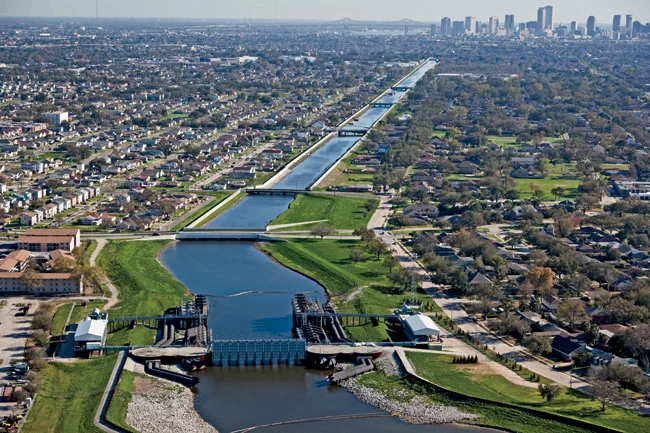
So far, however, most of the resources pumped into the city to protect against flooding have been for traditional hard infrastructure. The revamp of the levees, flood gates, and pumping stations are the most conspicuous and expensive ($14 billion) transformation of the city since Katrina. Drivers who make a wrong turn just about anywhere may confront the high concrete walls that line drainage canals and top levees. Though this extensive system is managed by local boards that have undergone reform, the rebuilding was funded largely by federal taxpayers, and built by the U.S. Army Corps of Engineers, which had under-engineered the levee walls that failed in Katrina.
Looking for quick answers on architecture and design topics?
Try Ask RECORD, our new smart AI search tool.
Ask RECORD →
For all the cash and engineering, ordinary storms threaten livability day to day. So much of New Orleans lies below sea level that the massive pumps can't move stormwater from the highway-size canals into Lake Pontchartrain fast enough, leaving streets throughout the city impassably flooded. Even double the pumping capacity could only handle 40 percent of the runoff from a 10-year storm. “We can't keep making the system larger as rainfall increases,” says Ray Manning, a local architect who sits on the city's water board. “It costs too much money.”
That's why the city has adopted a $6.2 billion water plan led by Waggonner & Ball Architects that augments civil engineering with water-managing urban design. Inspired by Dutch precedents, the idea is to reduce the quantity of stormwater that must be pumped away by slowing its flow, storing it, and encouraging infiltration into the ground.
Principal David Waggonner says water management is a holistic enterprise that operates from the scale of the city to the individual lot. Neglected canals will be restored with property-value-enhancing trees and wetlands. Planted, parklike water storage (already piloted by the New Orleans Redevelopment Authority) will repurpose vacant land.
Waggonner's firm has designed a waterway that could run 1.5 miles from Bayou St. John, near Lake Ponchartrain, to the French Quarter. It would share a corridor along a long-buried canal route that's in the process of being turned into a bare-bones bike trail called the Lafitte Greenway. Aside from picking up stormwater from several neighborhoods, the proposed canal emulates the meandering Bayou St. John, which is lined with marsh grasses and overarching trees. The waterway would add allure to the corridor, which is already attracting new development.
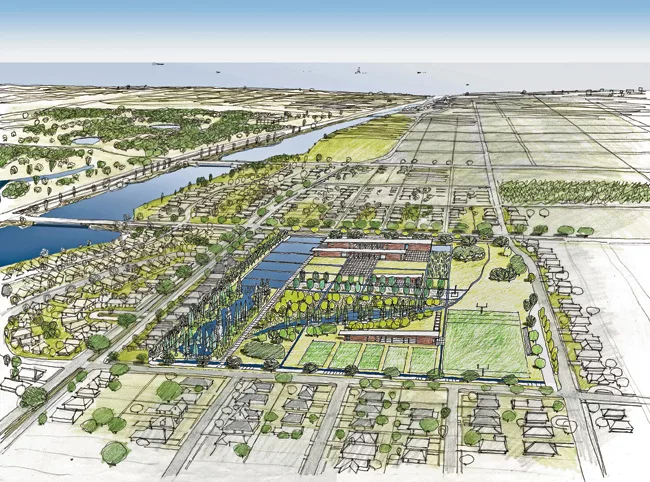
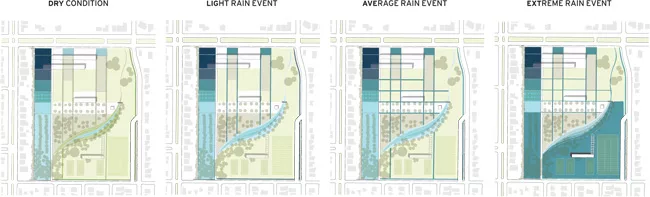
The city is proceeding with Waggonner & Ball's design for the 25-acre Mirabeau Water Garden as a demonstration of large-scale water retention. Rather than directing runoff to storm sewers, it will store water and filter it to a sandy substrate through a series of planted terraces that range from marshes to grasslands. Between storms, the site will host neighborhood recreation and environmental education.
A recent zoning change requires owners to manage the first 1.25 inches of stormwater on-site, which may well mean enlisting the inventiveness of architects and landscape architects in the use of tactics that encourage infiltration. These include permeable pavement, backyard rain gardens (shallow depressions planted with pollutant-filtering vegetation), and parking-lot bioswales (which work in a similar fashion but are generally larger).
Water management must offer multiple benefits, as the Mirabeau site does, not just dispose of water, Waggonner says. He believes that if the billions more in funding promised from the federal government and other sources come through, the water plan can be implemented in a decade.
In addition to helping control flooding, the water plan also promises to solve a major problem induced by the current drainage and pump system—pulling too much water from the ground during dry periods, contributing to subsidence. That's one reason why sinkhole-strewn streets are ubiquitous and tilted houses are common. According to the water plan, its green infrastructure strategies will ultimately help stabilize the soil, saving more than $10.8 billion in subsidence-related costs over 50 years.
In the meantime, several key streets are now torn up for a $1.5 billion expansion of the conventional drainage system. The projects are going ahead not because they aid an integrated water-management strategy but because Congress, after the storm, rushed to fund projects that date from before Katrina. The reliance on expensive, dysfunctional, and maintenance-intensive civil-engineering infrastructure “is a ship that's very hard to turn,” comments Waggonner.
Over the years, people have come to take the protection offered by the levee fortifications for granted, even though they were not designed to repel the worst storms. The majority of owners follow the most recent guidance from the Federal Emergency Management Agency (FEMA), which usually means elevating structures 2 or 3 feet. The agency's base flood elevations bet that catastrophic levee failure will not recur.
Make It Right, which has brought in global architects to design 110 houses a stone's throw from Katrina's worst levee break in the Lower Ninth Ward, now builds at 2 feet above the FEMA 100-year-flood elevation and no longer perches structures at 10 or 12 feet above grade, as it did with the first houses built. The expense is too great, says project manager Jason Pollard, and the high floors strain the front-porch sociability that lured many people back.
The new hospitals of the downtown medical center, by contrast, are built much more robustly, a response to the horror of hospitals completely disabled by Katrina. NBBJ, with Blitch Knevel Architects, has designed the Alexander Academic Research Hospital to run for a week without outside support or supplies. No critical functions are located lower than 21 feet above the base flood elevation. Eskew+Dumez+Ripple, with Manning Architects, has similarly raised the New Orleans East Hospital emergency room. It is reached by an ambulance ramp that can be used as a boat launch should flooding make streets impassible.
The concern with water does not end at the levees. The coastal marshes that protect New Orleans and other parishes from storm surges continue to erode, but a solution that also preserves navigation and fisheries has long eluded the Army Corps of Engineers. New York's Van Alen Institute, which advocates for transformative urban design, is working with the Environmental Defense Fund, supported by several foundations, on a multiyear, in-depth design competition called Changing Course: Navigating the Future of the Lower Mississippi River Delta. A winning solution is far from fully developed, but the three competing interdisciplinary teams all recognize that miles of the river below New Orleans will ultimately have to be substantially reconfigured. Saving the coast, regrettably, may accelerate the abandonment of many of its rural communities.
Given all of the challenges and uncertainties, it is extraordinary that the allure of New Orleans is not only undimmed but enhanced. Reflecting on the wisdom of defiantly rebuilding near a catastrophic levee breech, Make It Right's Pollard says, “If you are not from New Orleans, the necessity of returning is hard to understand. But people who have lived here for generations know that storms destroy and people rebuild. It's the hurricane 'tax' people pay to stay.”
New Orleans's survival has depended on deep social bonds and its unique culture—both thought in danger after the storm. Yet the city's culture made it resilient, even in the face of enormous destruction and the displacement of hundreds of thousands of people.
|
Continuing Education
 To earn one AIA learning unit (LU), including one hour of health, safety, and welfare (HSW) credit, read the three stories in the “Water and Resilience” section: “New Orleans Goes with the Flow”; “Befriending the Floods”; and “Flirting with Disaster”. Then complete the test at architecturalrecord.com. Upon passing the test, you will receive a certificate of completion, and your credit will be automatically reported to the AIA. Additional information regarding credit reporting and continuing-education requirements can be found online at continuingeducation.bnpmedia.com. To earn one AIA learning unit (LU), including one hour of health, safety, and welfare (HSW) credit, read the three stories in the “Water and Resilience” section: “New Orleans Goes with the Flow”; “Befriending the Floods”; and “Flirting with Disaster”. Then complete the test at architecturalrecord.com. Upon passing the test, you will receive a certificate of completion, and your credit will be automatically reported to the AIA. Additional information regarding credit reporting and continuing-education requirements can be found online at continuingeducation.bnpmedia.com.
Learning Objectives
1 Explain how green infrastructure can be used to bolster traditional hard infrastructure for flood control. 2 Describe how green infrastructure tactics can be used to remove pollutants from stormwater. 3 Discuss measures implemented by two recent art museums as protection from flooding. 4 Outline the testing regimen for hurricane-resistant glazing. AIA/CES Course #K1507A
For CEU credit, Read “Water and Resilience” and take the Quiz at continuingeducation.bnpmedia.com, or use our architectural record continuing-education app, available in the itunes store.
|
Looking for a reprint of this article?
From high-res PDFs to custom plaques, order your copy today!