Continuing Education: Tall Mass Timber Construction
Read the story below, then take the quiz "Timber Grows Up" for Continuing Education credit.
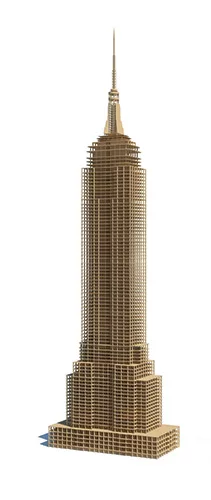
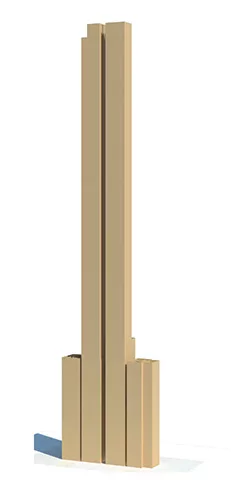
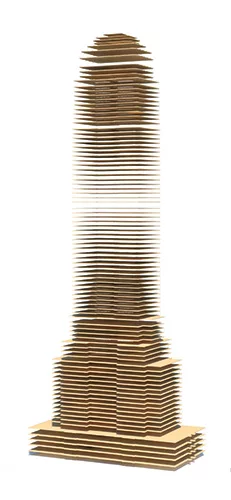
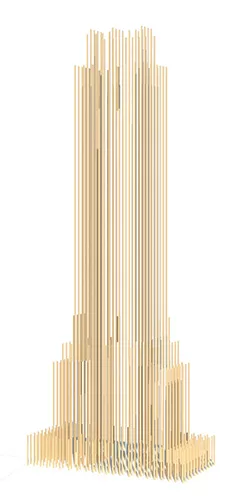
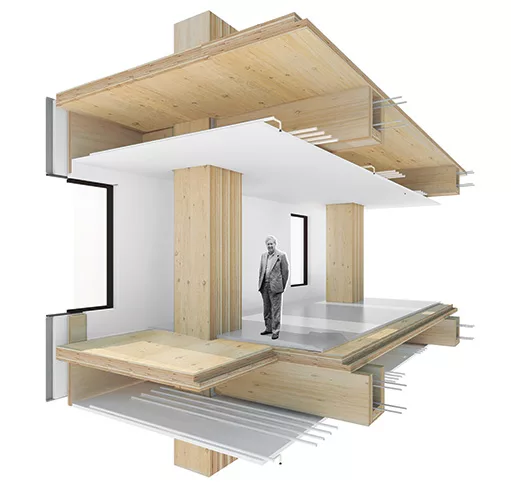
When designing a skyscraper, one doesn’t normally think of wood as the primary structural material—but that hasn’t stopped Vancouver, British Columbia–based architect Michael Green from redesigning New York’s famed 102-story Empire State Building as a timber tower. The hypothetical remake of Shreve Lamb & Harmon’s 1931 landmark, the result of a collaboration with another Vancouver-based firm, Equilibrium Consulting, relies almost exclusively on structural elements made of laminated veneer lumber (LVL), a product manufactured from multiple wood plies whose fibers are oriented in one direction.
Green and Equilibrium insist that such a tower is technically feasible, yet even they do not believe timber buildings as tall as the Empire State will be rising anytime soon. “We all know we aren’t going to build 100-story towers out of wood,” says Eric Karsh, an Equilibrium principal. Instead, the point of the project, commissioned by Finnish forest products manufacturer Metsa Wood, “was to change people’s perceptions about what wood can and can not do” he says. “It makes wood buildings of 30 or 40 stories seem quite possible,” adds Asher deGroot, an associate at Michael Green Architecture (MGA).
Although the design of the wood Empire State was a theoretical exercise, MGA and Equilibrium took it seriously. The timber tower has the same overall dimensions, floor-to-floor heights, and column spacing as the original. Its lateral load-resisting system consists of a series of box beams in the short direction and shear walls in the long direction. Its moment frames are created by running post-tensioned cables through the box beams and columns. The manufacturer maintains that the wood components would burn slowly, forming a layer of protective char, but the timber skyscraper would still have additional protection in the form of sprinklers, fire-stopping, and drywall. The wood elements could remain exposed in some strategic locations.
This is not the first time MGA and Equilibrium have tackled tall timber structures. In 2012 they published a detailed scheme for a wood tower as tall as 30 stories. Other firms have also explored wood’s potential in tall buildings: in 2013 Skidmore, Owings & Merrill released its research for a 42-story tower that relies on timber for its main structural elements, with reinforced concrete at connecting joints.
One thing to keep in mind is that timber fans are not advocating towers built with conventional light-frame, wood-stud construction, which has limited structural capacity and low fire-resistance. Instead, they are pushing for more widespread use of “mass timber”—a term that can describe structures built of logs or large, solid sawn lumber but more typically refers to a system relying on engineered wood products. These include glue-laminated (glulam) beams and posts, cross-laminated timber (CLT), and laminated strand lumber (LSL), as well as LVL. In general, these are large elements made from small-dimension lumber or other types of wood fibers assembled under pressure and fixed with adhesives. Instead of old-growth lumber, engineered-wood components can be made of younger trees of a variety of species and varying grades. Still, their manufacturing methods yield consistent components with predictable structural characteristics and fire-resistive properties.
What’s behind this campaign for more use of timber? The chief attraction is environmental: wood is a renewable material. And when responsibly grown and harvested, the forests from which it is obtained perform important ecological functions. They filter water and air, provide habitat for wildlife, and they have the ability to store atmospheric carbon. Trees retain this carbon even after they are cut down and transformed into building products. Only when the wood decays or burns is it released back into the atmosphere. As an example, the timber version of the Empire State would use more than 100,000 cubic yards of LVL, offsetting about 71,000 metric tons of carbon dioxide, according to deGroot. In contrast, the manufacturing processes for steel and concrete emit carbon dioxide.
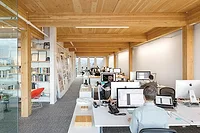
There are other advantages. Joseph Mayo, a designer at Mahlum Architects in Seattle and author of the recently published Solid Wood: Case Studies in Mass Timber, Architecture, Technology and Design, points to benefits such as lighter structures, which in turn can allow smaller and less expensive foundations. He says that engineered wood elements are typically prefabricated and precut, which can reduce waste, speed construction, and make for quieter building sites. There is also an argument for incorporating biophilic elements, or products of living systems, into architecture. When the wood structure is left exposed, “it brings a little bit of nature into the building,” he says.
Looking for quick answers on architecture and design topics?
Try Ask RECORD, our new smart AI search tool.
Ask RECORD →
Although genuinely tall wood buildings are still only conceptual, mid-rise timber structures are being constructed all over the world. The wood building that currently holds the title of tallest in North America is MGA’s 100-foot-high Wood Innovation Design Centre in Prince George, British Columbia. Completed last year, the building is supported by a glulam and CLT structure. The worldwide record holder is the 105-foot-high Forté—a 23-unit residential building in Melbourne, completed at the end of 2012. Designed and developed by Lend Lease, the 10-story structure is built almost entirely of CLT above its cast-in-place concrete ground floor.
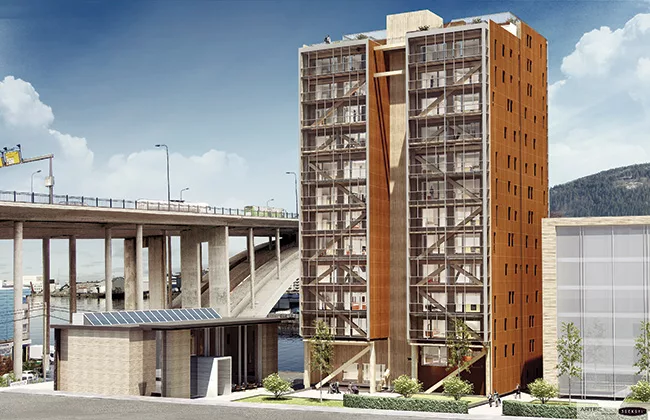
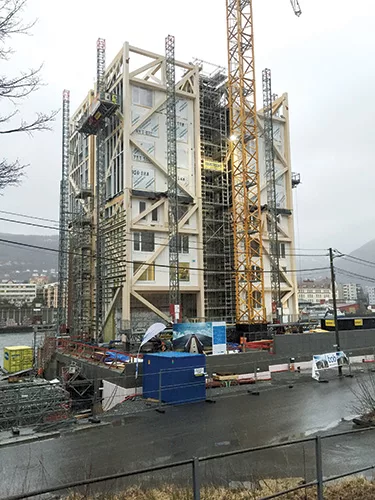
Forté will soon be surpassed by the 14-story Treet—an almost 163-foot-tall tower nearing completion in Bergen, Norway. Designed by local architect ARTEC, the 62-unit residential building’s primary load-carrying system consists of glulam trusses.
“Power stories”—reinforced levels carrying precast concrete slabs—occur every fifth floor. These serve as platforms for CLT apartment modules stacked within the frame. But their main purpose is to increase the mass of the building, explains Rune Abrahamsen, the project’s chief structural engineer with international engineering firm Sweco. Otherwise the relatively light wood structure would sway in the wind, he says, adding that the movement is actually an occupant-comfort concern rather than a safety problem.
Treet’s designers have, of course, also taken safety seriously. The building has sprinklers, pressurized stairwells, and carefully compartmentalized residential units to keep fire from spreading from one to another. The structure has also been thoroughly analyzed to make sure that the building will remain standing in the highly unlikely event that one truss member fails.
To ensure the structure’s long-term durability in Bergen’s mild but wet climate (a particular concern when building in wood), the designers clad the building in glass and metal sheeting. They also opted to prefabricate the CLT apartment modules—complete with plumbing fixtures, appliances, and finishes—and lift them into place by crane. The decision to assemble the apartments in a controlled factory setting limits their exposure to the elements. But it also, together with choosing wood as the primary building material, has helped speed completion. According to Abrahamsen’s estimates, the construction phase will be about three months shorter than the 18 months required had Treet been built with more conventional materials and methods. And Abrahamsen is quick to point out that Forté is a prototype. “Next time, we will be even faster,” he says.
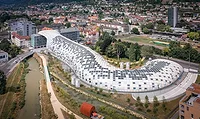
Sweco is already working on that next time. The firm is designing a timber tower for a town just north of Oslo that will include a hotel, apartments, and offices. At 17 stories and 216 feet, it will be even taller than Treet. But that record could be eclipsed if any one of a number of proposals moves forward, including a plan for a 24-story mixed-use wood tower in Vienna.
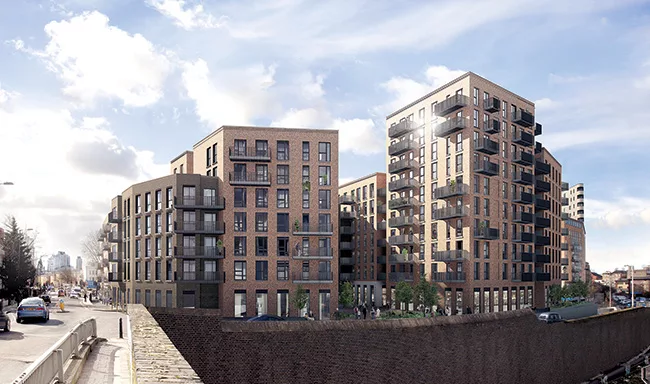
All the discussion about height for height’s sake misses the most important point, according to some wood proponents. “Tall makes good PR,” says architect Andrew Waugh, director of London-based Waugh Thistleton. “But the real debate should be about density” and about housing more inhabitants in increasingly populous cities. Among the firm’s timber projects is Murray Grove, a nine-story residential building in the borough of Hackney in London. Not so incidentally, it was the world’s tallest CLT structure when it was completed in 2009. Now his firm is working on another project in Hackney, Dalston Lane, a 10-story mixed-use complex that will include 121 apartments and 37,000 square feet of commercial space. Dalston, which is already under construction, will use more than 5,000 cubic yards of CLT, making it, by volume of material, the largest such project in the world, according to Waugh. The statistic is somewhat misleading, however. The structure is in fact very efficient, using the equivalent of only 3.2 trees per occupant. “We can cut down three trees and give a person a home,” he says.
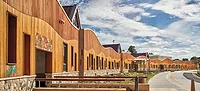
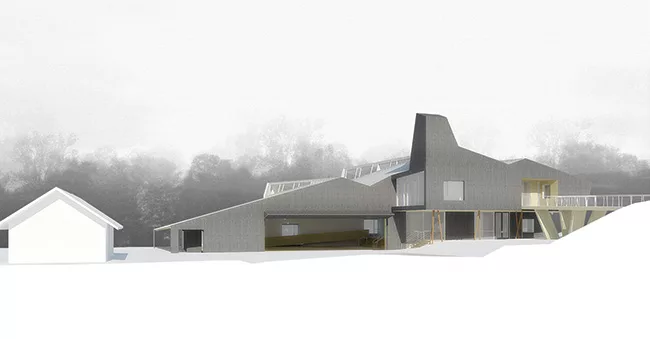
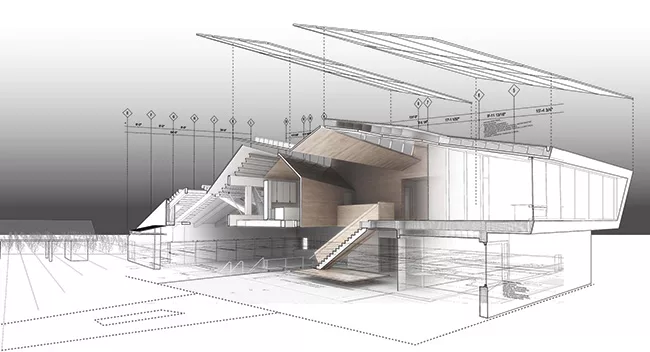
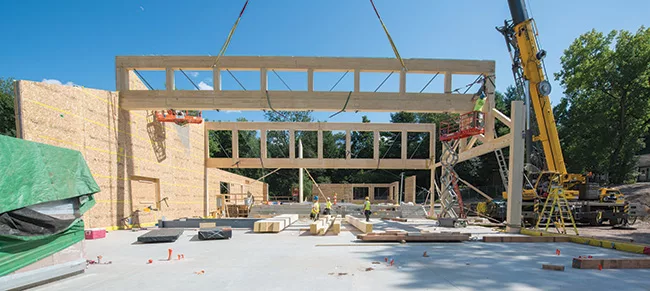
Even smaller projects can reap the benefits of mass timber. Gray Organschi Architects is using the construction method for a two-story arts and sciences building at Common Ground High School—a charter school with an environmental curriculum at the edge of a park in New Haven, Connecticut. The project, slated for completion in spring 2016, has a wood structure that will be exposed on the interior, with glulam trusses spanning a large multipurpose space. It relies on CLT for its bearing and shear walls and for its innovative stressed-skin roof system. This roof, which echoes the profile of the school’s other barnlike buildings, incorporates skylights and dense cellulose batts to help create a tight super-insulated envelope.
The wood elements in Common Ground’s building sequester 243 metric tons of carbon—enough to make the highly energy-efficient structure carbon-negative for the next decade. These storage capabilities are, for Alan Organschi, firm principal, one of the main arguments for mass timber, particularly in urban settings. Historically, “we’ve used the least energy-intensive building product in the most land- and energy-intensive way,” he says, referring to light-frame construction and suburban sprawl. But if Organschi and other mass-timber advocates have their way, that situation could soon change, transforming our cities from sources of greenhouse gases into places that offset them.
| Courtesy reThinkWood |
|
Rune Abrahamsen from engineering firm Sweco discusses the design concept and construction process for Treet, a 14-story timber residential tower nearing completion in Bergen, Norway. |
|
Continuing Education
 To earn one AIA learning unit (LU), including one hour of health, safety, and welfare (HSW) credit, read “Timber Grows Up,” review the supplemental material listed below, and complete the online test. Upon passing the test, you will receive a certificate of completion, and your credit will be automatically reported to the AIA. Additional information regarding credit reporting and continuing-education requirements can be found online at continuingeducation.bnpmedia.com. To earn one AIA learning unit (LU), including one hour of health, safety, and welfare (HSW) credit, read “Timber Grows Up,” review the supplemental material listed below, and complete the online test. Upon passing the test, you will receive a certificate of completion, and your credit will be automatically reported to the AIA. Additional information regarding credit reporting and continuing-education requirements can be found online at continuingeducation.bnpmedia.com.
Supplemental Material
Timber Tower Research Project Final Report
Skidmore, Owings & Merrill, 2013
Tall Wood
MGB Architecture + Design, 2012
Learning Objectives
1 Define the term “mass timber.” 2 Discuss the fire-resistive and structural properties of different types of wood construction. 3 Outline the environmental benefits of building with wood. 4 Describe the construction and structural strategies that some project teams are deploying in order to use wood in taller buildings. AIA/CES Course #K1509A
For CEU credit, Read “Timber Grows Up” and take the quiz at continuingeducation.bnpmedia.com, or use our architectural record continuing-education app, available in the itunes store.
|
Looking for a reprint of this article?
From high-res PDFs to custom plaques, order your copy today!