This Way
Linnaea Tillett discusses her lighting installation in the shadow of the Brooklyn Bridge.
Brooklyn, New York
Linnaea Tillett and Karin Tehve
In May, This Way was switched on, illuminating the pedestrian entrance to the Brooklyn Bridge in Brooklyn’s DUMBO neighborhood. The result of a competition held by New York’s Percent for Art Program, “This Way” was designed by artist Linnaea Tillett and Karin Tehve, an architect and DUMBO resident. Here Tillett discusses the project.
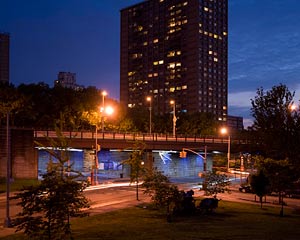

David Sokol: Considering that the commission for This Way (2008) was meant, in part, to celebrate the 125th birthday of the Brooklyn Bridge, did you find the job particularly freighted with symbolism?
Linnaea Tillett: We were not so impacted by the celebration. We felt this was a permanent installation and the timing of the celebration was a happy coincidence. However, the task of working on such an iconic bridge was pregnant.
DS: How did your background in environmental psychology inform your approach to this project?
LT: Environmental psychology shapes all my work. We are always interested in the social, cultural, political, and personal dynamics of public space and always looking for ways to use lighting to support social interaction. In this space we brought a sensitivity to the dynamics of use and to how the space was felt and perceived.
DS: Tillett Lighting Design was founded in 1983. Are there previous works in your 25-year-long oeuvre that have a particular kinship with “This Way”?
LT: East New York is still the touchstone for all my public work. It was my first—in 1999. There was an urgent need for functional pedestrian lighting and a poverty of resources. The community I was working with in New Lots was sick and tired of their neighborhood being caricatured as an abandoned, terrifying wasteland. Certainly, they had had their fill of ugly, high-wattage crime lighting. So I had to work with very little money and very few pieces of equipment to make as beautiful a statement as I could in a fairly desolate space. It had to be transformative of the whole environment, how it felt. I developed an approach through which a few pieces of the right equipment in the right location could make for maximal difference.
Icepool (2004), installed at “The Snow Show,” and [the Maya Lin collaboration] Ecliptic/Rosa Parks Circle (2002) were art installations that required that I think minimally, but aim for a poetic impact. In all of these projects, the physical environment had a harshness and bleakness, whether it was in the abandoned downtown streets of Grand Rapids or above the Artic Circle in winter.
DS: Would you explain the asymmetrical starbursts that adorn the ceiling of Brooklyn Bridge pedestrian entrance: Why this pattern? From what kinds of light sources is it assembled?
LT: I have always been taken with the stranded steel cables that hold the bridge together. They were the inspiration for the “cables of light” which are made of stranded fiber optics. The optic cables had a structure very like the steel cables themselves. This is not necessarily perceivable from the ground plane but it had, I thought, a lovely symmetry.
The patterns, which Karin Tehve was very much responsible for developing, were meant as abstractions of directional signs. They all point to the entrance of the bridge. What she and I worked to do was to create a strong three-dimensional experience of the light, so the wrapping of the light at the corners was particularly important.
DS: The pedestrian entrance is officially located in Brooklyn's DUMBO. This is a fairly gentrified and well-visited neighborhood, so did “This Way” have to perform any safety or wayfinding function?
LT: The project was at its core a safety and wayfinding art installation. The site was underlit, filthy, and intimidating, particularly to women who had to cross it at night coming to or from public transportation. A surprising number of people used it as a urinal, which is what it smelled like. It looked and felt like a back-of-house storage space, without value or use to the communities on either side of it.
Tourists were entirely and completely lost when they descended from the bridge or when they tried to leave DUMBO and get back on the bridge or find a train. There were so many of them and they were so lost that residents made jokes about how much time they spent giving directions and a local lady put up homemade signs (which she took down after the completion of “This Way”). During the installation we had to assign a bridge construction guy just to give directions—otherwise we would never have completed in time.
DS: What is the role of lighting design in public spaces?
LT: To support and facilitate a robust nighttime public realm in which strangers can interact (however fleetingly) in a civil and creative manner. As to light art, I follow Clause Oldenburg in believing in “art that helps old ladies cross the street.” Though I wouldn’t use quite those words.
DS: How would you say that role is amplified (or not) within an urban context?
LT: I think urban lighting is doing a lot, possibly too much, heavy lifting right at this particular juncture. Historically lighting was as a sign of urbanity and a policing practice. There were very few functional requirements. Beautiful poles glowed and “watched the street.” Now we ask urban lighting to fulfill its traditional functions and to be highly functional: help us identify strangers, keep bicycles from crashing into pedestrians, prevent anyone from tripping, add to a perception of safety, and to be, in many cases, a unique 21st-century presence. And to require no maintenance. It’s a big job that’s getting bigger.
Looking for a reprint of this article?
From high-res PDFs to custom plaques, order your copy today!