Beijing, China
Paul Andreu Architect Paris
If ever a building were ripe for second-guessing, it is Paul Andreu’s National Center for the Performing Arts, near the Forbidden City, Tiananmen Square, and the cavernous Grand Hall of the People. Andreu, the winner of a government competition designed to give Beijing a cultural complex equivalent to New York’s Lincoln Center, placed three separate performance halls beneath a glass-and-titanium roof. The roof reduces the complex, containing an astonishing 2.4 million square feet, to a single form, widely known as “The Egg.” Clearly, some kind of unifying gesture was needed.
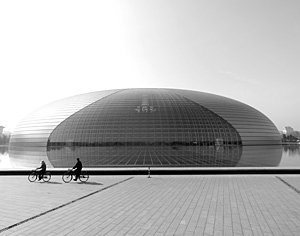

How else could the building hold its own against its monumental neighbors?
But Andreu’s Egg is flat, both in shape and tone. (The titanium has a brushed texture, perhaps to prevent glare—though Beijing’s polluted air usually does the trick.) And it is so carefully detailed that its surface is scaleless; except when window washers are climbing the exterior, it is impossible to grasp the building’s size. Ultimately, for all the time (eight years) and money (at least $400 million, in a country where construction costs are minimal) that went into it, The Egg doesn’t pack much of a punch.
Worse, the building, which was originally called the National Grand Theater, may induce a sense of déjà vu. The city’s new airport, designed by Foster + Partners (see page 112), includes a subway terminal under a flattened glass dome. Millions of people will see that dome before they see this one. True, Andreu’s version, supported by welded steel trusses, is particularly elegant from inside. But most visitors will never get inside (to Andreu’s disappointment, velvet ropes prevent crowds from getting past the ticket windows). Indeed, given the modest size of the three theaters, the dome is far larger than it would be if the goal were merely to shelter, rather than to dazzle, theatergoers. Meanwhile, the environmental costs of heating and cooling this city under glass are vast—The architect says that a zoned HVAC system cuts energy use, but he admits that the building is not green by Western standards.
Andreu positioned The Egg, which he refers to as a cultural island, in the middle of a wide reflecting pool. The island metaphor required hiding the entrance to the building, so a large stair at the front of the site leads down to a long, below-grade passageway, suggesting the coin slot on a bubble-gum machine. The passageway has a glass ceiling, but looking through the shallow pool is less exciting than it sounds.


Post a comment to this article
Report Abusive Comment