The Shack at Hinkle Farm
Broadhurst Architects' 'off-the-grid' Shack at Hinkle Farm embodies the virtues of the simple life.
Architects & Firms
Upper Tract, West Virginia
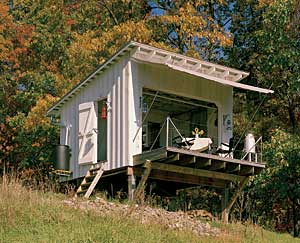
The Shack at Hinkle Farm represents a first for record—a residence without electricity. The single-room house is simplicity embodied. Architect Jeffery Broadhurst, AIA, designed the diminutive abode as a retreat for his family. A few hours from their home in suburban Washington, D.C., the shack perches on a 27-acre mountaintop property in West Virginia.
Additional Content:
Jump to credits & specifications
Although Broadhurst thinks of the shack as a place for family and friends, it exhibits an undeniably monastic dimension. Exceedingly remote, it is inaccessible without an off-road vehicle. A long, winding drive over stones and grasses along the ridge of South Fork Mountain leads to a steep clearing where the bucolic box hovers at 3,600 feet above sea level. It’s an ideal hermitage, but on weekends in the warmer seasons, Broadhurst packs up to a half-dozen people in the 140-square-foot room.
The convivial occupation of the shack echoes the nature of its construction. Broadhurst’s friends and neighbors helped him assemble it, using products pulled from the shelves of a home-improvement retailer. Simple board-and-batten siding and a standing-seam, terne-coated steel roof sits atop a wood platform supported by four pressure-treated pine posts. Inside the shack, you can see between the floor planks to the ground below. Rodent barriers, like those used to protect local corn cribs, arm the platform’s underside.
A ladder unhitches from the southwest side of the building and swings down to the ground, providing access to the entry door. Inside, oil lamps provide light and a woodstove heats the space. Lifting a small trap door in the floor reveals the lid of a water tank beneath the platform. A gravitational system delivers water from the tank to a faucet in the miniscule “kitchen.” A hand-powered bilge pump, designed for removing water from the bottom of a boat’s hull, draws water from below the platform to a smaller tank suspended from the ceiling, so it can fall into the shack’s descending plumbing. The pump can also be hooked up to a water-storage compartment on the woodstove, sending hot water to the faucet.
CreditsArchitect Jeffery S. Broadhurst, AIA
Engineer:
General contractor:
Photographer: |
SpecificationsStructural system: Exterior cladding Roofing Windows Doors Wood doors: Hardware Hinges: Pulls: Cabinet hardware: Deck Railing: Interior finishes Cabinetwork and custom woodwork: Paints and stains: Paneling: Special surfacing: Countertops: Wood flooring: Furnishings Table: Rugs: Bed: Trunk: Metal Tray Table: Aluminum Milk Can: Miscellaneous Metal Fabrications by ABC Welding, Inc. Wood Stove: Awning: Lighting Conveyance: Plumbing Milk Can Shower/Water Heater: Water Pump: Water Storage Tanks: |
Looking for a reprint of this article?
From high-res PDFs to custom plaques, order your copy today!