Niemeyer's Forgotten Legacy in Lebanon Faces Threats
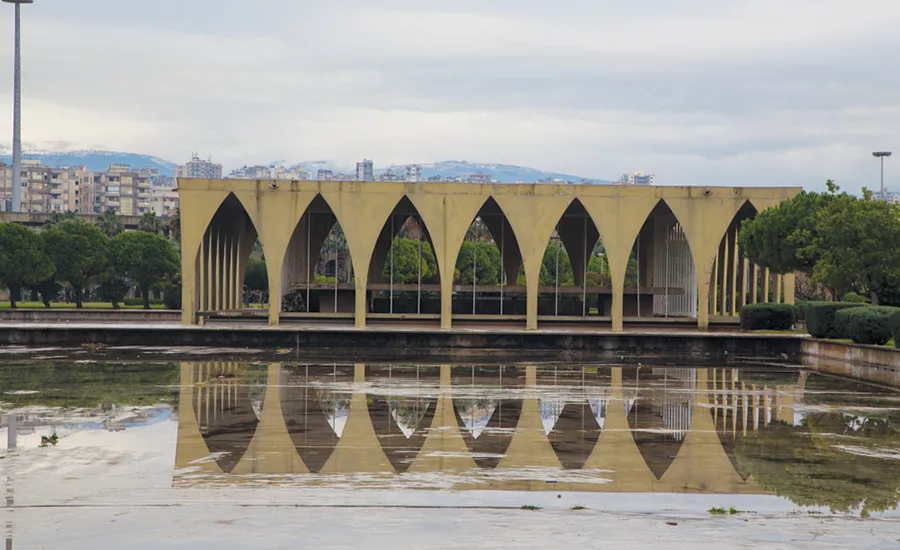
Only seven pavilions were built as part of Oscar Niemeyer’s master plan for the Tripoli fairground. The site, disused for years, includes many long reflecting pools which stand empty save for rainwater.
Photo © Jack Crosbie
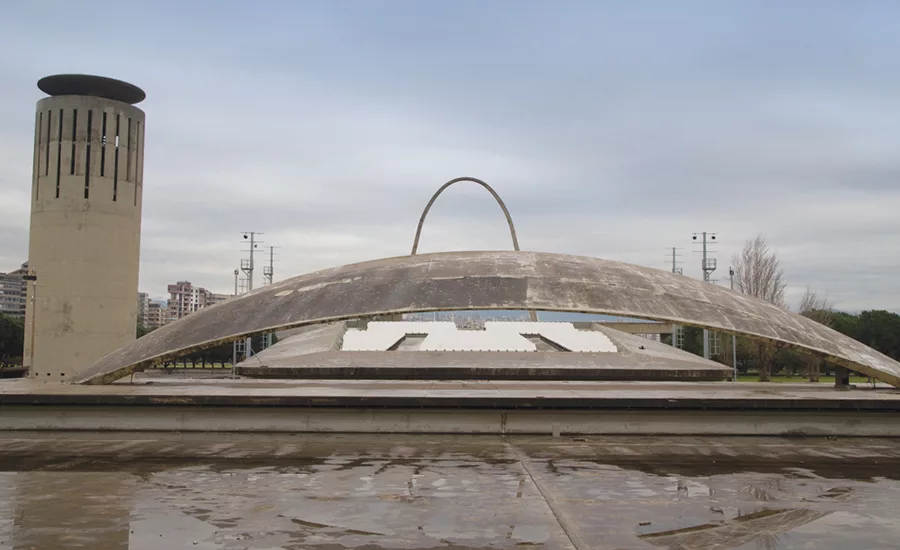
The amphitheater’s stage provides a view of several of the remaining concrete structures, including the complex’s central arch.
Photo © Jack Crosbie
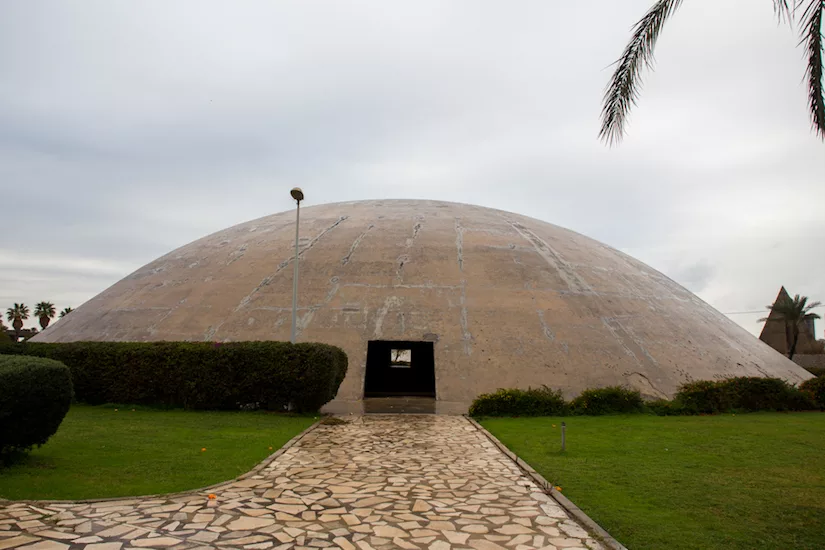
Niemeyer built this domed structure as a theater for the world's fair. The outside is scarred with bullet holes from the Lebanese Civil War.
Photo © Jack Crosbie
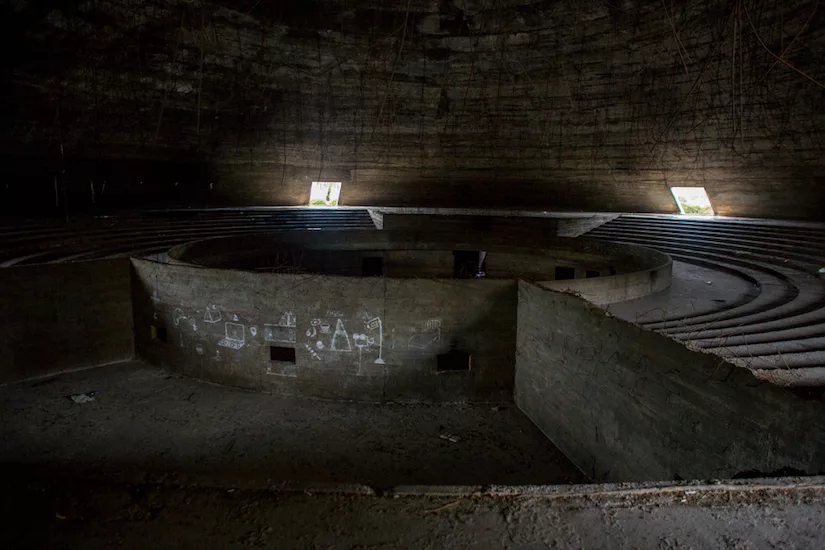
The interior of Niemeyer's theater is a gutted labyrinth of hanging rebar and dripping water. Militant groups allegedly used some of the basement rooms for executions and interrogations during the Lebanese Civil War.
Photo © Jack Crosbie
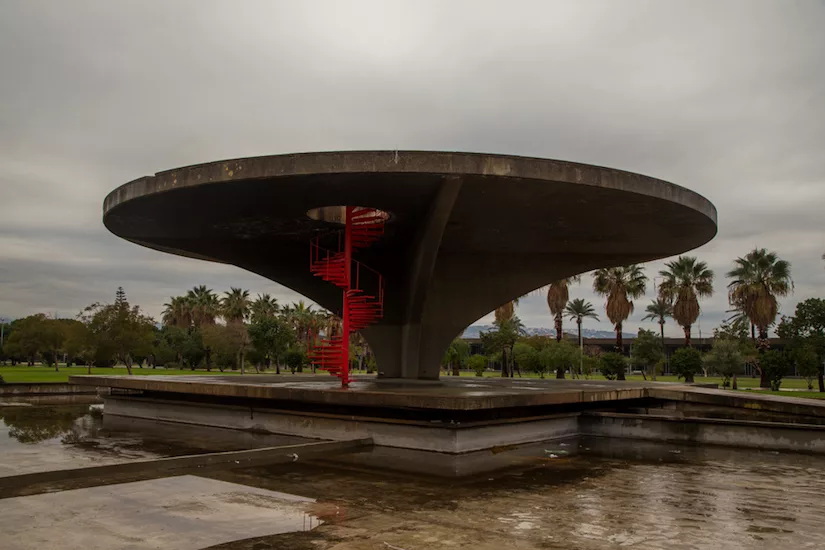
Niemeyer's plans for the site include a number of arches, and many of the buildings follow the same curved lines, like this helipad.
Photo © Jack Crosbie
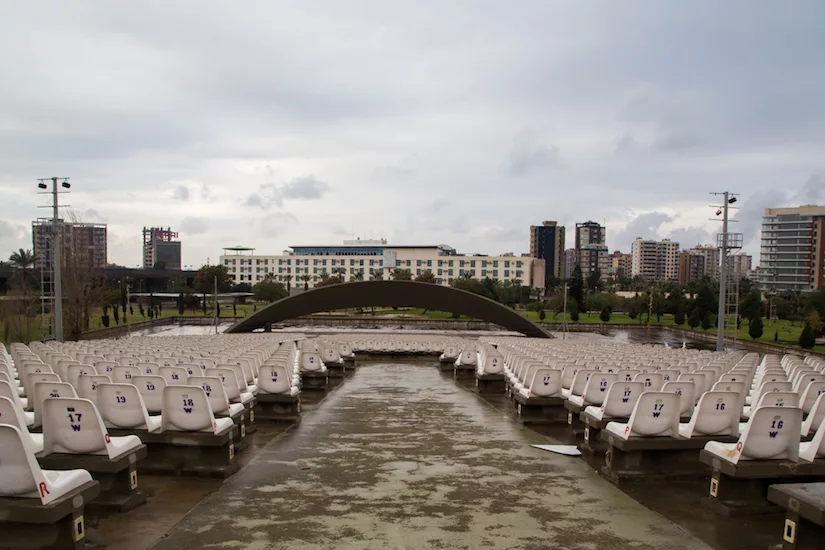
Abandoned seats in the outdoor amphitheater with Tripoli's skyline behind it.
Photo © Jack Crosbie
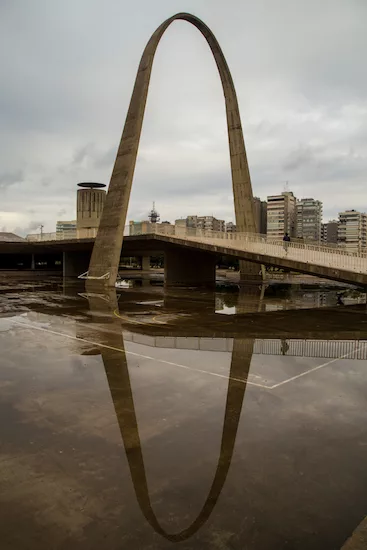
Niemeyer's biggest archway, near the outdoor amphitheater.
Photo © Jack Crosbie
One day in 1962, Oscar Niemeyer found himself strapped into the seat of a helicopter thundering over a tract of land on the outskirts of Tripoli, Lebanon. After two circuits over the city, the nervous architect (Niemeyer hated flying) told his project manager, “OK, we can go back. I’ve decided the best location for the fair.” At the time, the Brazilian architect was riding the wave of success from his work in Brasilia, the new capital of his home country. Niemeyer’s revolutionary designs had spurred a flurry of interest from international clients, among them the Lebanese, who gave him nearly 250 acres of land to design the grounds for a grand World’s Fair meant to showcase the country’s development and innovation.
The architect completed his plans in 1963, including a wild array of concrete structures that incorporated elements of traditional Arab style into the distinctly modern aesthetic he perfected in Brasilia: a mushroom-shaped helipad over a subterranean science museum, a concrete dome housing an experimental theater, pyramid structures with star-shaped footprints, and a boomerang-like “Grand Ouverture”—the main exhibition hall. Construction began in 1967, but the outbreak of Lebanon’s civil war in 1975 brought the slow-moving project to a halt.
More than half a century later, Niemeyer’s grand exhibition lies in disuse, the remaining seven structures succumbing to decay. Cigarette butts and empty water bottles litter the corners of reflecting pools, dark blue graffiti is scrawled inside a pavilion, and broken concrete pocks the fair’s central arch. The forgotten fairground—now renamed after former Lebanese prime minister Rashid Karameh—is once again attracting interest, but from divergent forces. Tripoli, a city of a quarter million people along the Mediterranean, is becoming a popular tourist destination after years of turmoil, but preservationists say political and commercial interests in developing the site—proposals have included an amusement park—threaten the integrity of Niemeyer’s design.
These activists are campaigning for UNESCO recognition and for the completion of Niemeyer’s original design, turning it into a public park and historic site. They hope that one day Niemeyer’s utopian vision—a space for all Tripolitans—will be realized. When then-Lebanese president Fouad Chehab offered the World’s Fair contract to Niemeyer’s Forgotten Legacy in Lebanon Faces Threats Niemeyer, he hoped the architect’s work could foster a sense of national identity in Lebanon—a country fractured by sectarian divides and vestiges of colonial power—as the architect’s work in Brasilia had.
Niemeyer “saw great value in producing works for countries that at the time were viewed as underdeveloped and peripheral,” says Styliane Philippou, an architectural historian and author of Oscar Niemeyer: Curves of Irreverence. “Niemeyer conceived of the site as a place of social and political integration, open to all.” But Lebanon’s civil war left the fairground first abandoned, then used as a barracks and staging ground for Syrian Army forces. Beneath Niemeyer’s concrete dome, militant groups allegedly conducted executions. Its exterior is scarred with bullet holes. “It’s dilapidated and in need of attention,” says Philippou, “but it has survived, and it has great potential.”
Developers see potential in the site too. In 2000, a portion of what Niemeyer envisioned as a residential complex became a nondescript Quality Inn hotel; in 2001, the site’s board of directors tried to turn the southern portion into a theme park; in 2006, the site narrowly escaped becoming a permanent exhibition ground for imported Chinese products when the Hezbollah-Israel war broke out. Most recently, a member of parliament proposed turning the fair into a tech hub and university under a plan called Tripoli 2020. But the real danger to Niemeyer’s fairground is the Lebanese government’s inactivity.
While lawns are mowed, trees are pruned, and walkways are cleaned, the concrete facades are beginning to crack. The site has been on the World Monuments Fund’s biennial Watch List for a decade, but little has been done to save it. Six months ago, a group of concerned architects and activists launched a campaign to force the Lebanese government and the exhibition’s board of directors to make the grounds a protected cultural landmark as a UNESCO world heritage site, the same designation granted to the entire city of Brasilia in 1987. “Listing a monument as a local or international heritage will give the site life,” argues Wassim Naghi, the president of the Union of Architects in Tripoli and one of the campaign’s leaders.
Naghi has raised awareness at meetings both in Tripoli and abroad. He believes that a UNESCO heritage site status would make the venue more attractive to investors, while keeping the architecture intact. He is finalizing the process of making Tripoli and Brasilia sister cities to foster cultural exchange, with Niemeyer as the common denominator. He and other preservationists hope that, one day, the fairground will host summer festivals in the outdoor theater, and cultural events, giving Niemeyer’s work the chance to become the symbol of Lebanese unity he originally intended, rather than another monument to sectarian conflict and opportunist bureaucracy.
Looking for quick answers on architecture and design topics?
Try Ask RECORD, our new smart AI search tool.
Ask RECORD →
Looking for a reprint of this article?
From high-res PDFs to custom plaques, order your copy today!