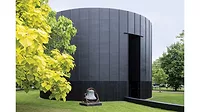
Continuing Education: Healthy Materials
Read the story below, then take the quiz "Sweating the Small Stuff" for Continuing Education credit.

Lucile Packard Children's Hospital
The Lucile Packard Children’s Hospital, under construction in Palo Alto, California, incorporates natural materials such as the salvaged redwood timbers that clad the lobby elevator tower.
Image courtesy Perkins+Will
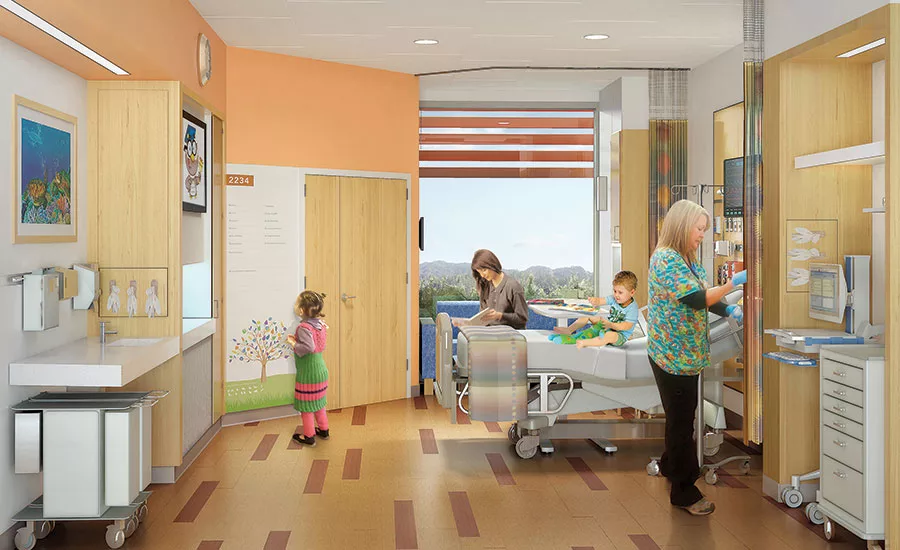
Lucile Packard Children's Hospital
Patient rooms have non-PVC flooring that does not require a sealant and furnishings without halogenated flame retardants.
Image courtesy Perkins+Will
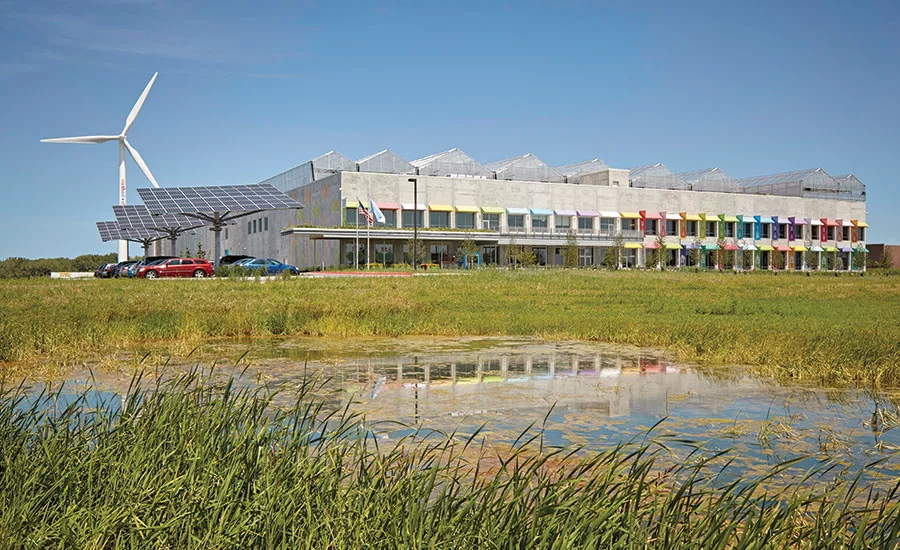
Method Manufacturing Facility
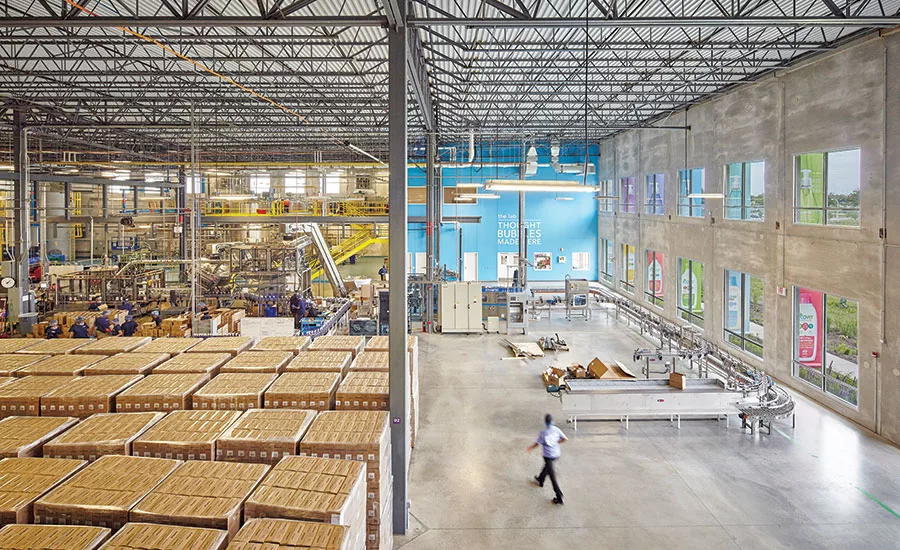
Architect William McDonough’s Method cleaning products factory in Chicago has solar panels and wind turbines that satisfy about a third of its energy demands.
Photo © Patsy McEnroe
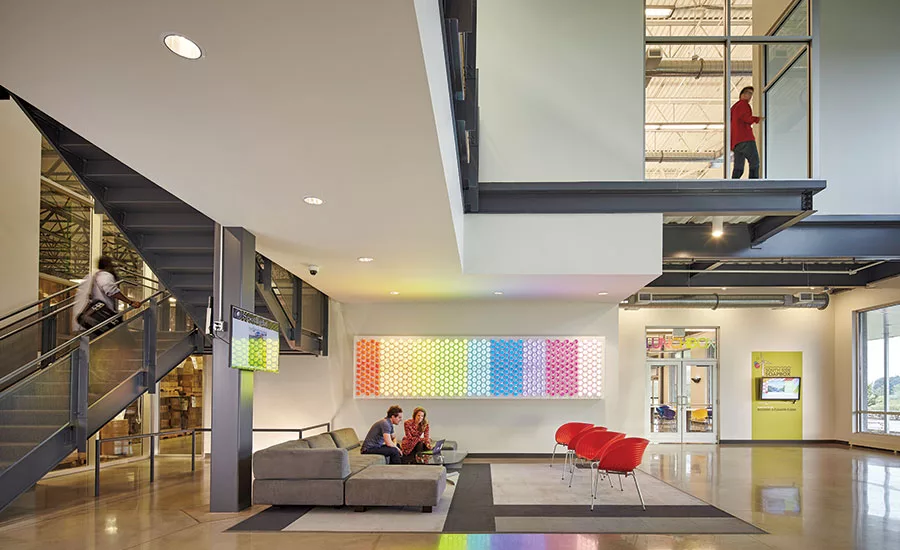
Method Manufacturing Facility
The facility is constructed of materials vetted according to the C2C protocol, including paint, wall base, and adhesives.
Photo © Patsy McEnroe
Method Manufacturing Facility
Because Method’s products are known for their vibrant color, the designers used bold hues throughout the building. They specified a paint that received its official C2C designation as construction neared completion.
Photo © Patsy McEnroe

The Rose
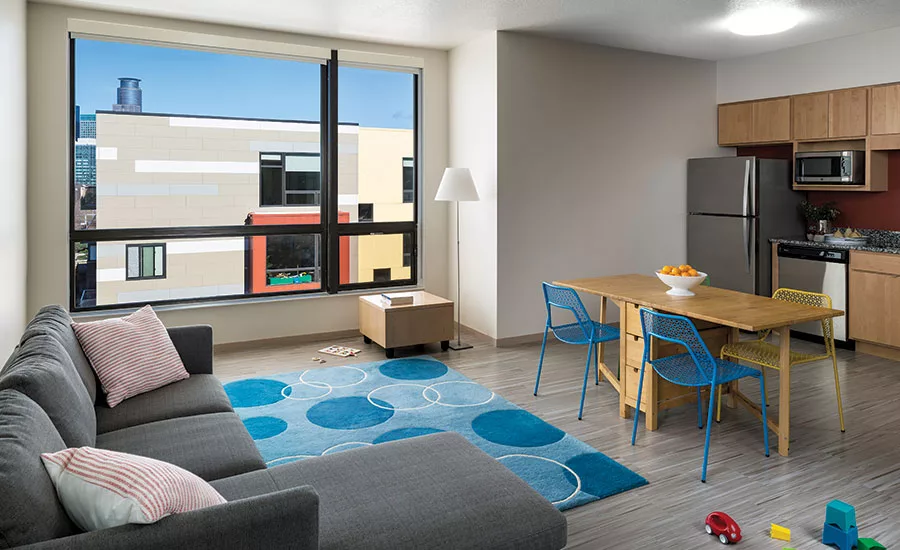
The Rose, a 90-unit mixed-income residential development in Minneapolis, was part of a Living Building Challenge pilot program. The initiative’s aim was to generate replicable models for using the stringent certification system on affordable housing.
Photo © Don Wong
The Rose
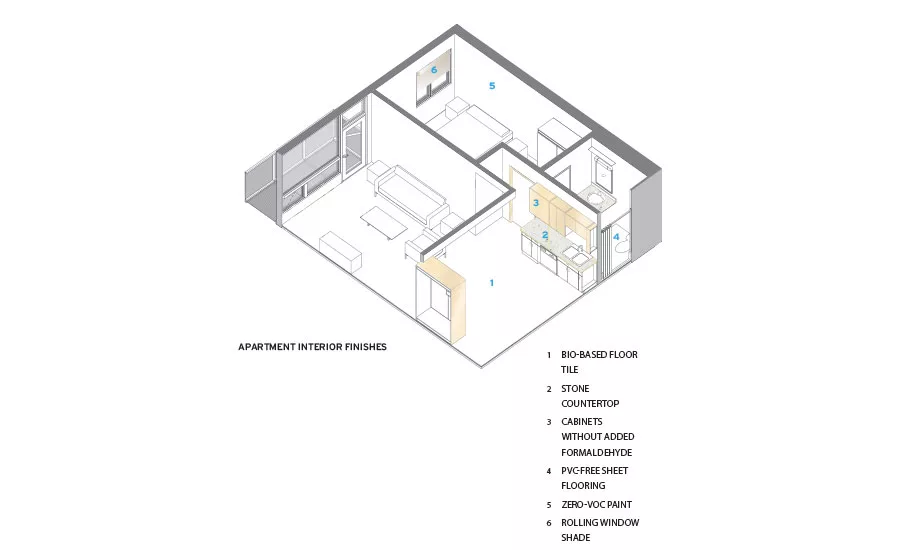
Inside the Rose’s apartments, architects MSR Design focused on the materials that occupants would come in direct contact with. Among their selections were bio-based flooring and plywood core cabinets without added formaldehyde.
Photo © Don Wong
The Rose
Image courtesy MSR Design
If there’s one thing architects know, it’s materials. Attention to detail? It practically defines the profession. Now, however, as awareness of building materials’ environmental and health impacts grows, architects are being asked to consider materials at an even smaller scale: molecular.
In North America, chemicals can be used in consumer products before being tested for toxicity. According to the Natural Resources Defense Council, more than 80,000 chemicals currently used in the United States haven’t been adequately tested for their effects on human health. For proven toxins, regulation is premised on the notion of safe levels not to be exceeded. But for children, researchers maintain that no level is safe. Multiple toxins, including heavy metals, bioaccumulative compounds, and endocrine disruptors, are now found in all of us; among the most common sources of exposure are building materials.
Disclosure from manufacturers about building products’ ingredients, either directly to a project team or through a transparency program, can help architects select more benign materials, which in turn spurs further improvements. But in the short term, this market disruption, with its swarm of acronyms for unfamiliar substances, can have architects sweating some very small stuff.
To help, RECORD has identified three pathfinding projects that successfully grappled with materials’ evaluation: the Lucile Packard Children’s Hospital (LPCH) expansion on
the Stanford University Medical Center campus; the Method Manufacturing Facility on Chicago’s south side; and the Rose, a mixed-income housing development in Minneapolis. Their architects shared what they know about molecular gatekeeping.
Taking Precautions
The 521,000-square-foot, six-story LPCH expansion, scheduled for completion in 2017 and targeting LEED Gold certification, aims to support health and healing by reinforcing patients’ connections to community and the natural environment. In addition to features to insure good indoor air quality and water and energy conservation, the building has several elements intended to bring nature inside, including planter boxes outside patient windows, multiuse gardens, and a variety of interactive displays and artwork relating to the eco-regions of California.
In keeping with this project theme, the team prioritized local, natural, and healthy materials. “Natural materials have an innate healthfulness,” says Robin Guenther, a principal of Perkins+Will, architects for the hospital, “so we use them wherever they’re appropriate.” Salvaged structural timbers from local buildings and site-harvested redwood, for example, appear in the entrance canopy, elevator tower cladding, and trim, introducing biophilic elements.
But more complex materials require screening. Perkins+Will’s first step is to consult its in-house-developed “precautionary list”—a publicly available catalogue of substances commonly found in building materials that multiple regulatory entities have classified as detrimental to human and environmental health. “The virtue of such a list,” says Guenther, “is that it points to low-hanging fruit.”
Looking for quick answers on architecture and design topics?
Try Ask RECORD, our new smart AI search tool.
Ask RECORD →
Getting to that fruit took some clambering, though. Six years ago, when the LPCH specifications were being developed, the only way to find out whether a product contained listed chemicals was to ask its manufacturer directly. Some answered, many didn’t, some refused to divulge what they considered proprietary information, and many didn’t know what had gone into their products lower down on the supply chain.
Now, as a growing number of manufacturers recognize the market advantage of transparency—especially with the disclosure and optimization credits in the latest version of LEED—product declarations are increasingly available. Even so, screening products for health impacts is laborious. Specifying from among products preselected for precautionary-list compliance saves time, says Suzanne Drake, a senior associate at Perkins+Will, “but the biggest hang-up is a lack of options.” For high-profile or especially large projects, a manufacturer may consider it worthwhile to reformulate a product, or publish information to comply with LEED credit requirements. Otherwise, the design team can do little but flag the issue for the client and make a materials recommendation based on other priorities.
Often, it’s the additives intended to improve appearance or performance, such as color, stain guards, fire retardants, antimicrobials, and sealants that introduce toxins into an otherwise benign base product. On LPCH, the team specified non-PVC (polyvinyl chloride) floorings that require no sealing, no- and low-VOC (volatile organic compound) paints, non-PVC window treatments and wall coverings, and furnishings without halogenated flame retardants. Occasionally the weight of other priorities prevailed over health factors (the selected solid surface countertops, for example, contain precautionary list chemicals). But, says Guenther, “presenting the options side by side in a graphic and easy-to-digest way allowed our clients to make clear decisions.”
Once the right products are in the spec, it might seem that the job of optimizing materials for health is done. Not so, says Guenther: “Getting better products into the spec is only half the battle. You still have to get them installed in the building.” Contractors inevitably want to substitute less expensive, easier to obtain, or more familiar options, and by that phase in a project, the client group that originally selected the materials often has disbanded. “If you don’t develop a strong culture that cares about these things,” says Guenther, “the intention will not be realized.”
Clean and Green
Method Manufacturing brought a strong culture to its new 150,000-square-foot cleaning products manufacturing facility in Chicago’s Pullman neighborhood—the first LEED Platinum project of its kind. The facility is “a living dedication to clean in as many ways as possible,” says William McDonough, principal of William McDonough + Partners, architects for the project.
Method’s cleaning products are certified by Cradle to Cradle (C2C)—a program developed by McDonough and chemist Michael Braungart and now administered by an independent nonprofit, the Cradle to Cradle Products Innovation Institute. C2C is based on the ideal that all products can be designed for continuous recovery and reutilization, and provides an assessment across five categories: material health, material reutilization, renewable energy and carbon management, water stewardship, and social fairness; alternatively, a stand-alone material health certificate is also available.
Method understandably wanted its manufacturing facility to be just as ecologically and socially responsible as the products it makes. Completed in 2015, about 80 percent of the factory’s 22-acre former brownfield site has been converted to wildlife habitat. It has a hydroponic greenhouse on the roof where food is grown for the local community. And where you might expect a smokestack, there’s a wind turbine and solar panels, producing over a third of the facility’s energy.
Although not every product in the building is C2C compliant, the architects identified certified products or products with certification potential wherever appropriate. McDonough’s and Braungart’s company, MBDC, served as the materials consultant, providing reports based on publicly available data to identify products that met C2C human and ecological health criteria. Products reviewed included countertops, cabinets, ceramic and acoustic tiles, flooring, wall base, and adhesives. In addition to identifying options for the project, this process also alerted manufacturers to their products’ potential for certification.
Ironically, a product that presented a challenge to the project’s goal of using healthy materials was one of the most significant for the building’s expression. Method’s products are known for their vibrant colors, and, McDonough had used color, both on the interior and exterior, as an important design device. During the early phases of the project, however, no C2C-certified paint was available. But MBDC identified a zero-VOC, zero emissions paint in the process of being certified that would receive its official C2C designation by the time construction neared completion.
For McDonough, Method’s commitment to transparency represents a complete reworking of what a factory can be, resulting in a new, clean model for an industrial workplace.
Breath of Fresh Air
Between work and home, Americans spend almost 90 percent of their time indoors, where pollutant levels can run two to five—sometimes as many as 100—times higher than outdoor levels, according to the Centers for Disease Control and Prevention. The problem affects some building types, such as affordable housing, disproportionately. According to architects who work in this sector, such projects often prioritize materials’ cost, then maintenance and durability, rarely factoring in occupant health.
The Rose, a 90-unit mixed-income apartment complex developed by Aeon and Hope Community, completed in Minneapolis in 2015, aims to change that. The project was part of pilot program with the goal of generating replicable models for using the stringent green building certification system, the Living Building Challenge (LBC), in affordable housing. The Rose tackled the LBC’s materials “red list,” which, much like Perkins+Will’s precautionary list, outlines toxins commonly found in the built environment. It also attempted to meet LBC’s imperatives for net zero energy and water, and for social equity—all on an extremely tight budget of $148 per square foot.
“To reconcile our red list ambitions with the amount of money we had, we needed a strategy to get the most bang for our buck,” says Paul Mellblom, a principal of MSR Design, architects for the project. The team’s tactic was to tackle the products building occupants have the most contact with: flooring, cabinets, finishes, countertops, and window treatments, for example, which account for some of the most common exposures to such toxins as VOCs and phthalates. In all, the architects identified 40 materials within the dwelling unit where factoring in health impacts would provide the biggest payoff.
This approach not only transformed the way the architects understood the building, says Rhys MacPherson, a project manager with MSR—it allowed the owners to pitch to potential project backers more effectively: “Where funders might not have been interested in wood studs, they were very interested in helping pay for individual finish materials. They could see a clear return on investment.” Among the finishes the completed apartments include are stone countertops, which are naturally free of methacrylate (an asthmagen commonly found in solid surface countertops) and red list–compliant flooring. Compared with a standard spec, the flooring alone kept five tons of PVC out of the apartments.
As with LPCH and Method, MSR’s quest for budget-friendly, red list–compliant materials entailed checking declarations on multiple transparency programs. Complicating that effort, says Mellblom, were the programs’ different standards for hazard assessment. To address this problem, the U.S. Green Building Council has convened a harmonization initiative. In addition to the Cradle to Cradle Products Innovation Institute and the International Living Future Institute (the organization that administers the LBC), participants include Clean Production Action, the Healthy Building Network, and the Health Product Declaration Collaborative.
Indoor air testing at the Rose prior to turning it over to residents confirmed that unit VOC readings were between 20 to 30 micrograms per cubic meter, well below the target level of 500 micrograms. Now a research initiative by the Parsons School of Design and the Healthy Building Network intends to quantify the health hazards the Rose’s materials choices avoided. The study’s goal is to express reduced ill effects in terms of time added to the occupants’ lifespans.
“Improving someone’s health is a very tangible benefit,” says Mellblom. “Once we understand the specifics of how design can do that, we will be able to really step up the effort to make the world better—in a quantifiable way.”
|
Continuing Education

To earn one AIA learning unit (LU), including one hour of health, safety, and welfare (HSW) credit, read the above article, review the supplemental material listed below, and complete the online test. Upon passing the test, you will receive a certificate of completion, and your credit will be automatically reported to the AIA. Additional information regarding credit-reporting and continuing-education requirements can be found online at continuingeducation.bnpmedia.com.
Supplemental Material Little Things Matter: The impact of toxins on the developing brain Dr. Bruce Lanphear, Faculty of Health Sciences, Simon Fraser University
AIA Sustainability White Paper
Learning Objectives 1 List some of the potential toxins commonly found in building materials. 2 Explain why it is often labor-intensive to find out what building materials contain. 3 Describe some of the disclosure tools for materials ingredients that are available to architects and product manufacturers. 4 Outline the vetting process used by each of the design teams behind the three projects discussed in "Sweating the Small Stuff."
AIA/CES Course #K1606A
For CEU credit, read "Sweating the Small Stuff" and take the quiz at continuingeducation.bnpmedia.com, or use our architectural record continuing-education app, available in the itunes store. structure, finishes, and other original fabric when
a building is moved.
significant buildings.
|
Looking for a reprint of this article?
From high-res PDFs to custom plaques, order your copy today!