The University of Arizona Cancer Center
A Place in the Sun: A high-performance building in the desert serves as a therapeutic refuge for cancer patients.

The rhythmic placement of folded copper-colored screens on the east and west facades not only serves as a shading device but also creates a unique identity for the new building, which features large expanses of stone and glass as well.
Photo © Nick Merrick

The rhythmic placement of folded copper-colored screens on the east and west facades not only serves as a shading device but also creates a unique identity for the new building, which features large expanses of stone and glass as well.
Photo © Nick Merrick

Multiple scenarios for the exterior screens on the east and west facades were tested for their performance and optimal design related to materiality, fold, perforation size, and distance from window.
Photo © Nick Merrick

A transparent design in the infusion area brings daylight to every treatment space.
Photo © Nick Merrick

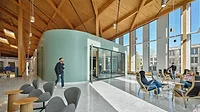
The idea behind the interior design was to create comfortable spaces that lend a sense of security and tranquility.
Photo © Nick Merrick

The second-floor waiting room employs a layering of materials.
Photo © Nick Merrick

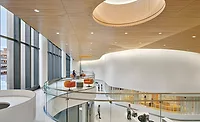
A central stair connects all levels, to encourage connectivity between program areas.
Photo © Nick Merrick

Radiotherapy delivers high-energy radiation via a linear accelerator; the new center has two such machines.
Photo © Tom Harris

A protected seating area outside the café can be used for dining or quiet reflection.
Photo © Nick Merrick

Image courtesy ZGF Architects

Image courtesy ZGF Architects

Image courtesy ZGF Architects

Image courtesy ZGF Architects
Architects & Firms
Phoenix
Situated in the Sonoran Desert and ringed by mountains, Phoenix can be an inspiring but difficult place to create architecture. The natural topography and turquoise sky are a powerful backdrop, but the blistering sun, which can generate temperatures of 100-plus degrees, imposes severe design limitations. ZGF Architects embraced these conditions while conceiving the new University of Arizona Cancer Center, resulting in a distinctive, climate-responsive building that offers a tranquil atmosphere for patients. “Everyone is under stress in a cancer center,” said Doss Mabe, a design partner at the firm. “We wanted to provide a shelter in the desert.”
With deep experience in the health-care sector, ZGF’s Los Angeles office teamed up with general contractor Hensel Phelps for the design-build project. Encompassing 220,000 square feet, the five-story center is equipped to deliver outpatient services, from chemotherapy and radiation treatments to yoga and cooking classes, for more than 500 people per day. The facility is operated by St. Joseph’s Hospital and Medical Center, one of the region’s top hospitals, in affiliation with the Tucson-based University of Arizona. Completed in June 2015, the center is the first clinical facility on a research-focused biomedical campus in downtown Phoenix.
The goal from the start was to produce an exemplary facility that ranked high on performance and comfort. L-shaped in plan, the building comprises rectilinear volumes clad in glass, travertine, and various shading devices. On the sun-blasted east and west elevations, the walls are sheathed in a faceted, copper-colored screen whose appearance evokes the scaly skins of desert reptiles. Composed of perforated aluminum panels that are gently folded and slightly spaced apart, the brise-soleil alleviates heat gain and glare while enabling outward views and ushering in daylight.
The other facades required somewhat less protection from the harsh sun. Horizontal glass fins with a dense frit were placed on the southern face, while glazing on the north was left fully exposed, providing “uninterrupted views of the landscape and the city,” notes Mabe.
Inside the facility, the environment is more akin to a luxury hotel than a sterile hospital—an approach that has become increasingly common in health-care projects. “We wanted to create a hospitality feel for the patients—for it to be warm and embracing,” says Mitra Memari, a project manager for ZGF.
The team employed a neutral color palette and earthy materials such as stone and wood. Visitors enter a quiet, streamlined lobby bathed in diffused light and bordered by a coffee bar and healing garden with native plants. Elevators shuttle patients to intimate waiting lounges on each floor, where they can relax in contemporary-style sofas and chairs. The lounges are delineated by slatted walls made of vertical strips of white oak, making the areas both airy and private.
Of course, creating a successful medical facility is about more than ambience. “It’s a balance between having a welcome feel and an efficient work flow,” says Marcia Gruber-Page, the center’s vice president of oncology services. In planning the layout, ZGF focused on minimizing travel times within the facility. Each floor houses clinics dedicated to specific forms of cancer, with complementary services colocated wherever possible (a 12-bay recovery room, for instance, is shared by the endoscopy and interventional radiology departments). The clinics have their own reception areas and exam and treatment rooms, along with spaces for support specialists such as nutritionists and financial counselors.
To promote multidisciplinary collaboration among doctors, the architects placed meeting rooms in close proximity to patients. “We have a lot of space to meet as teams and also to see patients,” says Dr. Nathalie Zeitouni, a dermatologist specializing in skin cancer. “The building is very functional for all of us. It’s large without being overwhelming.”
One of the facility’s special features isn’t visible to the naked eye. The team incorporated a chilled beam system for heating and cooling, reportedly the first such system in an Arizona health-care facility. It not only reduces energy consumption, it enhances occupant comfort, since it doesn’t produce drafts of cool air—an important consideration, given that cancer patients tend to feel cold.
Exhaustion is also common among people battling cancer. “Fatigue is the most frequent and most distressing symptom they have,” says Gruber-Page. She once worked at a sprawling Houston facility where patients were transported to different areas by golf carts. In contrast, the University of Arizona Cancer Center offers a spectrum of services within a compact yet light-filled facility, preventing distressed patients from feeling lost. From its hardy shell to its soft interiors, the thoughtfully designed building serves as a welcoming and therapeutic refuge in a vast desert metropolis.
PeopleArchitect:
ZGF Architects LLP
Architect of record: ZGF Architects LLP
Interior designer: ZGF Archiects LLP
Engineers:
Affiliated Engineers - Mechanical/Electrical/Plumbing Engineer Dibble & Associates Consulting Engineers - Civil Engineer
Consultants
Atelier Ten - Enviornmental Designer
General contractor: Hensel Phelps Construction
Photographer: Nick Merrick © Hedrich Blessing / 312-491-1101
Client: University of Arizona
Size: 220,000 square feet
Cost: $135 million
Completion date: June 2015
|
ProductsStructural System
Five story concrete frame with structural steel at penthouse roof. Manufacturer of any structural components unique to this project: Façade Steel – MSI. Inc.
Exterior Cladding Masonry: Stone tile – Laticrete / Sun Valley Masonry Metal panels: Kovach Building Enclosures Metal/glass curtain wall: KT Fabrication EIFS, ACM, or other: Stucco – BASF Senerflex, Clark Western/Flannery Inc., SpecMix Moisture barrier: BASF Senershield / Senerwrap, Grace Ice & Water Shield, Tremco Curtain wall: KT Fabrication Other cladding unique to this project: Perforated Aluminum Sun Screens – Kovach Building Enclosures, Stone tile – Laticrete / Sun Valley Masonry
Windows Metal frame: KT Fabrication
Glazing Glass: Viracon. Skyline Design, SaftiFirst – Pyran Fire Rated Glazing Other: Perforated Aluminum Sun Screens – Kovach Building Enclosures, Stone tile – Laticrete / Sun Valley Masonry
Doors Entrances: Stanley Metal doors: KT Fabrication, West Central Manufacturing Wood doors: Algoma Hardwoods Inc. Sliding doors: Aurora Doors, Skyline Design Fire-control doors, security grilles: Overhead Door Company Special doors: Special Lite, Algoma, C.R. Laurence Co. Inc., Tiger Door, Nelco
Hardware Locksets: Stanley, Best Lock Corp. Closers: Dorma, Rixson Inc., ABH Manufacturing, Norton Door Controls Exit devices: Stanley Pulls: Precision Hardware, Inc., Architectural Builders Hardware, Trimco Security devices: Security Door Controls Other special hardware: Automatic Door Bottoms: Pemko
Interior Finishes Acoustical ceilings: USG, Decoustics Suspension grid: USG, Decoustics Demountable partitions: Modernfold Cabinetwork and custom woodwork: ISEC, Western Millwork Paints and stains: Sherwin Williams, Carboline Wall coverings: Flavor Paper, Forbo Paneling: Forbo, Acrovyn, Structoglas Plastic laminate: Pionite Solid surfacing: Corian Special surfacing: Difiniti Quartz Floor and wall tile: Daltile (Public, Patient, Staff restrooms and locker rooms) Resilient flooring: Tate Access Floors, Inc. Carpet: Bentley, Interface Raised flooring: Terrazzo – Advanced Terrazzo / Terroxy, Mechoshade Special interior finishes unique to this project: Terrazzo – Advanced Terrazzo / Terroxy, Mechoshade
Furnishings Fixed seating: Western Millwork Upholstery: Maharam
Lighting Interior ambient lighting: Prudential Ltg., Peerless, Axis, Bega, Kirlin, Finelite, FocalPoint, USAI, Edision Price, Modalight, Winona, NewStar, Ecosense, Electric Mirror Downlights: Prudential Ltg., Peerless, Axis, Bega, Kirlin, Finelite, FocalPoint, USAI, Edision Price, Modalight, Winona, NewStar, Ecosense Exterior: Wild West Lighting, Bega, HK Lighting, USAI, Axis Dimming system or other lighting controls: Wattstopper Light Control
Conveyance Elevators/escalators: Otis
Energy Other unique products that contribute to sustainability: Perforated Aluminum Sun Shades (Kovach), Horizontal Glass fins, Horizontal Solid and Louvered shun Shades (KT Fabrication) Add any additional building components or special equipment that made a significant contribution to this project: Chilled Beams (Price Industries) |
Looking for a reprint of this article?
From high-res PDFs to custom plaques, order your copy today!