Architectural Record
search
cart
facebook twitter linkedin youtube
  • Sign In
  • Subscribe
  • Sign Out
  • My Account
Architectural Record
  • NEWS
    • Latest News
    • Awards
    • Interviews
    • Obituaries
    • Podcasts
      • Design:Ed Podcast
      • Sponsored Podcasts
  • OPINION
    • Book Reviews / Excerpts
    • Exhibition Reviews
    • Forum
  • EXCLUSIVES
    • Videos
    • Design Vanguard
    • Top 300 Firms
    • Sponsored Content
    • Sponsored eBooks
    • From the Archives
  • CONTINUING ED
    • Editorial Continuing Ed
    • CE Center
    • CE Academies
  • PROJECTS
    • Buildings By Type
    • Reuse & Renovation
    • Museums & Arts Centers
    • Colleges & Universities
    • Multifamily Housing
    • Interiors
    • Lighting
    • Kitchen & Bath
  • HOUSES
    • Record Houses
    • House of the Month
    • Featured Houses
  • PRODUCTS
    • Products by Category
    • Record Products of the Year
    • Latest Products
  • EVENTS
    • Dates & Events
    • Record on the Road
    • Innovation Conference
    • Sustainability in Practice
    • Women In Architecture
    • Webinars
    • Ad Excellence Awards
    • Submit an Event
  • CONNECT
    • Ask RECORD AI
    • Newsletters
    • Contact
    • Advertise
    • Editorial Calendar
    • Store
    • Customer Service
  • SUBMIT
    • Submission Guidelines
    • RECORD Competitions
  • MAGAZINE
    • Subscribe
    • My Account
    • Digital Edition
    • Current Issue
    • Firm Pass
    • Historic Archive
Architectural Technology

A base-isolated makeover for Pasadena's historic City Hall
By Russell Fortmeyer
Pasadena City Hall

Pasadena City Hall

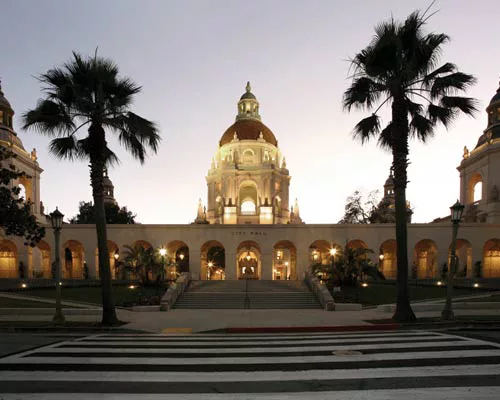
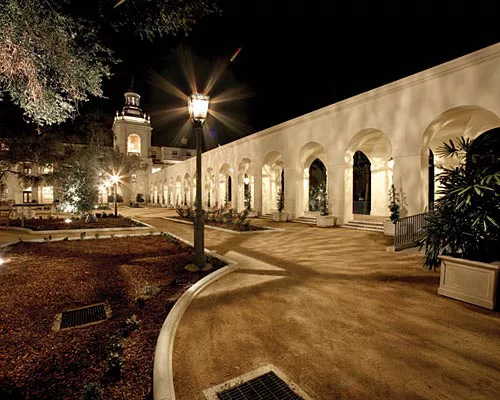
The seismic update and architectural renovation of Pasadena’s City Hall included the base isolation of the dome, as well as the structural buttressing of the courtyard staircases.

Photo © Victor Muschetto 
Pasadena City Hall

Pasadena City Hall

The seismic update and architectural renovation of Pasadena’s City Hall included the base isolation of the dome, as well as the structural buttressing of the courtyard staircases.

Photo © Victor Muschetto
Pasadena City Hall

Pasadena City Hall

The seismic update and architectural renovation of Pasadena’s City Hall included the base isolation of the dome, as well as the structural buttressing of the courtyard staircases.

Photo © Victor Muschetto  
Pasadena City Hall

Pasadena City Hall

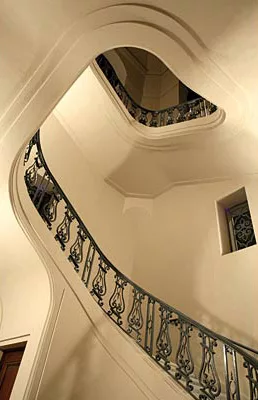
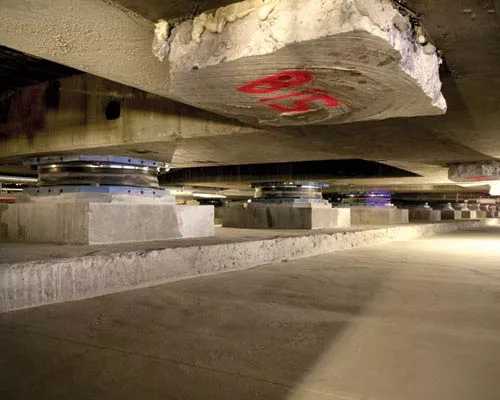
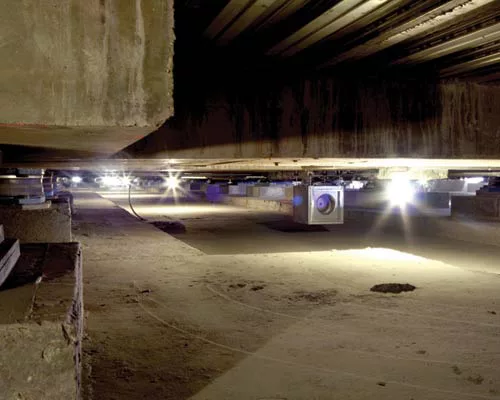
The base isolator level supports a new basement slab. With a transfer beam, each isolator can support two structural columns.

Photo © Victor Muschetto
Pasadena City Hall

Pasadena City Hall

The base isolator level supports a new basement slab. With a transfer beam, each isolator can support two structural columns.

Photo © Victor Muschetto 

Pasadena City Hall
Pasadena City Hall
Pasadena City Hall
Pasadena City Hall
Pasadena City Hall
January 16, 2008
Structural base isolation—effectively “floating” a building on rubber pads to safely ride out an earthquake—is nothing new in California. But the isolators installed for the structural and architectural renovation of Pasadena’s 1927 City Hall, designed by Bakewell and Brown, represent an innovative approach for addressing historic structures. Instead of placing an isolator under each structural concrete column, as is typically done, the engineers at San Francisco–based Forell/Elsesser Engineers designed a system of transfer beams that reduce the overall number of isolators.
 
The seismic update and architectural renovation of Pasadena’s City Hall included the base isolation of the dome (above), as well as the structural buttressing of the courtyard staircases.
 
“For an existing building, you usually only isolate one column at a time to maintain the global stability of the building,” says Steve Marusich, a structural engineer and the project manager for Forell/Elsesser. “On this project, we built a new foundation in between the original and the structure above, and then set the new foundation on top of isolators.” There were several challenges with City Hall that led Forell/Elsesser and the project’s architects, San Francisco–based Architectural Resources Group (ARG), to consider unconventional structural solutions in order to bring it up to code. The original building, designed in a California Mediterranean style, was slated for the $117.5 million seismic upgrade and renovation project after suffering minor damage from the 1994 Northridge earthquake and after investigators found the structure to present potential life-safety issues, such as collapse. Although Forell/Elsesser began seismic investigation of the building in 1994, they were joined by ARG and construction manager DMJMH+N for the current completed project in 1999. Construction began in March 2005 and finished in April 2007, a surprising two months ahead of schedule.
 
First among the challenges the design team encountered was that the concrete building, located in the middle of downtown, is listed on the National Register of Historic Places. This meant that the structural changes allowing the building to move the necessary 21¼2 feet in any lateral direction couldn’t alter the appearance of the architecture. Jim Guthrie, a structural engineer and a principal at Forell/Elsesser, says the team considered conventional bracing and shear walls, instead of base isolators. However, he says adding shear walls would have been too visually intrusive to City Hall’s historic character. Aside from being registered as a historic building, City Hall is an architectural icon of Pasadena, if not Greater Los Angeles.
 
Additionally, the three-story, 190,000-square-foot building is U-shaped in plan, with two long wings and a large domed structure at the bottom of the U. During an earthquake, the two wings had the tendency to move separately, increasing strain on the remaining structure. The architects addressed this by removing a structurally isolated, single-story arcade that had visually connected the two wings, inserting a concrete “tube” that connected the foundations of the wings below grade, and then rebuilding the arcade. Bruce Judd, FAIA, a principal for ARG, says the new structure now acts as a unit, similar to a conventional courtyard building. The engineers also buttressed the piers of the dome to lessen shaking, while also connecting four stair towers, at each corner of the courtyard, which were originally structurally isolated.
 
The last significant challenge affected the isolators themselves, since the on-center spacing of the structural columns is tight. This made excavation for isolator pads in the basement quite difficult, since contractors from Clark Construction Group would need to remove the existing basement slab and excavate around the existing footings. The new isolators solved this: Each isolator was installed on new footings located in between the existing structural grid. Once an isolator was installed, a transfer beam would be introduced to connect two adjacent existing columns that could then rest on the new isolator. When completed, the footings for the existing columns could be removed, thereby freeing up space for excavation and shoring. After the isolators were installed (a conventional design of one isolator per column was used under the dome), a new slab was poured for the basement, which still remains occupied by city staff.
 
If this all sounds expensive, it is. Jim Guthrie, a structural engineer and a principal at Forell/Elsesser, says that although base isolation is usually always the more expensive option, once the design team investigated the costs of shutting the building down and relocating staff following a major earthquake, the numbers easily indicated isolators would be cheaper. Reducing the number of isolators—the engineers estimated they saved 20 percent of the total isolator cost with their solution—also helps the structure, since isolators perform better under heavier loads. The new structure was designed for a 500-year earthquake, or what would amount to around an 8.0 on the Richter scale earthquake from the nearby San Andreas Fault (there are no faults directly beneath the building).
 
Conceptually, the new base isolation scheme appears easy enough, but details make all the difference. Since the building’s structural columns now rest on transfer beams, the engineers needed to design post-tensioning rods that could effectively clamp the columns to the beams. “This creates enough friction so the column doesn’t punch through,” says Marusich.
 
The isolators themselves are like two dishes—a concave, cast-steel, Teflon-coated “bowl” that sits on the concrete footing and a convex, stainless-steel bearing that can roll around. These isolators, manufactured by the California company Earthquake Protection Systems, are known as the “friction-pendulum” type, since as the building moves, the bearing rides up the sides of the bowl and creates enough friction to slow down the movement of the building. A counterforce then returns the bearing to rest in the middle of the isolator. The most common are rubber-pad isolators.
 
Even with the innovative structure, ARG’s Judd says there were few surprises on the project. ARG’s work mostly focuses on historic preservation, so he says he’s particularly accustomed to surprises. He notes that when the City Hall staff returned, someone asked him if all he did was paint it. “That was good to hear,” he says, since it indicated the firm’s work had gone unnoticed.


Share This Story

Looking for a reprint of this article?
From high-res PDFs to custom plaques, order your copy today!


Russell fortmeyer
Russell Fortmeyer, a contributing editor to RECORD, is a Los Angeles-based sustainability principal at Arup and adjunct professor at the University of Southern California School of Architecture.

Post a comment to this article

Report Abusive Comment

Subscription Center
  • Create an Account
  • Start a Subscription
  • Manage My Account
  • Sign Up for Newsletters
  • Visit Customer Service
  • Update Preferences

More Videos

Sponsored Content

Sponsored Content is a special paid section where industry companies provide high quality, objective, non-commercial content around topics of interest to the Architectural Record audience. All Sponsored Content is supplied by the advertising company and any opinions expressed in this article are those of the author and not necessarily reflect the views of Architectural Record or its parent company, BNP Media. Interested in participating in our Sponsored Content section? Contact your local rep!

close
  • TAMLYN XtremeTrim Exterior Trim
    Sponsored byTamlyn

    Designing Cleaner Panel Facades: Why Exterior Trim Details Matter

  • Building with Vapor Barriers
    Sponsored byReef Industries, Inc.

    Vapor Barriers Help Control Moisture in Tighter Building Designs

  • Duct Interior with Prodeq System
    Sponsored byHenry, a Carlisle Company

    Designing Resilient Water Containment Systems

DESIGN:ED Podcast
Listen to Architectural Record’s DESIGN:ED Podcast

Events

June 10, 2026

Rethinking Stormwater – The Power of Porous Paving

Credits: 1 AIA LU/HSW; 1 AIBD P-CE; 0.1 ICC CEU

Learn how porous paving systems support stormwater management, reduce heat island effects, and enhance sustainable site design performance.

June 11, 2026

Very Early Warning Fire Detection for Mission-Critical Facilities

Credits: 1 AIA LU/HSW; 1 AIBD P-CE; 0.1 ICC CEU

Examine advanced fire detection strategies that support uptime and enhance safety in data centers and other mission-critical facilities.

View All Submit An Event

Products

2026 Architect's Square Foot Costbook

2026 Architect's Square Foot Costbook

See More Products

Popular Stories

Practice Matters illustration

What’s in a (Firm’s) Name? Thinking About Succession and Legacy

Coronado Bridge

The Architect’s Guide to San Diego

Practice Matters illustration

By the Numbers: Counting America's Architects

Riverdale House by Studio Lau

Riverdale House by Studio Lau

House on a Hill

Design Vanguard 2026: Forma

Broader Sustainability of CMU - Free Webinar - May 21, 2026

Related Articles

  • Boston City Hall

    Boston City Hall Designated as Historic Landmark

    See More
  • Boston's Mayor Revives Plans for New City Hall

    See More
  • More Changes Ahead for Boston City Hall

    More Changes Ahead for Boston City Hall

    See More

Related Products

See More Products
  • WC_-SCA.png

    Building Great Schools for a Great City

  • 0470126736.gif

    Modern Sustainable Residential Design: A Guide for Design Professionals

See More Products

Events

View AllSubmit An Event
  • June 2, 2026

    Adaptive Reuse for Multi-Family Residential: Transforming Historic Structures into Sustainable Housing

    NOW ON DEMANDCredits: 1 AIA LU/HSW; 1 AIBD P-CE; 0.1 ICC CEUExplore real-world adaptive reuse case studies that show how to transform historic buildings into high-performing, sustainable multi-family housing while preserving architectural character.
View AllSubmit An Event
×

The latest news and information

#1 Source for Architectural Design, News and Products

SUBSCRIBE
  • RESOURCES
    • Advertise
    • Contact Us
    • Submit
    • Store
  • ACCOUNT CENTER
    • Create an Account
    • Start a Subscription
    • Manage My Account
    • Sign Up for Newsletters
    • Visit Customer Service
    • Update Preferences
  • PRIVACY
    • PRIVACY POLICY
    • TERMS & CONDITIONS
    • DO NOT SELL MY PERSONAL INFORMATION
    • PRIVACY REQUEST
    • ACCESSIBILITY
  • SERVICES
    • Marketing Services
    • Reprints
    • Market Research
    • List Rental
    • Survey/Respondent Access
  • STAY CONNECTED
    • Linkedin
    • Facebook
    • Instagram
    • YouTube
    • X (Twitter)

Copyright ©2026. All Rights Reserved BNP Media, Inc. and BNP Media II, LLC.

Design, CMS, Hosting & Web Development :: ePublishing