Three Arts Center Buildings Designed by Kashef Chowdhury Respond to the Local Landscape of Northern Bangladesh
.webp?t=1676664003&width=1080)
Visual of completed artist housing at Srihatta. Rendering by Kashef Chowdhury-URBANA, Faisal Ash-Shafi, courtesy Samdani Art Foundation
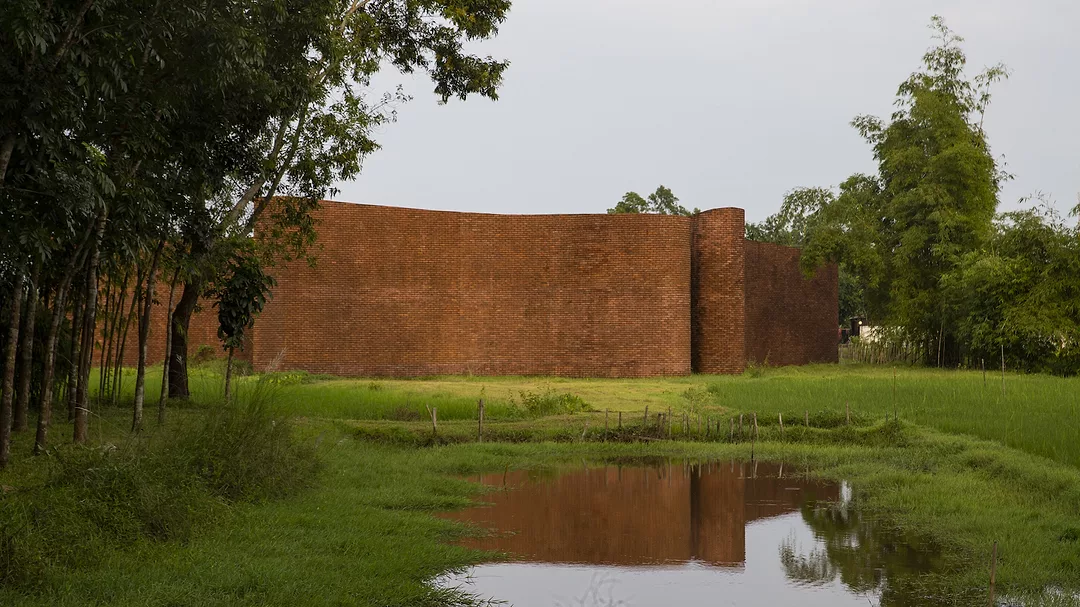
The undulating brick wall of an exhibition building at Srihatta, a rural arts center set to open next year in northeast Bangladesh. Photo by Ahmed Rasel, courtesy Samdani Art Foundation
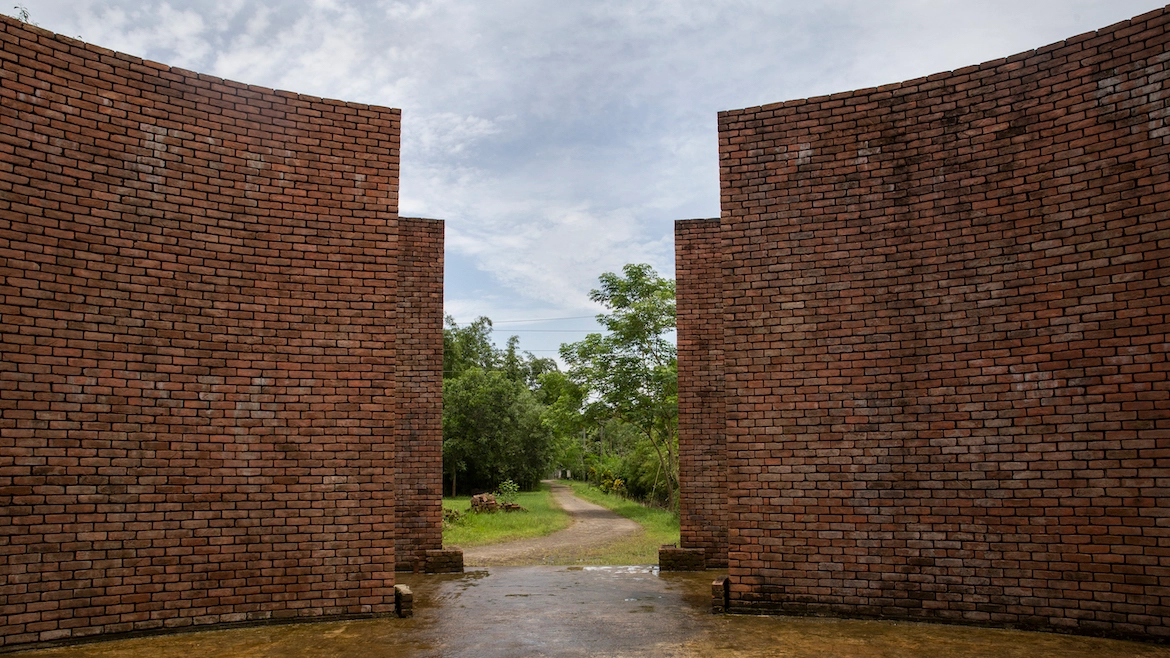
Entrance gate to Srihatta. Photo by Ahmed Rasel, courtesy Samdani Art Foundation
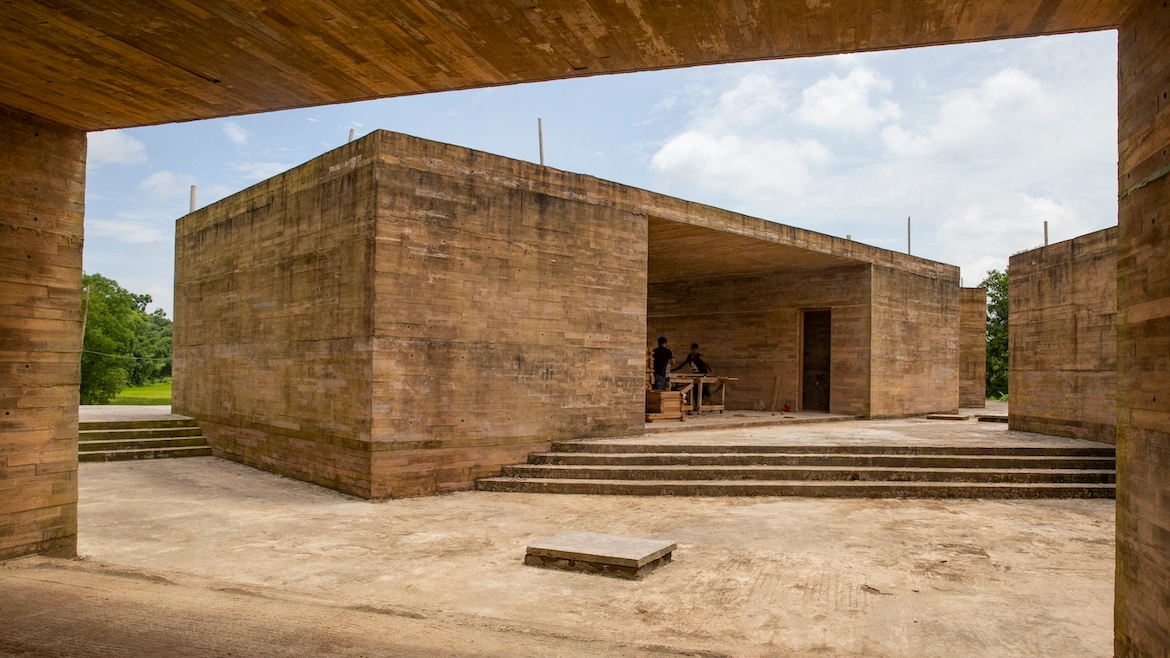
Construction of visiting artist housing underway at Srihatta. Photo by Ahmed Rasel, courtesy Samdani Art Foundation
.webp?t=1676853394&width=1080)
Srihatta gallery exterior, residency plaza. Rendering Kashef Chowdhury + URBANA, courtesy Samdani Art Foundation
.webp?t=1676853365&width=1080)
Srihatta Residency Plaza. Rendering Kashef Chowdhury + Urbana, courtesy Samdani Art Foundation
The landscapes of Sylhet, northeastern Bangladesh, are lush tea plantations, swamp forests, and paddy fields. As one of the wettest parts of the world, with monsoon rains relentlessly lasting weeks, there is a dialogue of understanding between people and landscape, with a history of agriculture and architecture working with extreme seasonal weather.
It will also be the site of Srihatta, a new arts and sculpture center due to open in 2024 and formed around a suite of three architectural set pieces designed by Kashef Chowdhury. With his Dhaka-based firm URBANA, Bangladeshi architect Chowdhury is recognized globally for a series of projects responding to climate change and utilizing a design language rooted in materials and context. The environmental and social issues he contends with are amplified in Bangladesh, a nation hit in 2022 by record flooding and reckoning with ongoing humanitarian crises related to the 2017 Rohingya genocide and 2021 Myanmar military coup.
Chowdhury is perhaps recently most well-known for a project dealing with such concerns: the RIBA 2021 International Prize–winning Friendship Hospital in rural southwest Bangladesh. A compact complex formed of locally sourced bricks, it is recognizable by a narrow stream zigzagging through the center supporting micro-climatic cooling and rainwater harvesting as well as acting as separation between in- and out-patient zones of the hospital.
.webp)
Open-air exhibition space at Srihatta. Rendering by Kashef Chowdhury/URBANA, Faisal-Ash-Shafi, courtesy Samdani Art Foundation
Back in Sylhet, Srihatta will house the art collection of founders Nadia and Rajeeb Samdani, also behind the capital’s biennial Dhaka Art Summit. Primarily though, it is intended as a place for architects and artists to work with the local landscape and community through site-responsive and socially-engaged practice. It is planned as a slow project in which architecture and installations incrementally populate the landscape as artistic, community, and environmental needs demand, evolving over decades into a center of architecture, nature, and creative nurture. For example, Indian artist Asim Waqif’s newly planted 140-by-100-foot bamboo grove will take years of careful maturing and sculpting before whistling harmoniously as wind passes through it.
Chowdhury’s buildings act as initial infrastructure from which longer-term ambitions will emerge across the 100-acre site. The architect explains that “the idea was not to have one single iconic structure, but to break it up and spread it all over the landscape.” He describes the first of these as “a kind of spacecraft,” that offers more of a psychological function than physical. Two concentric brick circles act as a point of arrival to Srihatta, forcing visitors from vehicles and onto foot. It is a poetic threshold with an enclosing central chamber of resonant acoustics—when RECORD visited, a man sat on a chair at its focus, beautifully reciting a local song of weather and water—with the curving passage offering symbolic transition opening into the landscape beyond.
Deeper into the site, another structure with an enticingly undulated curtain wall catches the light with an ever-shifting tonal range, its curved skin concealing a simpler geometric form within. Behind the structural wraparound brick, which is designed with earthquakes in mind, sits a 60-by-80-foot shed, specifically sized to hold an arrangement of audiovisual works curated by Californian Diana Campbell, who also oversees the Samdani’s wider collection and the Art Summit.
.webp)
Entrance gate to Srihatta. Rendering by Kashef Chowdhury/URBANA, Faisal-Ash-Shafi, courtesy Samdani Art Foundation
When heavier rains fall, this building will read as a marooned island rising from deep waters; an internal floor slab raised above ground level protects artworks and technical equipment from flooding. With the building formed of the two components of serpentine skin and rigid box, it is the interstitial space between, an unexpected and revealing passage, which will offer intrigue to local youngsters and artists alike.
Looking for quick answers on architecture and design topics?
Try Ask RECORD, our new smart AI search tool.
Ask RECORD →
Both the entrance and gallery are formed of handmade bricks, which Chowdhury describes as having “beautiful imperfections.” The last of his three Srihatta buildings, however, is formed of poured-in-place concrete, subtly pigmented in hazy pink to play against the local reddish earth. Perched on a raised plateau safely above monsoon flooding, a series of semi-connected blocks will become housing for resident artists.
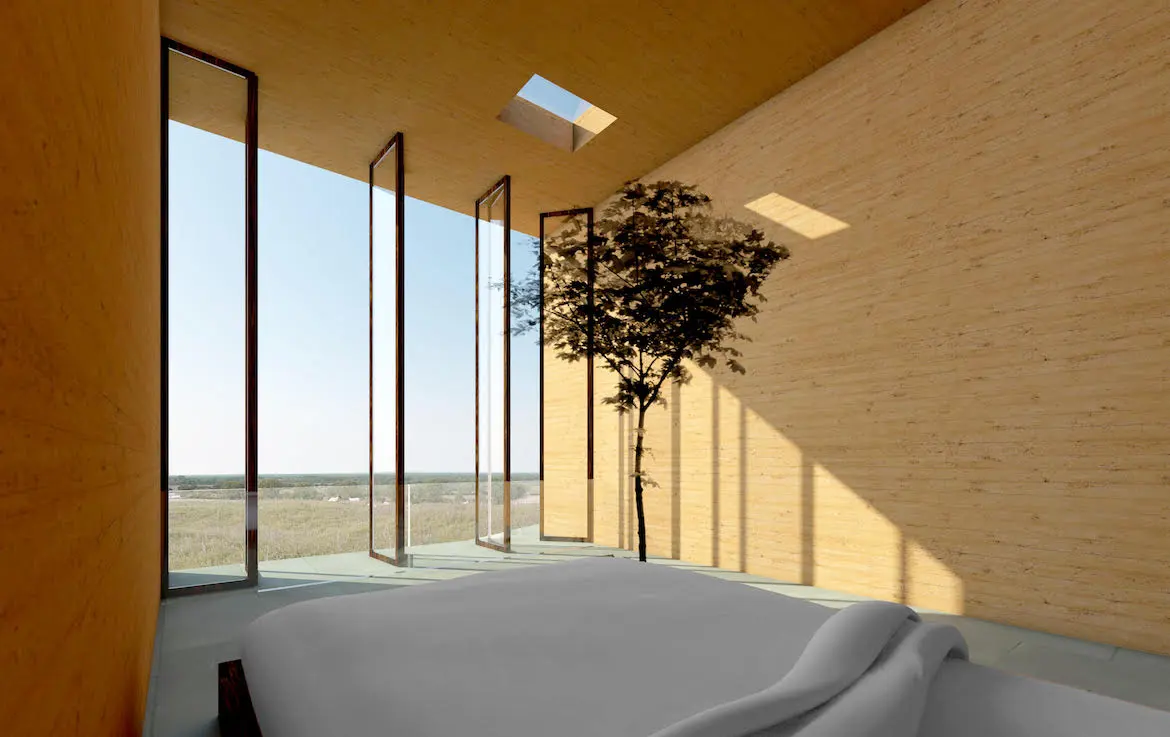
Srihatta residency plaza. Rendering by Kashef Chowdhury/URBANA, courtesy Samdani Art Foundation
These rectangular boxes, arranged around existing topology and trees, create a playful assemblage of open courtyards and passages with monastic bedrooms of simple raw detailing offering uninterrupted framed views onto the landscape. As Chowdhury explains, these spaces of creative reflection were conceived so that visiting artists are “exposed to the light, the wind, the breeze, and to the landscape.”
Wrapping the residential mound is Concrete River, an undulating path by Polish artist Monika Sosnowska which has already been used for local youth activities. Planned additions include: a tea house by Sylheti artist Rana Begum; a brick pavilion designed by London-based multimedia artist Haroon Mirza, with a solar panel roof inspired by sacred geometry and with a sound and light installation responding to the five daily calls to prayer; and an aerial drawing formed of local stones rooted in Bengal mythology by Yona Friedman.
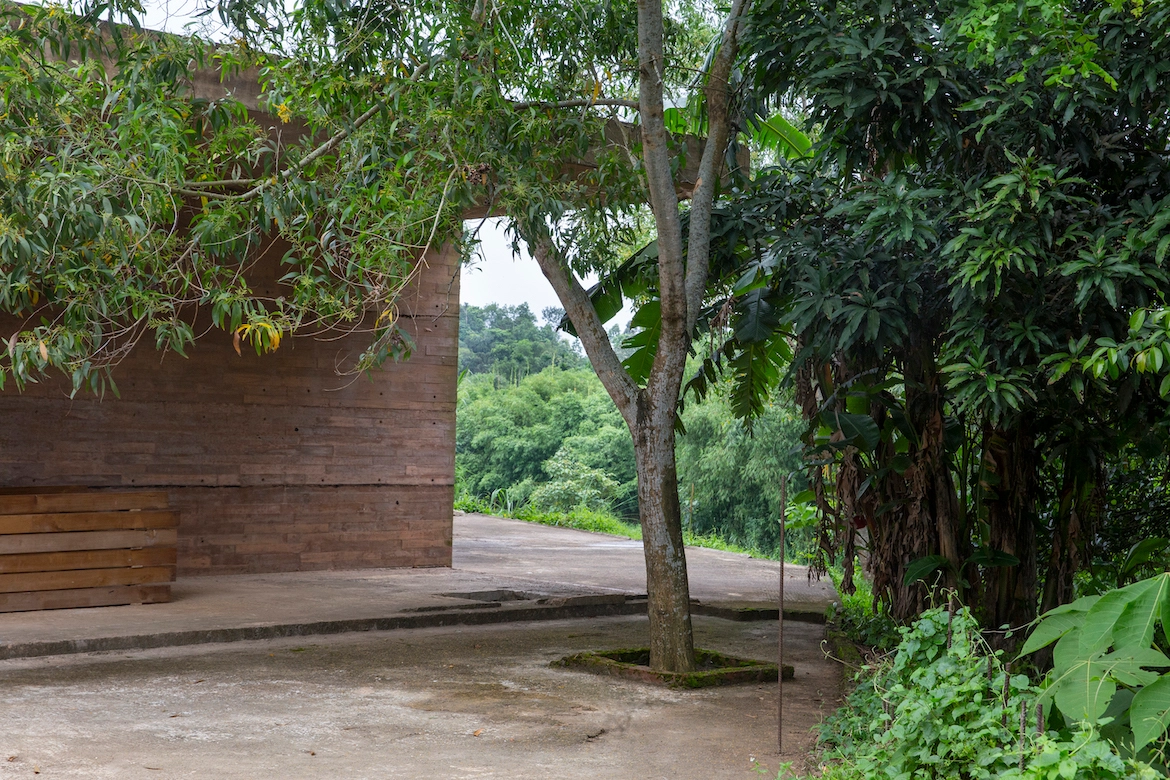
Artist housing. Photo by Ahmed Rasel, Courtesy Samdani Art Foundation
These, and many more projects, will emerge over years to come. And while it is not yet known how Srihatta may evolve over the coming decades following its opening in 2024, the three anchor buildings by Chowdhury offer a strong call to action for future creative acts.
Looking for a reprint of this article?
From high-res PDFs to custom plaques, order your copy today!