RECORD Forum
(Don't) Roll Credits: In Defense of the Cinema
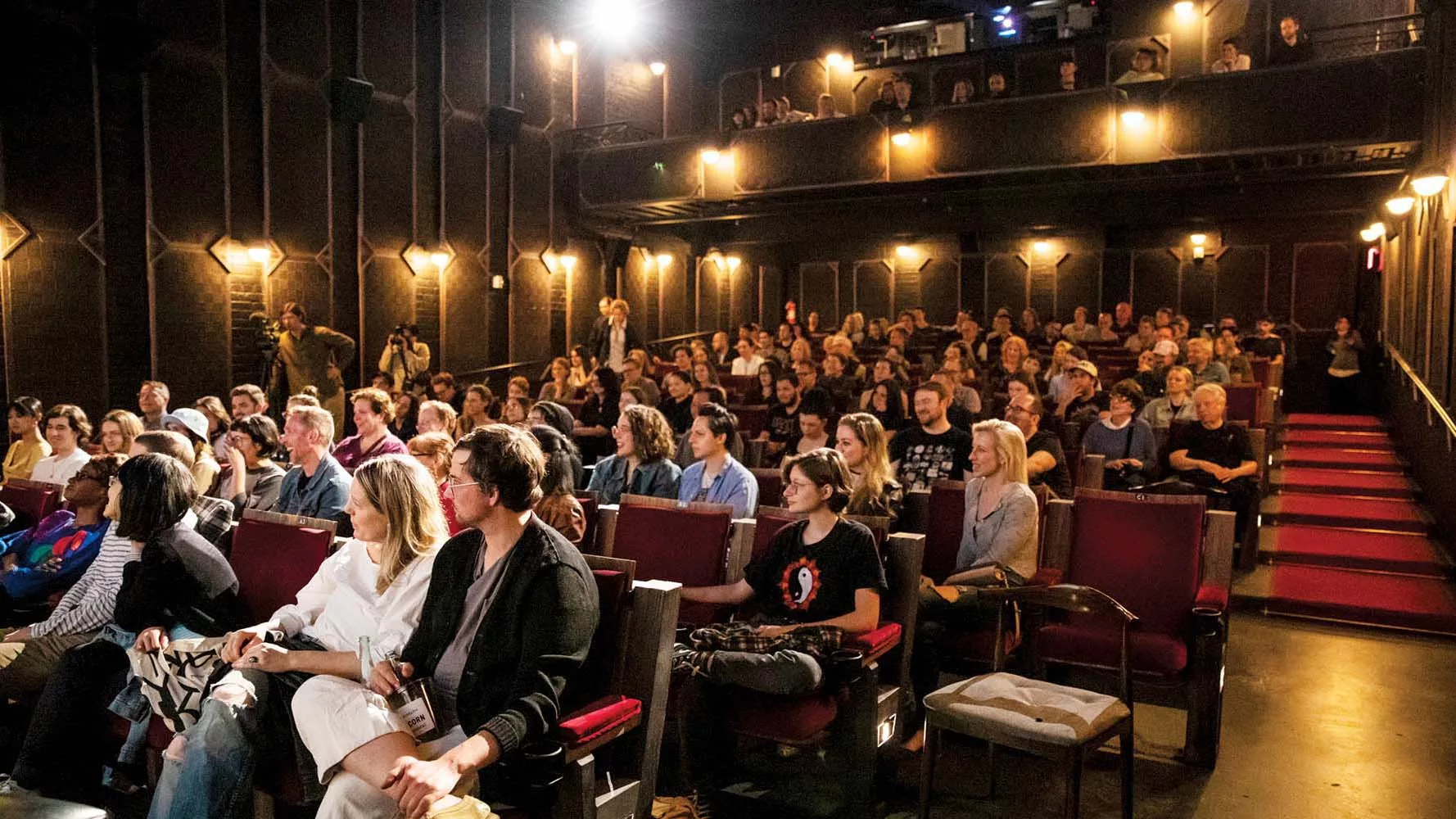
One Saturday evening in October, a few dozen people gathered at the Metrograph theater on Manhattan’s Lower East Side to watch a faded, scratched, missing-some-frames 35-millimeter print of All the President’s Men. Seen flickering on the larger of the theater’s two screens, the paranoia of this classic political thriller from 1976 felt tenser, the laughs bigger, the stakes higher. The audience fed off the film’s energy, and each other’s. Two-plus hours later, viewers buoyantly filed into a lobby buzzing with activity. Moviegoers leaving one screening mingled with those waiting for another. Friends huddled over plans for the night. Strangers discussed films, books, the neighborhood. It was the kind of experience watching a movie at home can never provide. And it’s endangered.
The nonprofit National Cinema Foundation reported that, in 2022, there were more than 39,000 movie screens in the United States, down from more than 41,000 in 2019. More have been lost in the years since. Theaters large and small have steadily closed, creating cinema deserts in cities and towns across America. In early 2024, Indiewire reported that Chicago’s South Side and its 1.2 million people now only have 18 screens across two theaters. Rutland, Vermont, population 16,000, doesn’t have a movie theater within 40 miles.
Viewing habits, steadily changing thanks to high-speed internet and mobile devices, crossed some kind of Rubicon during the pandemic, when staying home to watch new releases was normalized, and moviegoing has yet to rebound. The industry achieved box office returns in 2019 of $11.36 billion. In 2023, the year of Barbie and Oppenheimer, it only managed $8.9 billion. The long-term trend is down, to the point that, when digital media outlet Puck tackled the issue in April, it glibly wrote: “The U.S. is clearly over-screened, with the new normal of moviegoing falling far behind all the available theaters. What’s needed is a wholesale murder of the multiplex, so why won’t that happen anytime soon?”
America is “over-screened” only if you look at this as a dollars-and-cents issue. But there’s more to movie theaters than capital extraction. These spaces are vital social institutions and third places, as important to a functioning democracy as churches, social clubs, and school groups like the PTA. Yes, the experience of visiting a multiplex can be lousy: overpriced concessions, dirty floors and seats, and patrons more interested in their phone screen than the big screen. But when we see a movie in a theater, we’re engaging in a fundamentally communal act. We might turn out to watch buzzy Oscar bait or a new Marvel installment, but we’re also there to experience thrills, chills, drama, and comedy with other people—free of barriers, judgment, and exclusion.
Film is a democratic art. From the first silent shorts to the latest IMAX epics, movies bring people together unlike any other creative endeavor. They have evolved a lot in their more than 125-year history, but at their core they’re still cheap entertainments that tap primal feelings of love, fear, humor, sadness, and triumph and provide an outlet for our anxieties and imaginations. And from the first ramshackle nickelodeons to opulent movie palaces and shopping mall multiplexes, we’ve watched films in spaces shared with friends, family, strangers, neighbors, rich, poor, all races, all religions, all creeds. “Here is a shrine to democracy where there are no privileged patrons,” architect George L. Rapp said about his Loew’s Jersey City movie palace when it opened in 1929. The aesthetics and particulars have changed, but that general principle has proved resilient over decades of technological advancement that threatened to upend it.
Take the 1950s, when a new device—television—invaded homes with the promise of watching moving images right in your living room. People bought sets and stayed home, and, coupled with an exodus to the suburbs, it touched off a Hollywood crisis. But, eventually, the industry responded with widescreen presentations and Technicolor, giving viewers something they could only get in theaters, as well as new kinds of theaters to screen these bigger pictures.
The hulking single-screen movie palaces didn’t survive the moment. Many were demolished; others were left to rot. Some of the survivors, many now designated as historic landmarks, were eventually restored and revived as performing arts centers, like Rapp & Rapp’s Loew’s Jersey City and the Capitol Theatre in Madison, Wisconsin (RECORD, July 1980). Others were partitioned into commercial spaces. In rare cases, the reuse was executed with care for the site’s original purpose, such as Foster + Partners’s nimble 2021 conversion of the 1927 Tower Theatre in Downtown Los Angeles into an Apple store. More often, though, palaces are treated as spaces to fill—the Westmont in Haddon, New Jersey, now a Planet Fitness; the lobby of the Loew’s Canal, a mere 250 feet away from New York’s Metrograph, an always-closed TV repair shop—their original grandeur a faded memory.
Looking for quick answers on architecture and design topics?
Try Ask RECORD, our new smart AI search tool.
Ask RECORD →

Foster + Partners’s Tower Theatre retrofit in Los Angeles turned the 1927 movie palace into an Apple store while respecting its original function. Photo © Cesar Rubio, click to enlarge.
Those buildings at least gave way to the multiplex. This present moment feels more existential, the dominance of Silicon Valley money and management style instigating a retreat. The smartphone is the disruptive, omnipresent gadget, attached to us like a new limb. Film is now treated as content—that gray, meaningless word that encompasses everything from mediocre TikTok videos to prestige TV. If movies are content, they’re no longer unique, and no longer need unique, dedicated spaces. Best just to stay home and tumble down the algorithmic rabbit hole. And when those purpose-built boxes designed for showing a lot of movies to a lot of people in the most utilitarian way possible close, they’re often functionally useless. These transformations have made it easier to keep us segregated, sequestered, and streaming alone.
With some exceptions, such as Barbie, Oppenheimer, and Deadpool and Wolverine giving the box office boosts, audiences are still generally staying away. The offerings certainly don’t help; how many sequels and reboots can a culture stand? Neither does oligopolistic control of America’s theaters. AMC, Regal, and Cinemark, the three largest theater chains, operate more than 21,000 screens and account for 67 percent of ticket sales. They’ve added fancy laser projectors and leather recliner seats that shake, but cosmetic changes only go so far.
What’s the solution? One path forward lies in getting smarter-screened. New York’s Metrograph, Vidiots in Santa Monica, Trylon Cinema in Minneapolis, Row House Cinema in Pittsburgh are among the crop of boutique theaters that have opened within the last decade as spaces catering to cinephiles and adventurous moviegoers. They prioritize human engagement over passive consumption and are committed to attracting people with something they can’t experience at home, be it screenings on film, encounters with directors, or just spaces for community and gathering around a shared interest. These are the latest iteration of Rapp’s shrines to democracy, putting us in proximity with other people and a diversity of beliefs, opinions, and experiences in meaningful ways.
Corporate megaplexes have a role to play too, serving us the kinds of popcorn blockbusters that are best seen with a lot of people. But the kinds of civic-minded engagement offered by the crop of new independent theaters are the fulfillment of moviegoing’s promise. They’re reminders that to lose these spaces would be to lose something essential to our lives, communities, and culture. Movie theaters are necessary, and we need to appreciate and protect them, warts and all, before they’re “disrupted” out of existence.
Looking for a reprint of this article?
From high-res PDFs to custom plaques, order your copy today!


