Architectural Record
search
cart
facebook twitter linkedin youtube
  • Sign In
  • Subscribe
  • Sign Out
  • My Account
Architectural Record
  • NEWS
    • Latest News
    • Awards
    • Interviews
    • Obituaries
    • Podcasts
      • Design:Ed Podcast
      • Sponsored Podcasts
  • OPINION
    • Book Reviews / Excerpts
    • Exhibition Reviews
    • Forum
  • EXCLUSIVES
    • Videos
    • Design Vanguard
    • Top 300 Firms
    • Sponsored Content
    • Sponsored eBooks
    • From the Archives
  • CONTINUING ED
    • Editorial Continuing Ed
    • CE Center
    • CE Academies
  • PROJECTS
    • Buildings By Type
    • Reuse & Renovation
    • Museums & Arts Centers
    • Colleges & Universities
    • Multifamily Housing
    • Interiors
    • Lighting
    • Kitchen & Bath
  • HOUSES
    • Record Houses
    • House of the Month
    • Featured Houses
  • PRODUCTS
    • Products by Category
    • Record Products of the Year
    • Latest Products
  • EVENTS
    • Dates & Events
    • Record on the Road
    • Innovation Conference
    • Sustainability in Practice
    • Women In Architecture
    • Webinars
    • Ad Excellence Awards
    • Submit an Event
  • CONNECT
    • Ask RECORD AI
    • Newsletters
    • Contact
    • Advertise
    • Editorial Calendar
    • Store
    • Customer Service
  • SUBMIT
    • Submission Guidelines
    • RECORD Competitions
  • MAGAZINE
    • Subscribe
    • My Account
    • Digital Edition
    • Current Issue
    • Firm Pass
    • Historic Archive
Commentary & Criticism

Legal loophole trumps good zoning in SoHo

By Michael Sorkin
December 16, 2007

The form of the city rises from the convergence of legislation, imagination, ambition, and resistance. This complex of forces is getting a workout a few blocks from my office in Lower Manhattan, where Donald Trump and partners are building the Trump SoHo, a 45-story “condominium hotel” containing 400 apartments—ranging in size from 425 to 10,000 square feet—priced at $3,000 a square foot and said to be selling briskly. The tower, which is going up fast and is scheduled to open in spring 2009, sits adjacent to SoHo and will be, by far, the tallest building in an area characterized by structures of six to 15 stories. Like most Trump projects, the architecture, by Handel Architects, is merely bland, another glass box. Because of its size, however, it whimsically rescales the entire neighborhood, permanently marring the low roofscape that stretches downtown and culminates in the Lower Manhattan skyline. It’s a view I take in every morning as I walk to work, and the new tower already constitutes an awful scar on the sky. As urbanism, it’s vandalism.
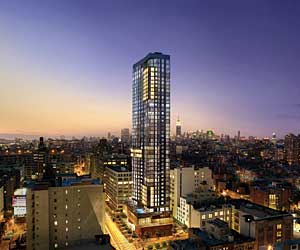
Trump SoHo
Rendering: ' Courtesy Trump SoHo
The 45-story Trump SoHo towers above all of its neighbors.

The controversy that surrounds the building, however, focuses on questions that exceed size. Use is the real issue: The hotel-condominium bifurcation is Trump’s strategy for building a residential structure in a neighborhood zoned for manufacturing, the last such district in Lower Manhattan. Although this zoning category does not permit residential structures, it does allow conventional hotels, which the code describes as facilities where units “are rented on a daily basis” and used “primarily for transient occupancy.” The condo hotel is a relatively new real estate product, introduced to New York in recent years and, to date, only in areas with residential zoning. It’s clear, though, that the zoning code was written well before any of its framers could possibly have imagined this particular bending of the idea of a “transient hotel.”

Because of this lack of specificity and obvious precedent, Trump has needed to finesse the nature of the project’s occupancy, to create a standard of transience. According to the deal struck between him and the city (via a “restrictive declaration” now described as “voluntary”), although the tower is clearly an apartment building—that is, a building filled with units that in every way resemble apartments, with kitchens, baths, bedrooms, and the rest—individual owners will be permitted to occupy their apartments a maximum of 120 days a year and no more than 29 out of any consecutive 36 days. There appears, however, to be no obligation to rent when vacant, although there will certainly be strong financial inducements to do so.

Despite gales of criticism from activist groups (who recently staged a demonstration at the construction site) and the discovery during excavation of a cemetery from a pioneering abolitionist church that once occupied the site, the project has moved ahead at breakneck speed. Recently, if tardily, a consortium of community organizations has announced a lawsuit against the city for permitting the project. The city has promised to defend it, arousing further outcry about the use of taxpayer money to pull Trump’s chestnuts out of the legal fire.

The suit’s claim will undoubtedly focus both on the appropriateness of the building—which will be a tough battle against arguments that it is, thanks to the loophole, technically “as of right”—and, perhaps more promisingly, on Trump’s claim that it is actually going to be a hotel. Here the issue devolves on whether what walks, flies, and quacks like a (residential) duck is actually another species. Trump has advertised the units as “residences” (there has been much back-and-forthing about advertising that crosses this line), and the legal confrontation will surely fix on the semantic technicalities of the meaning of “transience.” To be sure, the jet-set masters of the universe who buy into the property are an extremely transient class, but this certainly can’t have been what the framers of the code had in mind when they distinguished “residential” hotels (not permitted) from “transient” ones (allowed).

Share This Story

Looking for a reprint of this article?
From high-res PDFs to custom plaques, order your copy today!


Post a comment to this article

Report Abusive Comment

Subscription Center
  • Create an Account
  • Start a Subscription
  • Manage My Account
  • Sign Up for Newsletters
  • Visit Customer Service
  • Update Preferences

More Videos

Sponsored Content

Sponsored Content is a special paid section where industry companies provide high quality, objective, non-commercial content around topics of interest to the Architectural Record audience. All Sponsored Content is supplied by the advertising company and any opinions expressed in this article are those of the author and not necessarily reflect the views of Architectural Record or its parent company, BNP Media. Interested in participating in our Sponsored Content section? Contact your local rep!

close
  • TAMLYN XtremeTrim Exterior Trim
    Sponsored byTamlyn

    Designing Cleaner Panel Facades: Why Exterior Trim Details Matter

  • Building with Vapor Barriers
    Sponsored byReef Industries, Inc.

    Vapor Barriers Help Control Moisture in Tighter Building Designs

  • Duct Interior with Prodeq System
    Sponsored byHenry, a Carlisle Company

    Designing Resilient Water Containment Systems

DESIGN:ED Podcast
Listen to Architectural Record’s DESIGN:ED Podcast

Events

June 10, 2026

Rethinking Stormwater – The Power of Porous Paving

Credits: 1 AIA LU/HSW; 1 AIBD P-CE; 0.1 ICC CEU

Learn how porous paving systems support stormwater management, reduce heat island effects, and enhance sustainable site design performance.

June 11, 2026

Very Early Warning Fire Detection for Mission-Critical Facilities

Credits: 1 AIA LU/HSW; 1 AIBD P-CE; 0.1 ICC CEU

Examine advanced fire detection strategies that support uptime and enhance safety in data centers and other mission-critical facilities.

View All Submit An Event

Products

2026 Architect's Square Foot Costbook

2026 Architect's Square Foot Costbook

See More Products

Popular Stories

Practice Matters illustration

What’s in a (Firm’s) Name? Thinking About Succession and Legacy

Coronado Bridge

The Architect’s Guide to San Diego

Practice Matters illustration

By the Numbers: Counting America's Architects

Riverdale House by Studio Lau

Riverdale House by Studio Lau

House on a Hill

Design Vanguard 2026: Forma

Broader Sustainability of CMU - Free Webinar - May 21, 2026

Related Articles

  • Legal loophole trumps good zoning in SoHo

    See More
  • Bovis Faces Questions After Trump SoHo Death

    See More

Related Products

See More Products
  • book3.jpg

    If Architecture is a Language, Then a Building is a Story

  • GlobalData_logo_blue_header.png

    Construction in the US - Key Trends and Opportunities to 2023

See More Products
×

The latest news and information

#1 Source for Architectural Design, News and Products

SUBSCRIBE
  • RESOURCES
    • Advertise
    • Contact Us
    • Submit
    • Store
  • ACCOUNT CENTER
    • Create an Account
    • Start a Subscription
    • Manage My Account
    • Sign Up for Newsletters
    • Visit Customer Service
    • Update Preferences
  • PRIVACY
    • PRIVACY POLICY
    • TERMS & CONDITIONS
    • DO NOT SELL MY PERSONAL INFORMATION
    • PRIVACY REQUEST
    • ACCESSIBILITY
  • SERVICES
    • Marketing Services
    • Reprints
    • Market Research
    • List Rental
    • Survey/Respondent Access
  • STAY CONNECTED
    • Linkedin
    • Facebook
    • Instagram
    • YouTube
    • X (Twitter)

Copyright ©2026. All Rights Reserved BNP Media, Inc. and BNP Media II, LLC.

Design, CMS, Hosting & Web Development :: ePublishing